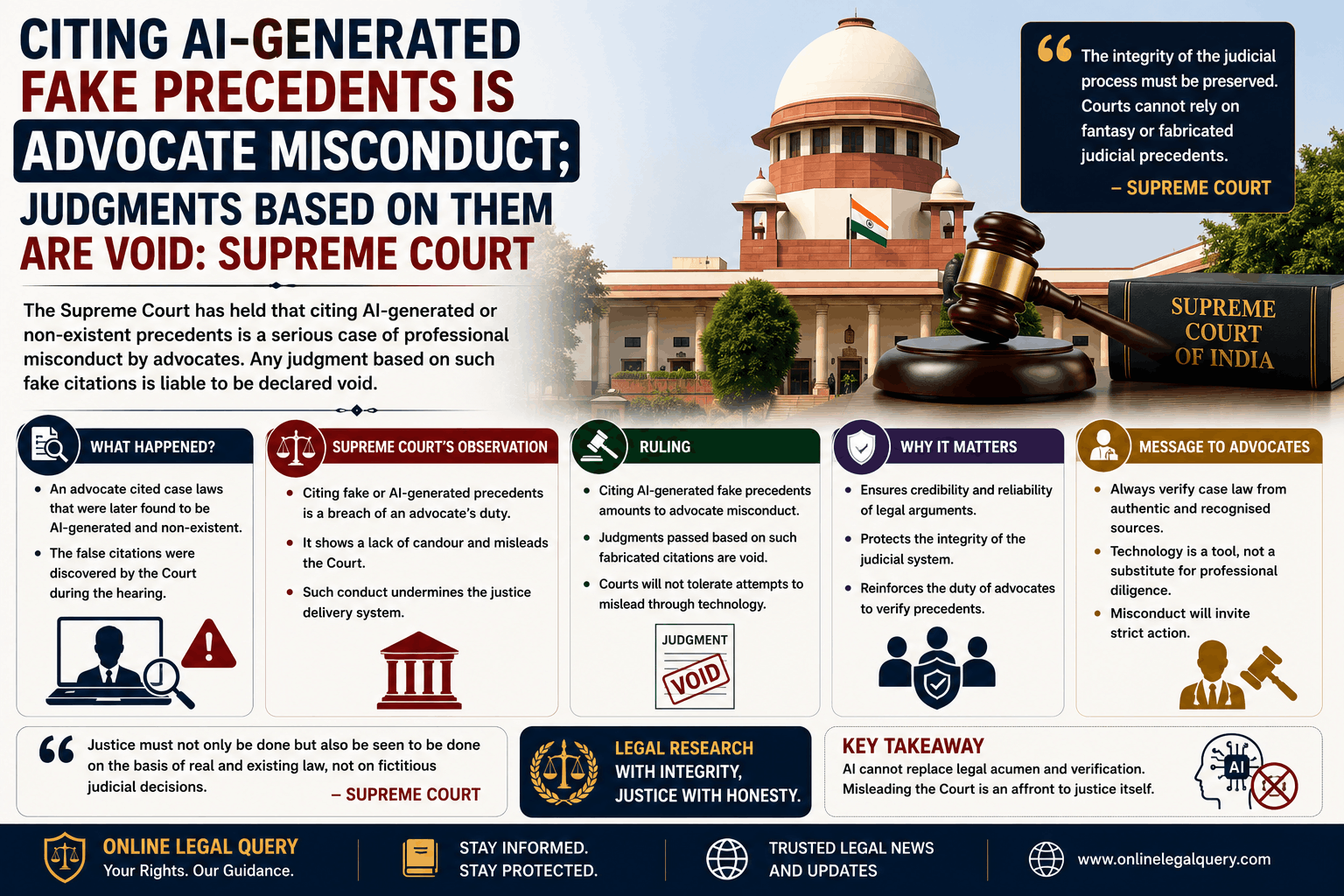
Citing AI-Generated Fake Precedents Is Advocate Misconduct; Judgments Based on Them Are Void: Supreme Court
Justice begins with facts, not fabricated citations
Citing AI-Generated Fake Precedents Is Advocate Misconduct; Judgments Based on Them Are Void: Supreme Court
Case Details
Case: Pooja Ramesh Singh versus J& K Bank 2026 INSC 668
Case Type: Civil Appeal No. 11950 of 2025
Bench: Justice P.S. Narasimha and Justice Alok Aradhe
Appellant’s Advocate: Senior Advocate Madhavi Divan, AOR Vishesh Vijay Kalra, Smriti Churiwal and Atharva
Respondent Advocate: Advocate Sumesh Dhawan, Jaskaran S. Bhutia and Shaurya Shyam
Decided: July 2, 2026
Introduction
Justice begins with facts, not fabricated citations
In the appeal arising from the insolvency proceedings against Essel Infraprojects Ltd., a Division Bench consisting of Justice Pamidighantam Sri Narasimha and Justice Aloke Aradhe set aside the orders of NCLT and NCLAT, which were admitted under Section 7 of The Insolvency and Bankruptcy Code,2016. The court stated that the judgment made by the Tribunal is not appropriate because it relied on non-existent, fake and artificial precedents while adjudicating this case.
Background of the case
The appeal was made against the insolvency proceedings initiated against Essel Infra Projects Ltd. (EIL), which is the corporate guarantor of Pan India Utilities Distribution Company Ltd. (PIUDCL), which availed the loan facility from the Jammu and Kashmir Bank Ltd. In due time, the PIUCL started experiencing severe financial loss and made a default on the payment schedule with the bank and declared its assets to be non-performing. The Bank authority then file an application under Section 7 of the Insolvency and Bankruptcy Code, 2016, before the National Company Law Tribunal (NCLT), Mumbai, to begin the process of corporate insolvency resolution against the EIL/corporate debtor for recovery of its financial debt. On 28 August 2024 the NCLT admitted the application and after finding the existence of financial debt and default, appointed an Interim Resolution Professional and declared a moratorium under Section 14 of the IBC. Aggrieved by such an order, he further appealed to the National Company Law Appellate Tribunal (NCLAT) bearing case No. 1808 of 2024, stating that NCLT has failed to consider the liabilities that have been transferred through demerger and amalgamation to another company and also mentioned that the renewed sanction letter dated 18.11.2017 did not specifically mention the terms of guarantee. Then the NCLAT, after hearing the appeal, dismissed it, upholding the NCLT observation, which stated that there were internal adjustments by the ESSEL Group by way of demerger/amalgamation, etc., but it does not affect the liability of the corporate guarantor, which is already mentioned in Section 8 of the IBC, which clearly mentions the liabilities of the corporate guarantor despite any merger, demerger or amalgamation of company. Further, being aggrieved by the dismissal of the appeal, the appellant approached the Supreme Court of India.
Case Law
Anthony Malcolm Cork & Anor V Mark Smith (2026): This is a landmark UK High Court case where the junior associate submitted a fabricated quote generated by AI software without verifying it. Later, the Court urged the firm to change the quote and make changes
Legal Provisions
Section 7, 8, 14 of The Insolvency and Bankruptcy Code,2016
Judgement
Believing that a decision cannot be based on fake precedents, the Supreme Court of India, after examining the decision made by NCLT and NCLAT, points out that the judgments and citations mentioned by them relied upon were non-existent and fake and probably AI-generated, and the citations are not properly applied to the case. The citations mentioned where State Bank of India v. M/s Shree Ram Urban Infrastructure Ltd., 2020 SCC Online SC 341, Everest Kento Cylinders Ltd. v. Union of India (2015) 2 SCC 1, ICICI Bank Ltd. v. Urban Infrastructure Real Estate Ltd., (2019) 16 SCC 528, V.S. Dempo & Co. Ltd. v. Reliance Communications Ltd., (2021) 10 SCC 176, Canara Bank v. N.G. Subbaraya Setty & Anr., (2018) 16 SCC 228 and Sarbjit Singh v. Union Bank of India, (2022) 7 SCC 464. The Court set aside the judgment of NCLT and NCLAT dated August 28, 2024, and 11 September 2025 and Section 7 of the IBC was originally restored. Further, the Court directs the NCLT Tribunal to dispose of the Section 7 application within a period of two weeks in a speedy manner. Till the proceeding, the parties are to maintain the status quo and wait for the final disposal and without expressing their opinion in the matter, leave the matter to the court, which shall further give judgment
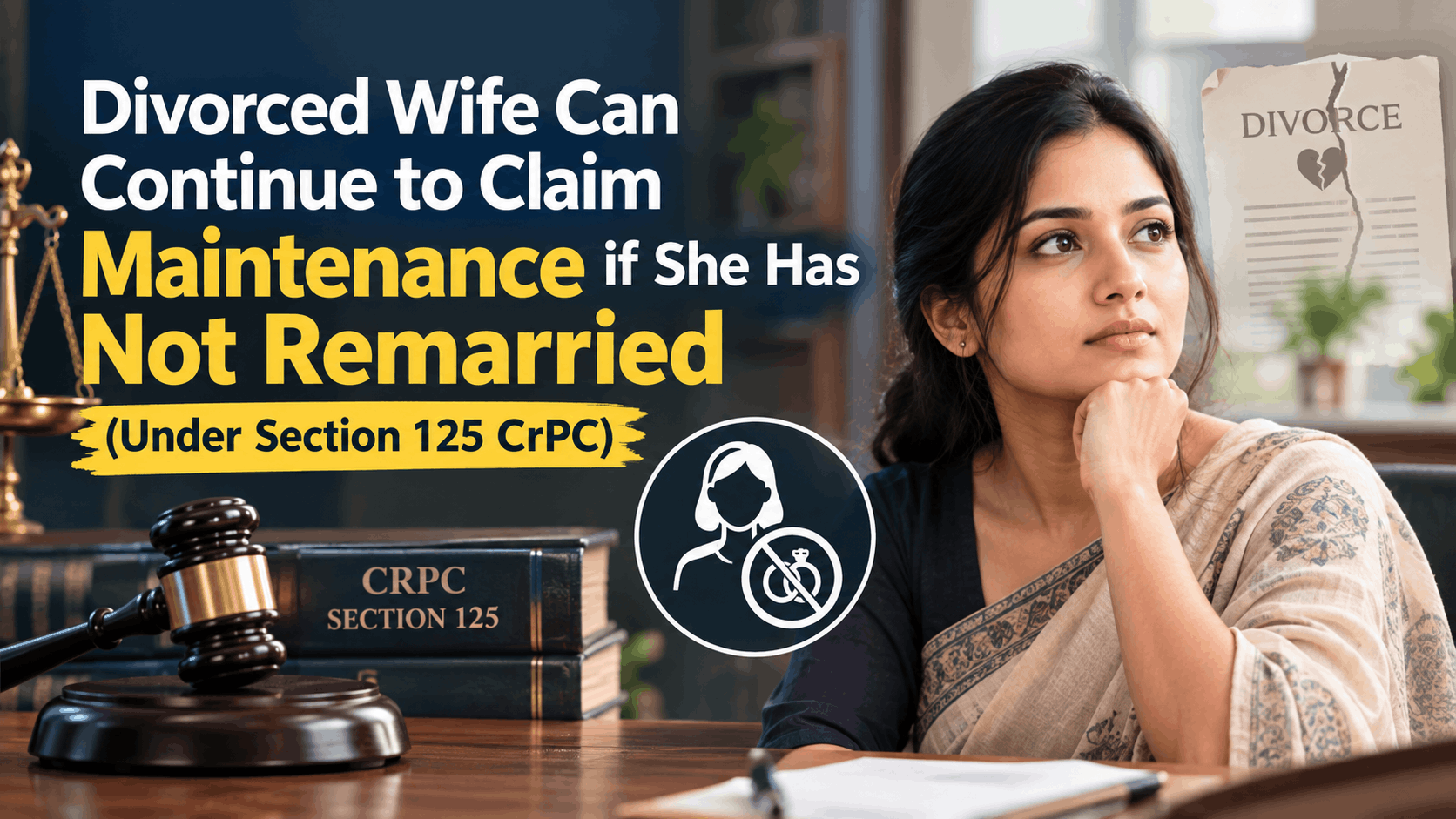

Divorced wife can continue to claim maintenance if she has not remarried (Under Section 125 Crpc)
Case DetailsCase Title: Samar Paul v. State of West Bengal & Ors.Case No: CRR 1438/2024Bench: Hon’ble Justice Uday K...
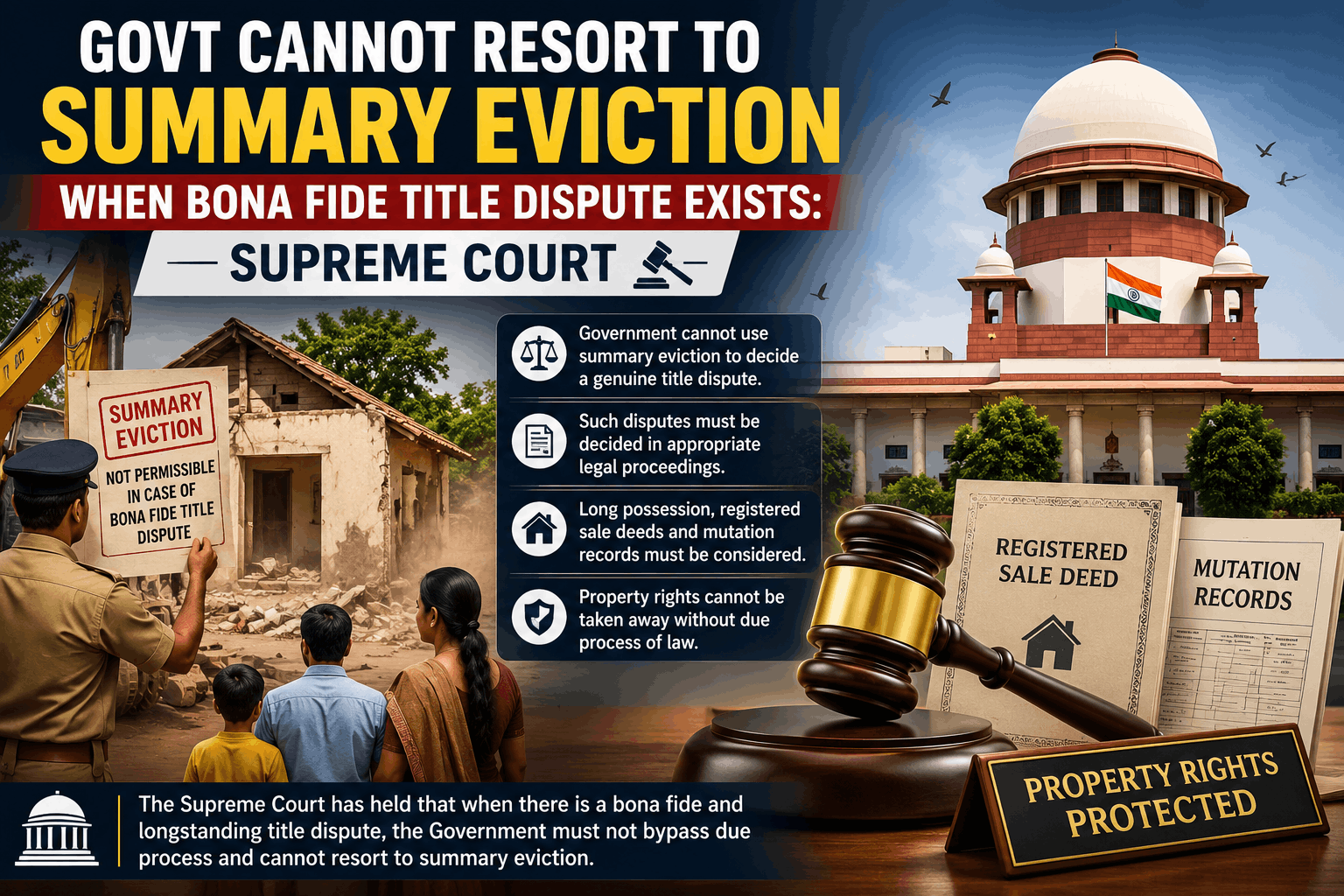
Govt Cannot Resort to Summary Eviction When Bona Fide Title Dispute Exists: Supreme Court
Govt Cannot Resort to Summary Eviction When BonaFide Title Dispute Exists: Supreme CourtCase Details:Case Title: M/s Cir...
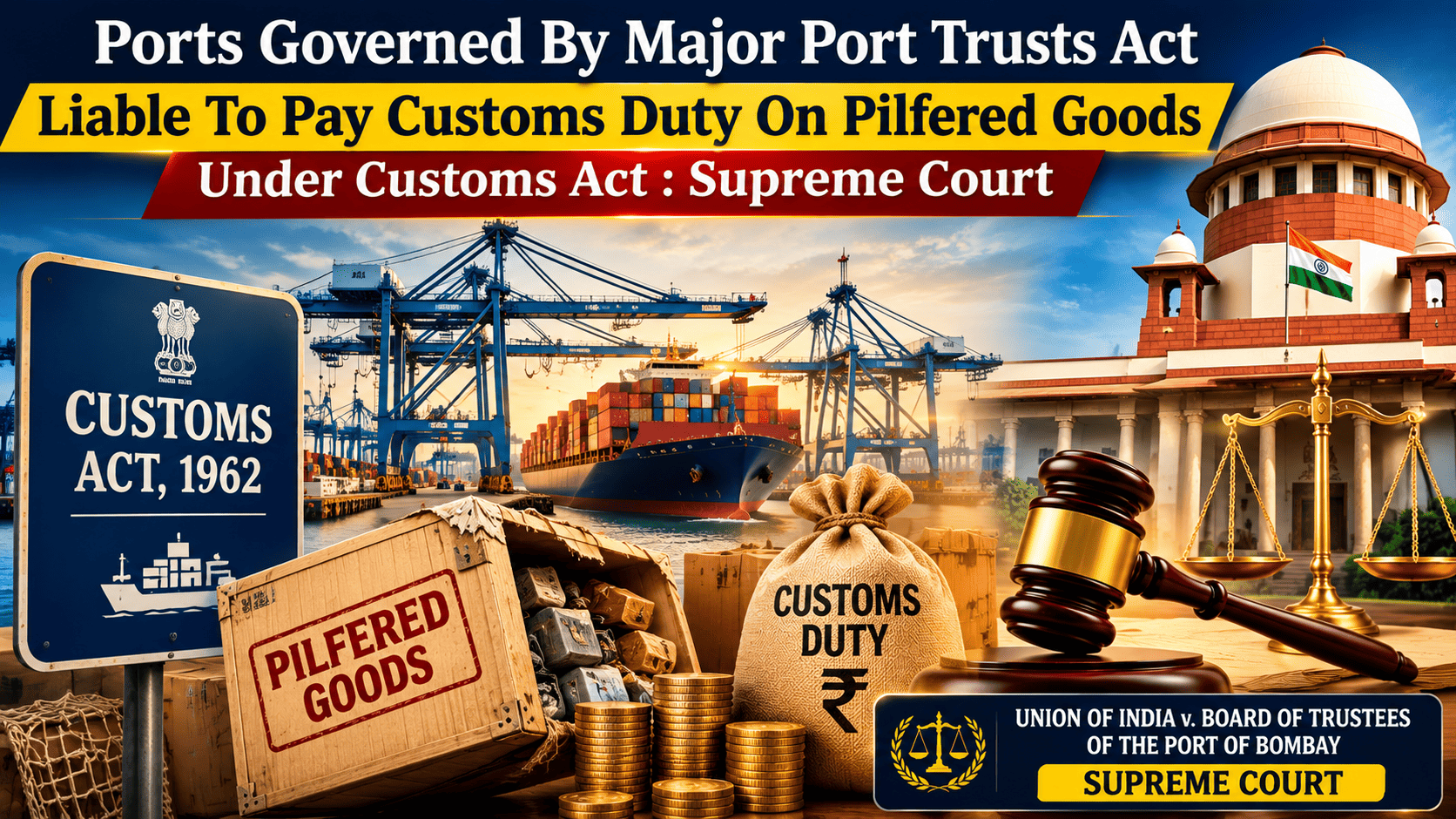
Ports Governed By Major Port Trusts Act Liable To Pay Customs Duty On Pilfered Goods Under Customs Act : Supreme Court
Ports Governed By Major Port Trusts Act Liable To Pay Customs Duty OnPilfered Goods Under Customs Act : Supreme CourtCas...