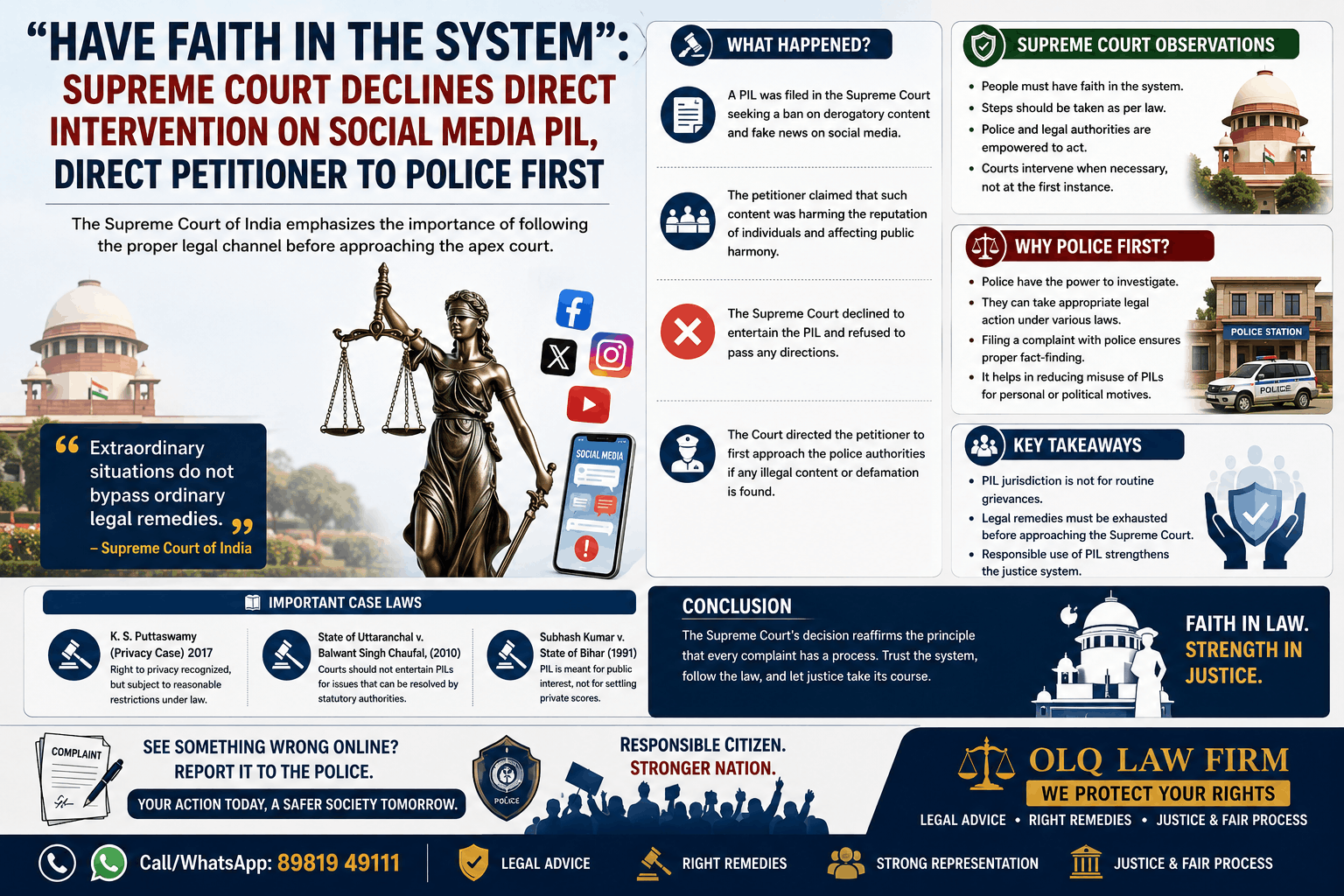
“Have Faith in the System”: Supreme Court Declines Direct Intervention on Social Media PIL, Direct Petitioner to Police First
"PIL isn’t just a case. It’s democracy knocking on the courtroom door."
“Have Faith in the System”: Supreme Court Declines Direct Intervention on Social Media PIL, Direct Petitioner to Police First
Case Details: The Supreme Court declined to directly intervene in a PIL concerning derogatory online comments directed at a religious figure, the court ruled that the petitioner must first follow the established Code of Criminal Procedure and lodge a complaint with local law enforcement.
Case Name: Md. Anas Chaudhary v. Union of India & Ors.
Court: Supreme Court of India.
Bench: HON’BLE MR. Justice Ahsanuddin Amanullah and Sheel Nagu.
Introduction
"PIL isn’t just a case. It’s democracy knocking on the courtroom door."
The case of Md. Anas Chowdhury v. Union of India is a Public Interest Litigation filed in the Supreme Court of India, look for the formulation of strict guidelines to curb derogatory online content targeting religious figures. The interlinkage between freedom of speech in the digital shape, the dissemination of information on social media, and communal harmony has repeatedly taken center stage in India’s legal discourse. The apex court declined to intervene directly in the matter emphasizing must first follow established legal procedures, like approaching local law enforcement agencies before be after recourse at the highest court.
Background of the Case
The incident began when a social media influencer posted highly offensive and derogatory comments targeting a respected religious figure. The matter spread rapidly, sparking immediate concerns regarding the potential disruption of communal harmony and deliberate hurting of religious sentiments.
Then, the legal action was taken, Md. Anas Chowdhury filed a PIL directly with the Supreme Court, bypassing the lower courts and local police.
The petition has implemented the Union Ministry of Home Affairs, the Ministry of Electronics and information technology and major social media intermediaries, like- YouTube, Facebook and Ors.
This PIL look for urgent structural safeguards and strict regulatory guidelines aimed at preventing, controlling and halting the spread of hate speech and religiously sensitive content across digital platforms.
What is PIL??
Public Interest Litigation is undoubtedly the most powerful thing in India’s legal system. Historically, it has enabled ordinary citizens, social activists, and lawyers to fight on behalf of marginalized communities, protect the environment and hold the government accountable, and all while bypassing complex legal hurdles.
India’s traditional legal system, derived from British common law, primarily adhered to a strict rule known as “Locus Standi” that indicate only a person whose rights had been directly violated could approach the court.
Importances of PIL
· A voice for the voiceless: It enables the filing of cases on behalf of poor, marginalized or uneducated individuals who lack the means or opportunity to approach the court themselves.
· Makes the judicial system people oriented: It eliminates the costly and rigid formalities of legal proceedings; it even allows ordinary letters or news reports to be treated as formal petitions.
· Maintains a check on government power: It compels sluggish corrupt bureaucratic systems to fulfil their duties and enforce the law.
· Creates new rights: It expands the scope of the “Right to Life” to include a clean environment, free education and workplace safety guidelines.
· Protects public spaces and resources: It serves as a legal shield for elements that cannot speak for themselves like, wildlife, environment, and public heritage.
Constitutional structure
· Article 32: Enables individuals to directly file PIL in the Supreme Court in cases of fundamental rights violations.
· Article 226: It empowers to High Courts to hear Public Interest Litigation concerning both the fundamental right and statutory rights.
· Article 39A: Mandates the provision the equal justice free legal aid, ensuring that no citizen is denied justice due to economic and social constraints.
The Decision of the Court
The Bench sternly reminds the legal fraternity, that “Have you filed a case? The police are there, after all. Place our faith in our judicial system. We are the apex court; our role is to oversee, it the normal processes are bypassed here, then they too will sit back and do nothing, every institution is falling into disarray today because everything is being imposed from the top”.
The bench comprising Justice Ahsanuddin Amanullah and Justice Sheel Nagu declined to list the PIL for urgent hearing or to pass any specific order on its merits. Rather than, the court directed the petitioner to first exhaust ordinary legal remedies by lodging a formal complaint with local law enforcement agencies and following the established judicial hierarchy or legal process.
Landmark Judgements on PIL
· M.C. Mehta v. Union of India (1988)
· Vishaka v. State of Rajasthan (1997)
· State of Uttaranchal v. Balwant Singh Chaufal (2010)
FAQs
1. What was the case about?
A: It was a petition filed against Union of India, Ministry of Home Affairs challenging an order/action by Dept. of Home.
2. What did the Court decide?
A: Court ruled on the legality/validity of the Home Dept. order and gave directions based on facts and law argued.
3.What principle was laid down?
A: Government actions by MHA must comply with law, natural justice and procedure. Arbitrary orders can be set aside.
4. Can citizens challenge MHA/Dept of Home orders?
A: Yes, via Writ Petition u/Art 226 or 32 if the order violates fundamental rights or is illegal.
5. How can OLQ Law Firm assist in such cases?
A: OLQ drafts and files Writ Petitions, RTIs, and representations against MHA/Home Dept orders.
How can OLQ help?
· Drafting and filing Writ Petitions against Union of India/MHA.
· Challenging illegal orders of Dept of Home.
· Anticipatory bail & criminal defence in central matters.
· Representation in HC, CAT and Supreme Court.
· Legal advice on constitutional and administrative law.
· Urgent legal support and documentation.
Writ Petitions | Bail Applications | Criminal Defence | Administrative Law | Legal Consultation


In-Laws Failure to Take Action Against Son for Allegedly Torturing his Wife Is Not Cruelty
In-Laws Failure to Take Action Against Son for Allegedly Torturing his Wife Is Not CrueltyCase DetailsCase Title: Dr. Sa...
Divorced wife can continue to claim maintenance if she has not remarried (Under Section 125 Crpc)
Case DetailsCase Title: Samar Paul v. State of West Bengal & Ors.Case No: CRR 1438/2024Bench: Hon’ble Justice Uday K...
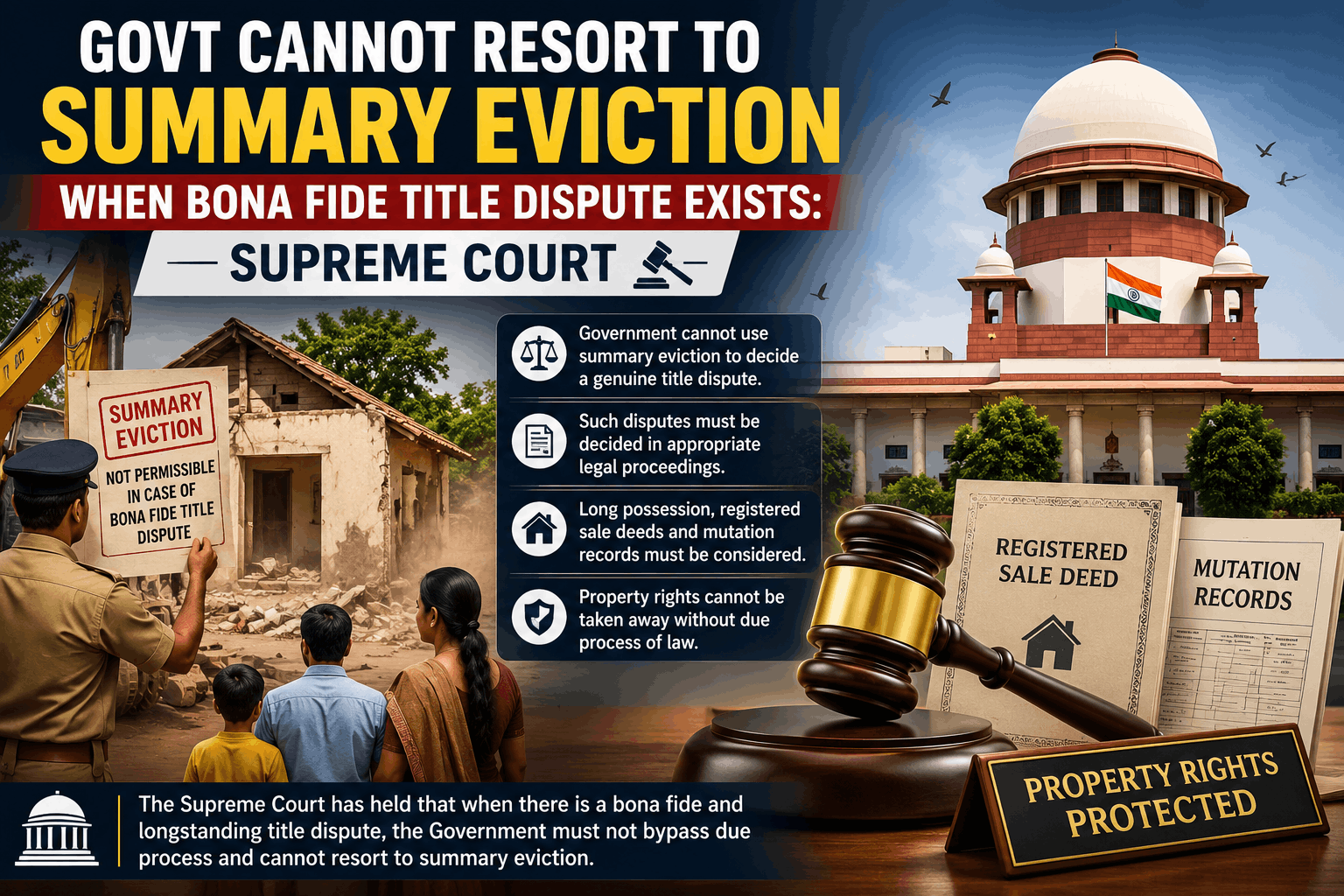
Govt Cannot Resort to Summary Eviction When Bona Fide Title Dispute Exists: Supreme Court
Govt Cannot Resort to Summary Eviction When BonaFide Title Dispute Exists: Supreme CourtCase Details:Case Title: M/s Cir...