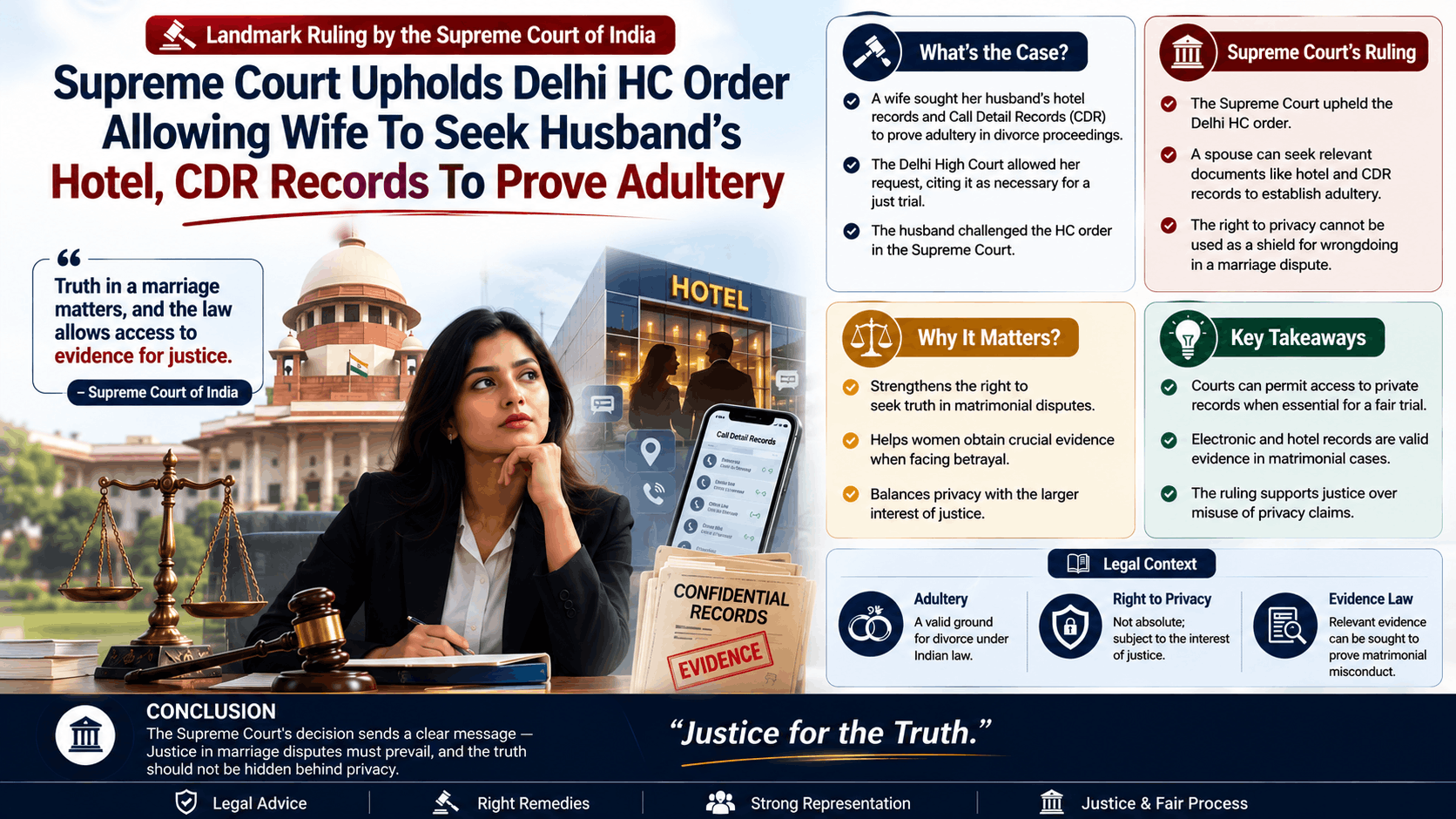
Supreme Court Upholds Delhi HC Order Allowing Wife To Seek Husband's Hotel, CDR Records To Prove Adultery
“Can privacy stand in the way of a fair trial? The Supreme Court’s recent order says not always.”
Supreme Court Upholds Delhi HC Order Allowing Wife To Seek Husband's Hotel, CDR Records To Prove Adultery
Case details :
Supreme Court: Sachin Arora v. Manju Arora
Case No.: SLP (Civil) No. 22087 of 2023
Order Date: 2 July 2026
Bench: Justice Vikram Nath and Justice Sandeep Mehta
Delhi High Court: Sachin Arora v. Manju Arora
Decision Date: 10 May 2023
Coram: Justice Rekha Palli
Introduction
“Can privacy stand in the way of a fair trial? The Supreme Court’s recent order says not always.”
In matrimonial disputes, it is often challenging to prove allegations like adultery. Finding direct evidence is difficult in such cases, and the court has to rely on surrounding circumstantial and documentary evidence. In the case of Sachin Arora v. Manju Arora, it has brought the balance between the right to privacy and the right to free trial into focus as the Supreme Court allowed hotel records and call detail records (CDRs).
Background of the case
The dispute started in the divorce case of Sachin Arora and Manju Arora. The wife filed for divorce on the grounds of cruelty and adultery. Since adultery is hard to prove directly, she applied to family court for permission to find the records to support her case. She requested details of his hotel bookings, check-in and check-out timings, copies of IDs submitted to hotels, payment history and phone call records (CDRs) for a specific time period. The family court granted her request. But the husband challenged her decision in the Delhi High Court, arguing that asking hotels and phone companies to hand over his records is a violation of his right to privacy under Article 21 of the Constitution.
Delhi High Court’s decision
The Delhi High Court rejected the husband’s appeal and agreed with the family court’s decision. Justice Rekha Palli stated that the right to privacy is a fundamental right under Article 21 of the Constitution, but it needs to be balanced to ensure a fair trial.
The court also referred to Section 14 of the Family Courts Act, 1984, which allows Family Courts to receive any evidence that may help in deciding a matrimonial dispute, even if such evidence is strictly inadmissible under the Indian Evidence Act. The court observed that accusations like adultery are often hard to prove; in this case, the wife requested specific hotel records and call details records ( CDRs) for a limited time. Since the request was relevant to the issue, the High Court found no reason to interfere with the Family Court’s order.
Supreme Court’s order
The husband appealed the Delhi High Court’s decision to the Supreme Court. On 2 July 2026, a bench of Justice Vikram Nath and Justice Sandeep Mehta rejected his appeal and decided not to interfere with the Delhi High Court’s decision. As a result, the High Court’s judgment continues to stand.
Why this case matters
This decision is important because it explains that the right to privacy, while fundamental, is not absolute. In certain cases, courts can require the production of relevant records if they are necessary for resolving a matrimonial dispute. However, the ruling does not allow spouses to freely access each other’s private information. And such records can only be obtained through a court order.
This decision balances the protection of an individual’s privacy with the need for a fair trial.
Relevant case laws
● Justice K.S. Puttaswamy (Retd.) v. Union of India, (2017) 10 SCC 1
● Joseph Shine v. Union of India, (2019) 3 SCC 39
Conclusion
This decision is a reminder that no right exists by itself. Privacy of an individual is still an important right, but the court can let people access certain records if it's needed to make a fair decision.
At the time, this judgment doesn't mean a husband or wife can easily get their spouse's personal records. A court can only ask for information if it's needed to solve the issue. Overall, this ruling finds a ground between keeping a person's private information safe and making sure justice is fair.
FAQs
Q1. Can a spouse directly access the other spouse's call records or hotel records?
No. Such records can only be obtained through a court order.
Q2. Is the right to privacy still a fundamental right?
Yes. It continues to be protected under Article 21 of the Constitution.
Q3. Can courts summon call records in matrimonial disputes?
Yes, if the records are relevant and necessary for deciding the case.
Q4. Is adultery still a crime in India?
No. It is no longer a criminal offence, but it remains a ground for divorce.
Q5. How can OLQ Law Firm assist in matrimonial disputes?
OLQ Law Firm provides legal advice and representation in divorce and other matrimonial matters, including disputes involving adultery, privacy, evidence, maintenance, and child custody.
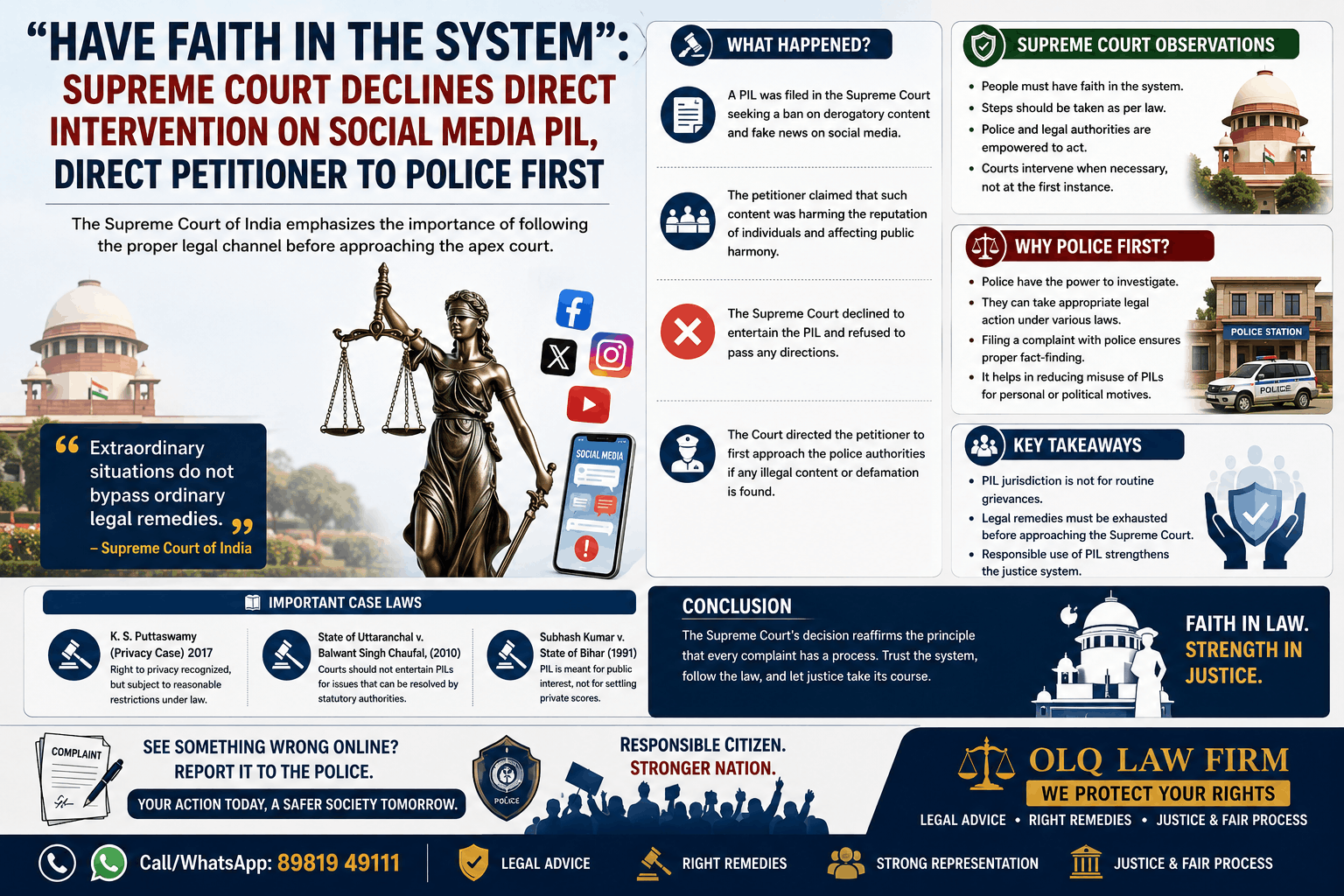
“Have Faith in the System”: Supreme Court Declines Direct Intervention on Social Media PIL, Direct Petitioner to Police First
“Have Faith in the System”: Supreme Court Declines Direct Intervention on Social Media PIL, Direct Petitioner to Police...
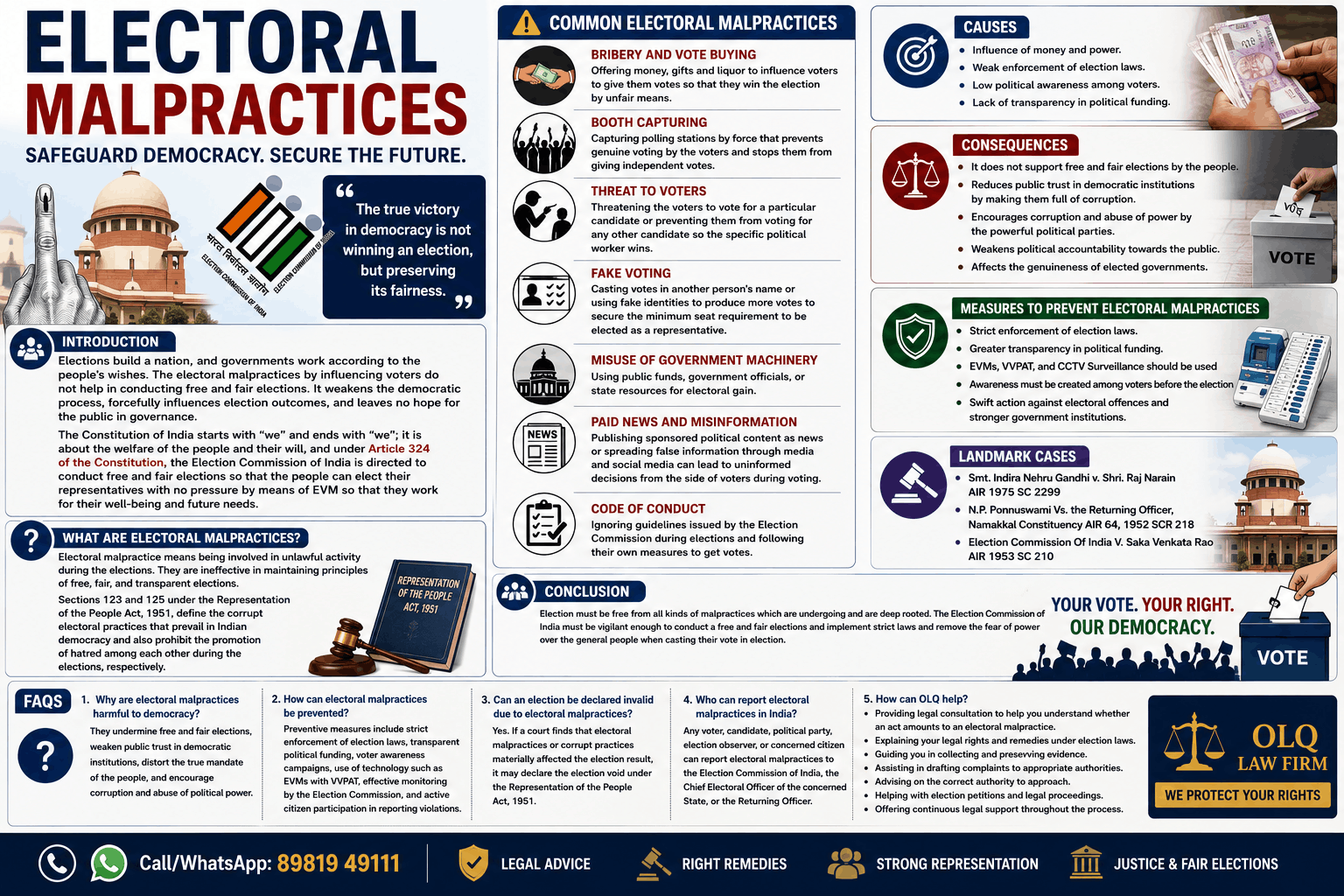
Electoral Malpractices
Electoral MalpracticesIntroductionThe true victory in democracy is not winning an election, but preserving its fairness....
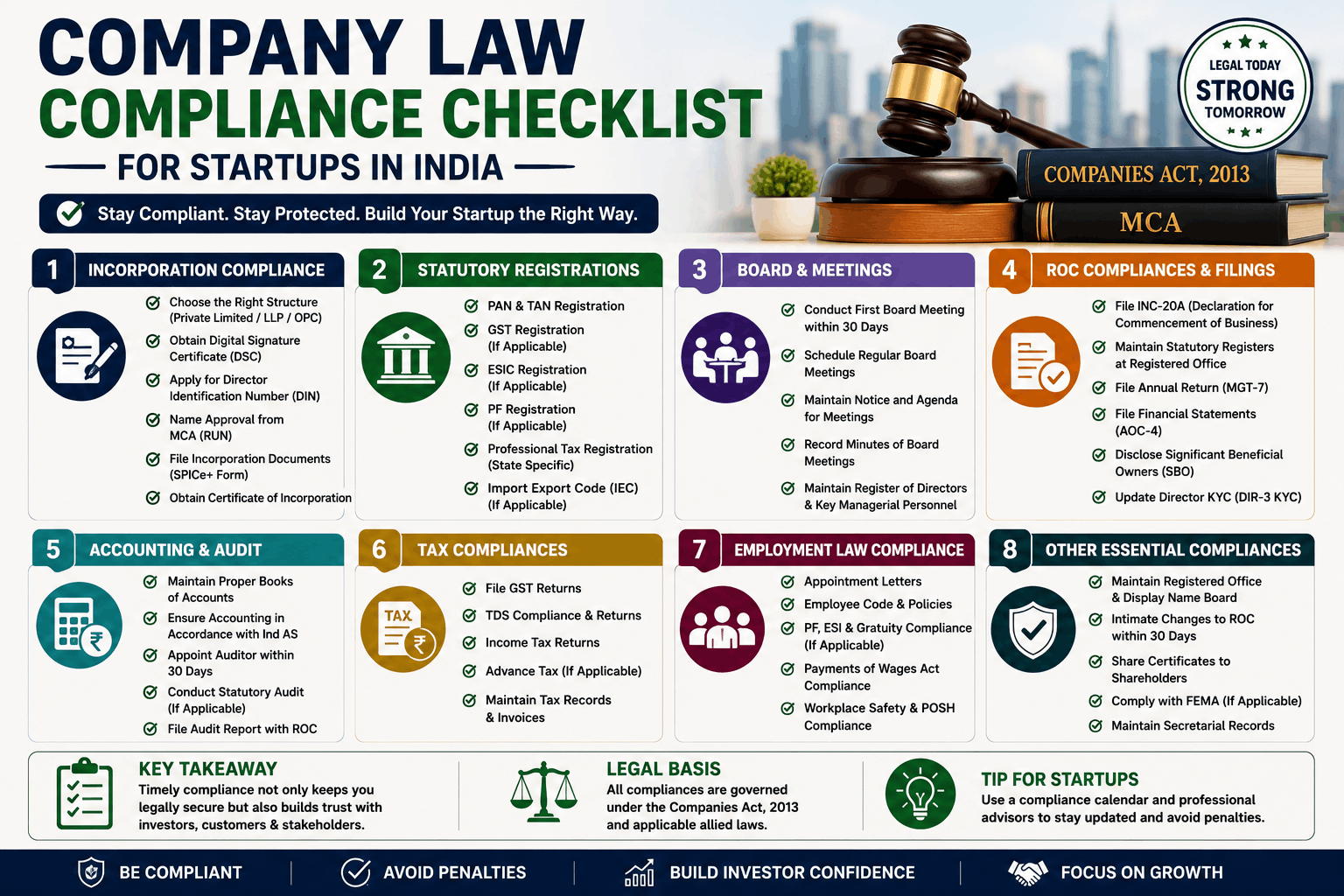
Company Law Compliance Checklist for Startups in India
Company Law Compliance Checklist for Startups in India Introduction – Miss a filing, risk a fine. Master...