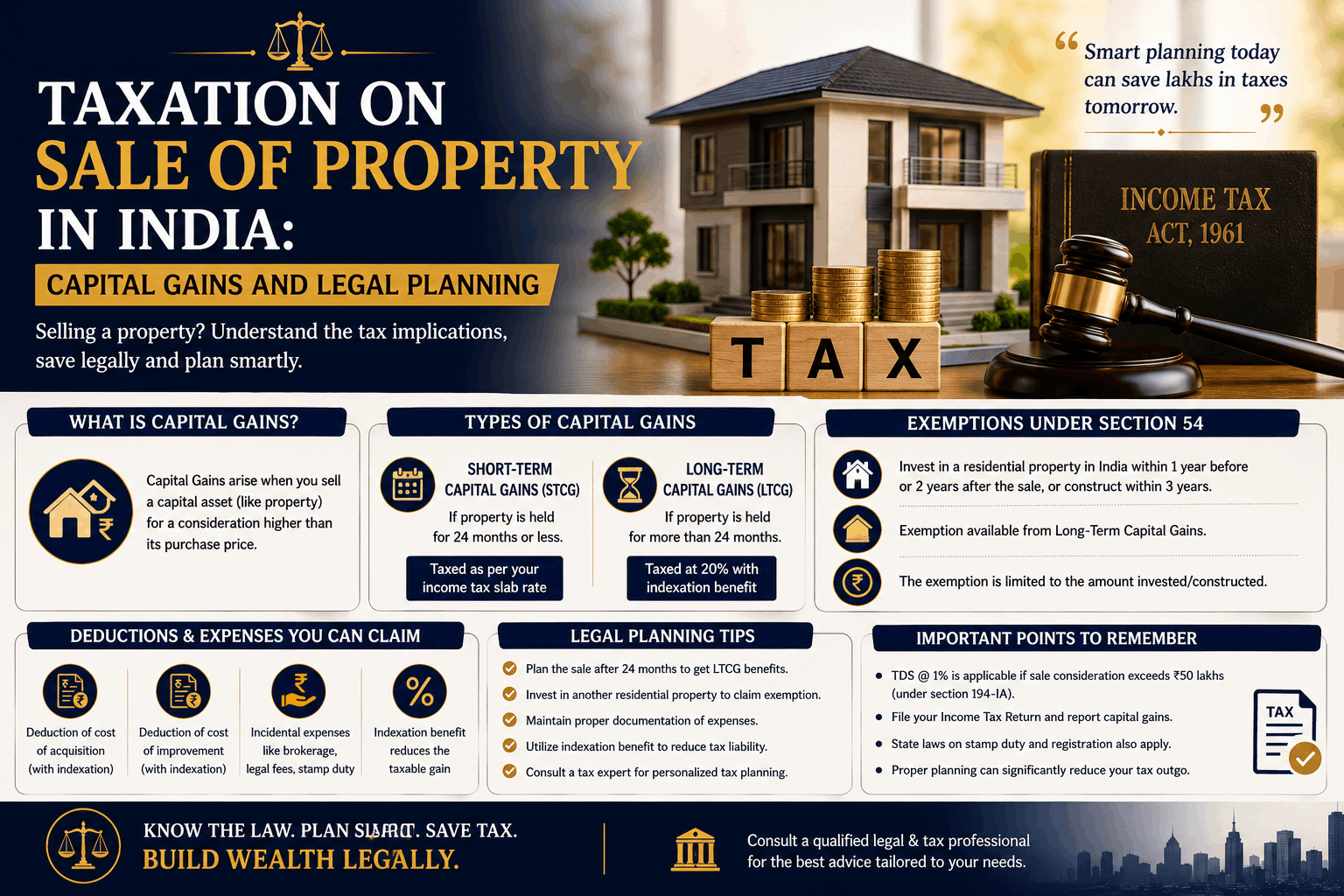
Taxation on Sale of Property in India: Capital Gains and Legal Planning
From registry to returns: Mastering property tax planning in India.
"From registry to returns: Mastering property tax planning in India." In India, the taxation on the sale of property is governed by the Income Tax Act, 1961. Taxation on sale of property in India attached to capital gains, which depend on how long period you have held the property. Capital gains indicate the profits it made from selling property. There are two main categories of capital gains. One of the Short- Term Capital Gains and secondly Long-Term Capital Gains.
Capital Gains –
· Short-Term Capital Gains: Short-Term Capital Gains held for up to 24 months of immovable property and 12 months or less for securities and financial assets.
STCG applies if someone sells the property within 24 months of purchase, then the profit is considered as STCG. STCG is added to the person’s total annual income and taxed according to applicable income tax slab rate.
· Long-Term Capital Gains: Long-Term Capital Gains held for more than 24 months of immovable property and more than 12 months for securities and financial assets.
LTCG applies if someone holds the property for more than 24 months; then the profit is considered as LTCG. LTCG tax is typically assessed at a flat 12.5% without indexation benefit.
· Inherited and Gifted property: For inherited and gifted property there is no capital gains tax upon receiving. If someone eventually sells it, then the holding period is counted from the date of the previous owner acquired it, and the cost of acquisition will be the price they originally paid.
Legal Planning-
· “Reinvest your gain, not the whole sale chain!” Under section 54 of the Income Tax Act, 1961, refers to any person in India can save LTCG tax by reinvesting the gains into constructing or purchasing another residential house in India. The act allows only individuals and Hindu Undivided Families to claim this exemption. Under this section the maximum amount exempted is capped at Rs. 10 Crore.
· According to the Income Tax Act 1961, under section 54F refers to the anyone can claim an exemption on LTCG from the sale of any long-term property by reinvesting the net sales consideration into a residential house. The person must not be own more than one residential house on the date of sale, and the maximum exemption is capped at Rs. 10 crores.
· Under section 54EC of the Income Tax Act, 1961, it allows someone who pays the tax to save on Long-Term Capital Gains tax arising from the sale of immovable property, only applies to LTCG generated from the transfer of land and buildings. The specific property must be held for 24 months before the sale.
This act specifies that the capital gains must be invested within 6 months from the date of the property’s transfer, and the limit of investment the investment amount Rs. 50 lakh is eligible for exemption in a financial year.
How to figure your capital gains tax
"Smart strategy, bigger savings: Decode Indian capital gains before you sell."
· It’s a simple math problem to calculate your property tax liability:
· Calculate Net Sale Consideration Start with the property’s final sale price. Deduct eligible transfer expenses, brokerage fees, stamp duty on sale and legal expenses to get net consideration.
· Calculate Cost of Acquisition Improvement: What you originally paid for the property plus any improvements or renovations.
· costs Apply Indexation (if applicable): For properties purchased before July 23, 2024, if you are using the older 20% method of indexation, then increase your original purchase price by the Cost Inflation Index (CII) issued by the government.
· Calculate the Gain: Subtract your acquisition and improvement expenses from your Net Sale Consideration. The profit that results is the amount that will be taxed.
Conclusion-
Taxation on sale of property in India attached to capital gains, which depend on how long period you have held the property. Legal planning is a very important part of sale of property. The Income Tax Act, 1961 is maintain the law and order of the property taxation. The important sections are 54, 54F, 54EC etc for tax on sale of property in India.
FAQs on Taxation on Sale of Property in India: Capital Gains and Legal Planning
1. What tax is applicable when a property is sold in India?
When a property is sold, the profit earned from the sale is taxed under the head Capital Gains under the Income-tax Act, 1961. The tax depends on how long the property was held before sale. If held for a shorter period, it may attract Short-Term Capital Gains (STCG), and if held longer, Long-Term Capital Gains (LTCG).
2. What is the difference between Short-Term and Long-Term Capital Gains on property?
If the property is sold within 24 months from the date of purchase, the gain is treated as Short-Term Capital Gain and taxed as per the seller’s income tax slab. If sold after 24 months, it becomes Long-Term Capital Gain, and tax benefits or exemptions may apply.
3. How is capital gain calculated on sale of property?
Capital gain is generally calculated by deducting the purchase price, cost of improvement, and transfer expenses from the sale price. In case of long-term assets, certain tax provisions may affect how this is computed.
4. Can I save tax on long-term capital gains from property sale?
Yes. Indian law provides several exemptions if the capital gains are reinvested properly. Some common exemptions are under Section 54, Section 54EC, and Section 54F.
5. What is Section 54 exemption?
Under *Section 54*, if you sell a residential property and reinvest the capital gains into another residential property within the prescribed time, you may claim exemption from capital gains tax. The new property must be purchased within 2 years or constructed within 3 years.
6. What is Section 54F?
Section 54F applies when the asset sold is not a residential house, but the seller invests the sale proceeds into a residential property. This helps in claiming tax exemption on capital gains.
7. What is Section 54EC?
This section allows exemption if the capital gains are invested in specified government bonds such as those issued by REC or NHAI within six months of sale, subject to legal limits.
8. What happens if I do not reinvest the capital gains immediately?
If you cannot reinvest before filing your income tax return, you may deposit the amount in the *Capital Gains Account Scheme (CGAS)* and claim the exemption, subject to conditions.
9. Is TDS applicable on sale of property?
Yes. Under Section 194-IA, the buyer must deduct TDS at 1% if the sale consideration exceeds the prescribed threshold.
10. Can legal planning reduce tax liability on property sale?
Yes. Proper legal and tax planning can help reduce liability by structuring the sale correctly, checking ownership documents, planning reinvestment, and claiming eligible exemptions.
11. Why is legal advice important before selling property?
Selling property involves tax implications, title verification, stamp duty, and documentation. A legal expert can help avoid mistakes and ensure compliance with both property and tax laws.
How can OLQ Law Firm assist?
✔️ Property sale documentation and verification
✔️ Capital gains tax planning
✔️ Advice on exemptions under Sections 54, 54EC, and 54F
✔️ TDS and compliance issues
✔️ Property dispute resolution
✔️ Tax and legal consultation before sale
Contact OLQ Law Firm
📞 Call/WhatsApp: *89819 49111*


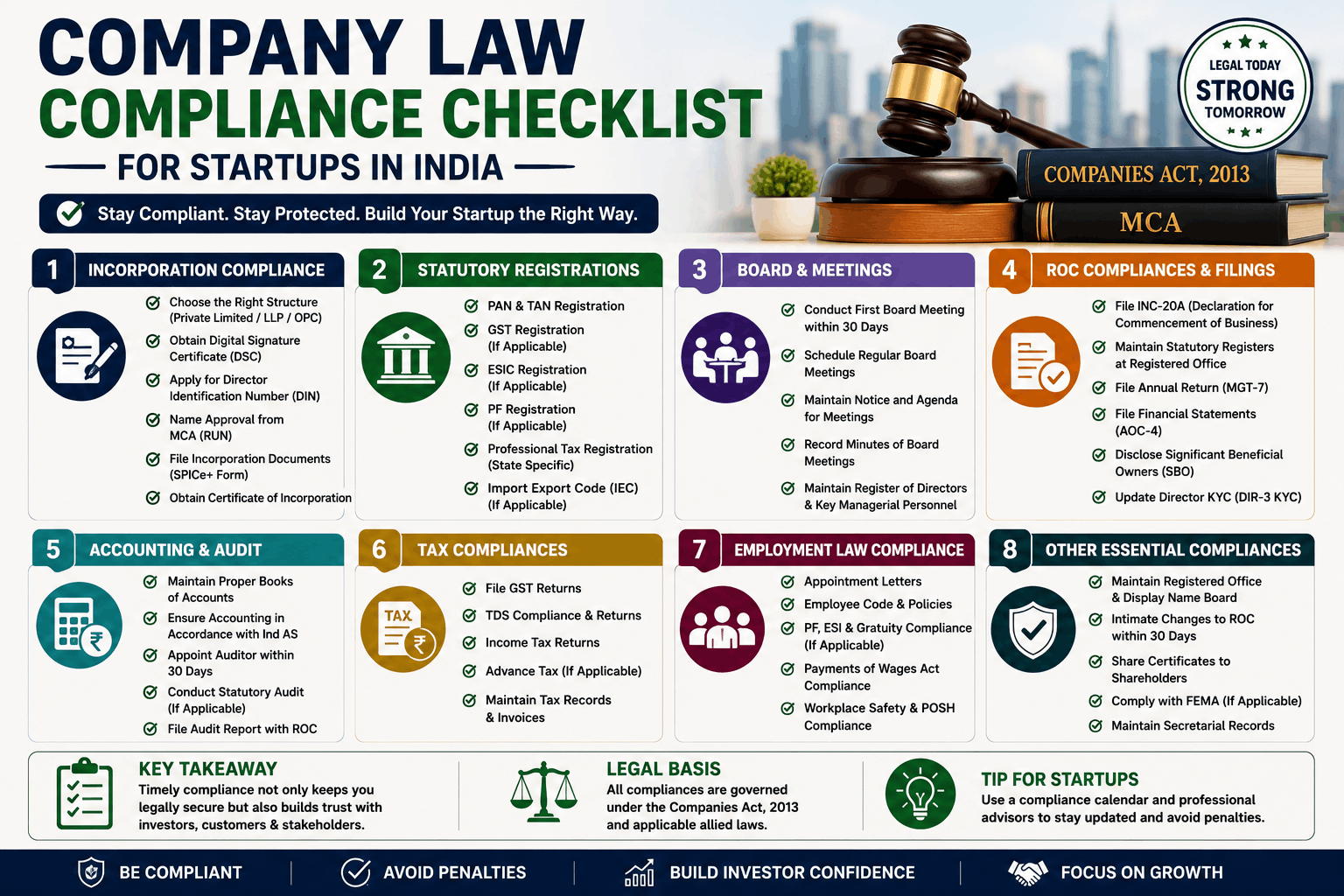
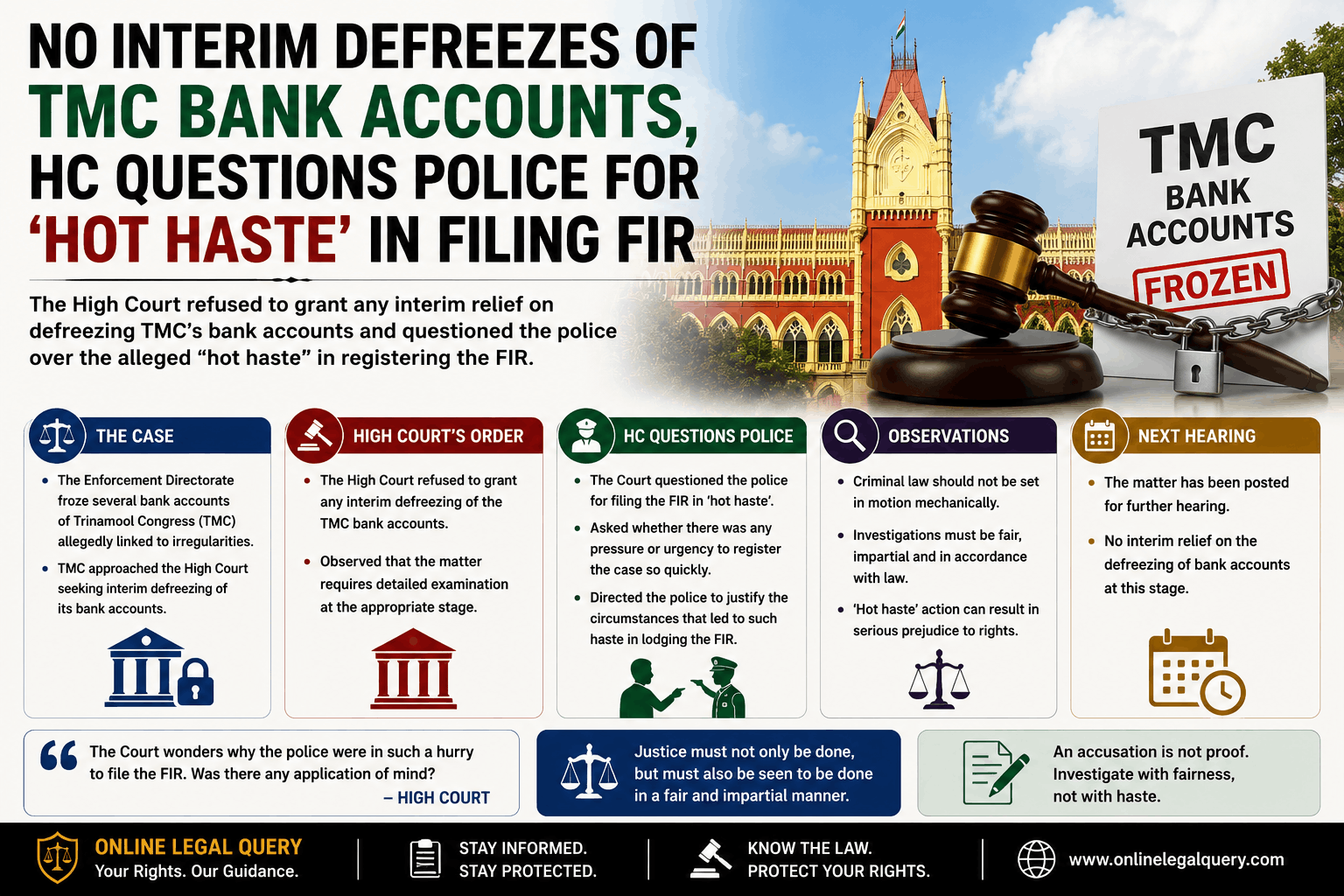
Supreme Court Upholds Delhi HC Order Allowing Wife To Seek Husband's Hotel, CDR Records To Prove Adultery
Supreme Court Upholds Delhi HC Order Allowing Wife To Seek Husband's Hotel, CDR Records To Prove AdulteryCase details :S...
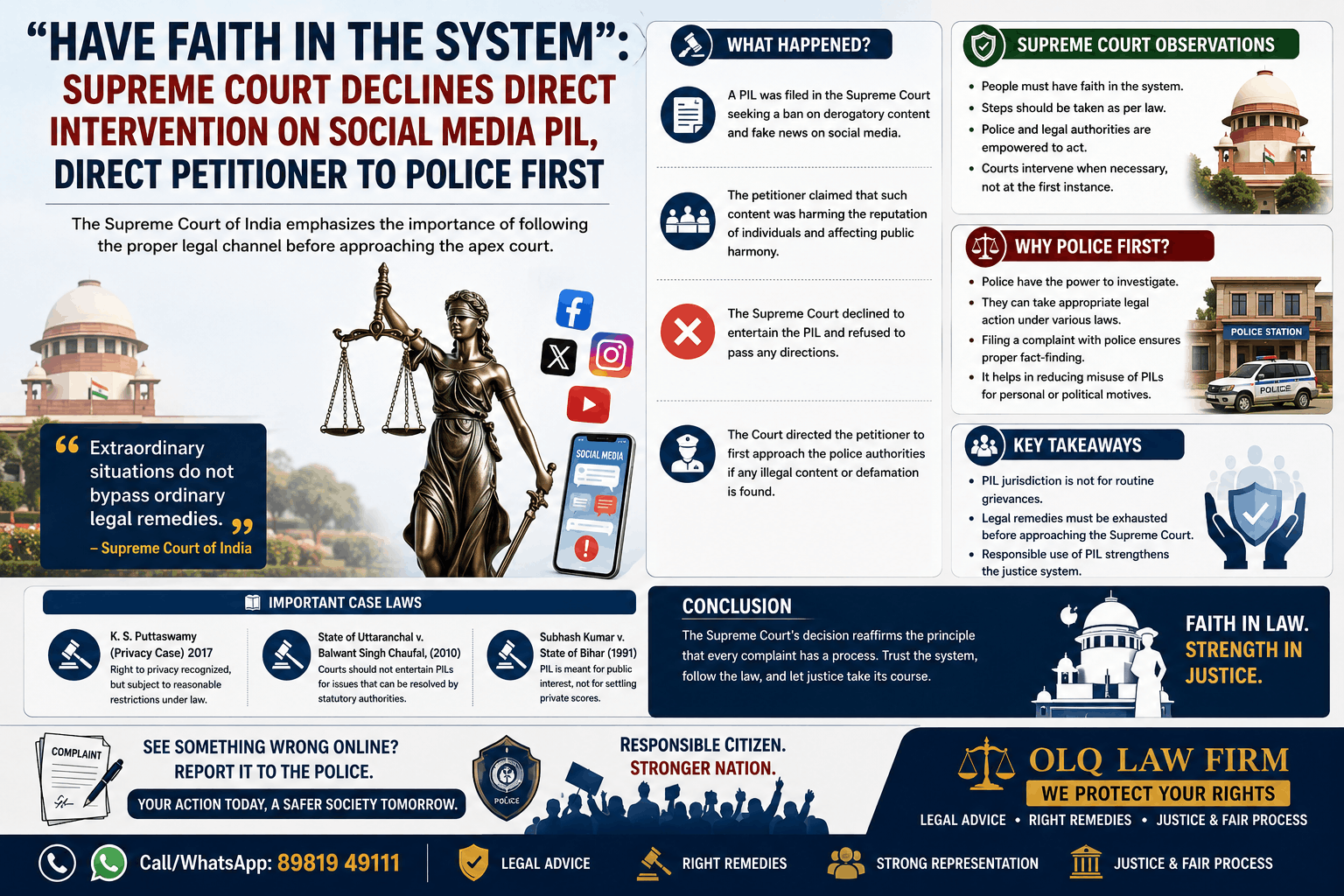
“Have Faith in the System”: Supreme Court Declines Direct Intervention on Social Media PIL, Direct Petitioner to Police First
“Have Faith in the System”: Supreme Court Declines Direct Intervention on Social Media PIL, Direct Petitioner to Police...
Electoral Malpractices
Electoral MalpracticesIntroductionThe true victory in democracy is not winning an election, but preserving its fairness....