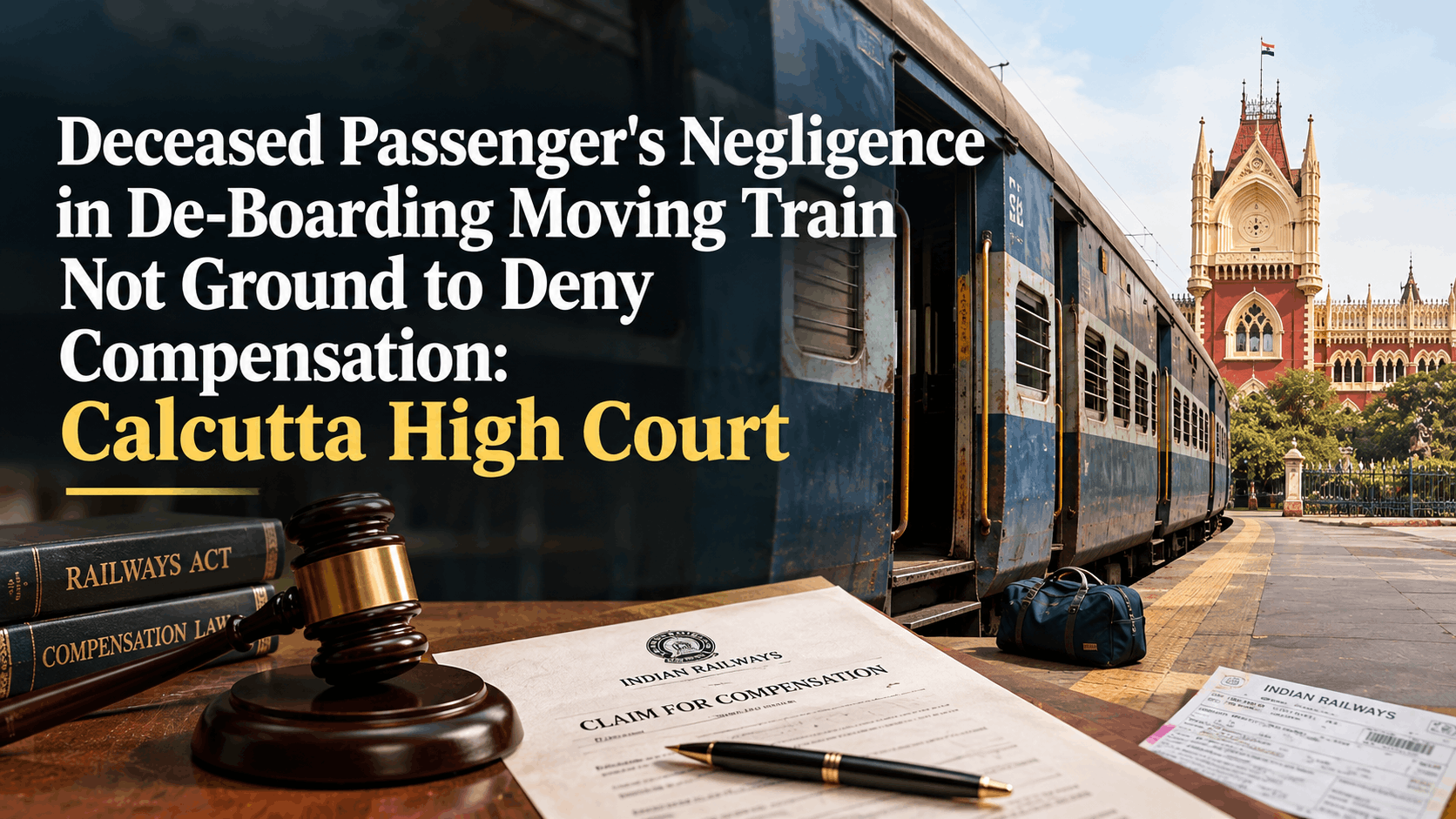
Deceased Passenger's Negligence in De-Boarding Moving Train Not Ground to Deny Compensation: Calcutta High Court
Mere Negligence Cannot Deny Railway Compensation The case arose from the unfortunate death of Suparna Mondal, who fell from a moving train on 21 January 2012 while travelling with her husband and children from Jhargram towards Howrah. The family claimed to be travelling with valid railway tickets. After the train stopped near Uluberia due to a red signal, Suparna attempted to get down while the train was still at the spot. The train suddenly started moving, causing her to fall and suffer serious injuries. She later died during treatment on 5 March 2012.The appellant, Sukumar Mondal, approached the Railway Claims Tribunal seeking compensation under the Railways Act, 1989. However, the Tribunal rejected the claim, holding that the deceased was not sufficiently proved to be a bona fide passenger and that the incident did not consider as an ‘untoward incident. The appellant then challenged the Tribunal’s decision before the Calcutta High Court.
Deceased Passenger's Negligence in De-Boarding Moving Train Not Ground to Deny Compensation: Calcutta High Court
Case Details:
Title: Sukumar Mondal v. Union of India, General Manager, South Eastern Railway
Case No.: F.M.A. 104 of 2021
Coram: Hon’ble Justice Biswaroop Chowdhury
Counsel for Appellants: Adv. Mr. Navin Mittal
Counsel for Respondents: Adv. Ms. Debjani Ghoshal
Judgement: 15 September 2026
Summary
Mere Negligence Cannot Deny Railway Compensation
The case arose from the unfortunate death of Suparna Mondal, who fell from a moving train on 21 January 2012 while travelling with her husband and children from Jhargram towards Howrah. The family claimed to be travelling with valid railway tickets. After the train stopped near Uluberia due to a red signal, Suparna attempted to get down while the train was still at the spot. The train suddenly started moving, causing her to fall and suffer serious injuries. She later died during treatment on 5 March 2012.The appellant, Sukumar Mondal, approached the Railway Claims Tribunal seeking compensation under the Railways Act, 1989. However, the Tribunal rejected the claim, holding that the deceased was not sufficiently proved to be a bona fide passenger and that the incident did not consider as an ‘untoward incident. The appellant then challenged the Tribunal’s decision before the Calcutta High Court.
What happened?
The incident took place when the train stopped near Uluberia because of a red signal. Sukumar Mondal got down along with his two children. His wife, Suparna, also tried to get down from the train. However, the train suddenly started moving, and she fell from it. She was taken to different hospitals for treatment, but her condition remained serious. She was ultimately admitted to Howrah General Hospital and passed away on 5 March 2012.After her death, a police enquiry was conducted and an Unnatural Death case was registered. The appellant thereafter sought compensation from the Railways.The Railway Claims Tribunal, however, did not accept the claim. This led the appellant to approach the Calcutta High Court.
Sections Involved
· Section 123(2), Railways Act, 1989 – Defines an “untoward incident
· Section 124A, Railways Act, 1989 – Provides compensation for death or injury caused by an untoward incident
· Section 125, Railways Act, 1989 – Deals with claims for railway compensation
· Section 174, CrPC, 1973 – Relates to police inquiry into unnatural deaths
Calcutta High Court Observation
The Calcutta High Court examined the circumstances of the accident and the evidence on record. The Court observed that mere negligence by a passenger is not enough to deny compensation for an untoward incident. The Court noted that the train had stopped at a signal and that Sukumar had already got down with the children when Suparna tried to get down. Her attempt to alight from the train could not, in these circumstances, be treated as a reason to deny compensation. The Court also considered the issue of the railway ticket. It held that the absence of the ticket alone could not defeat the claim when other evidence supported that she was a passenger. The Court therefore considered the overall circumstances of the accident rather than relying only on the allegation of negligence.
Judgment
The Calcutta High Court allowed the appeal and set aside the Tribunal’s decision dated 9 February 2018.The Court held that Suparna Mondal’s death due to the accidental fall from the train was an untoward incident under the Railways Act, making the appellant eligible for compensation. The Railway authorities were directed to pay ₹4 lakh with 9% annual interest, or ₹8 lakh, whichever was higher, within eight weeks.
Conclusion
The judgment highlights that a passenger’s negligence alone is not enough to deny compensation. Since Suparna’s death resulted from an accidental fall from the train, it was treated as an untoward incident under the Railways Act. The judgment supports the right of passengers and their families to seek compensation in such cases. For families who lose a loved one in a railway accident, the case demonstrates the importance of examining the complete circumstances of the incident, police records, railway reports and other available evidence before concluding that compensation is unavailable.


Presumption Of Guilt Under POCSO Act Not Absolute: Supreme Court Acquits Man
Presumption Of Guilt Under POCSO Act Not Absolute: Supreme Court Acquits Man Case DetailsCase Title: Deepak in JC v...
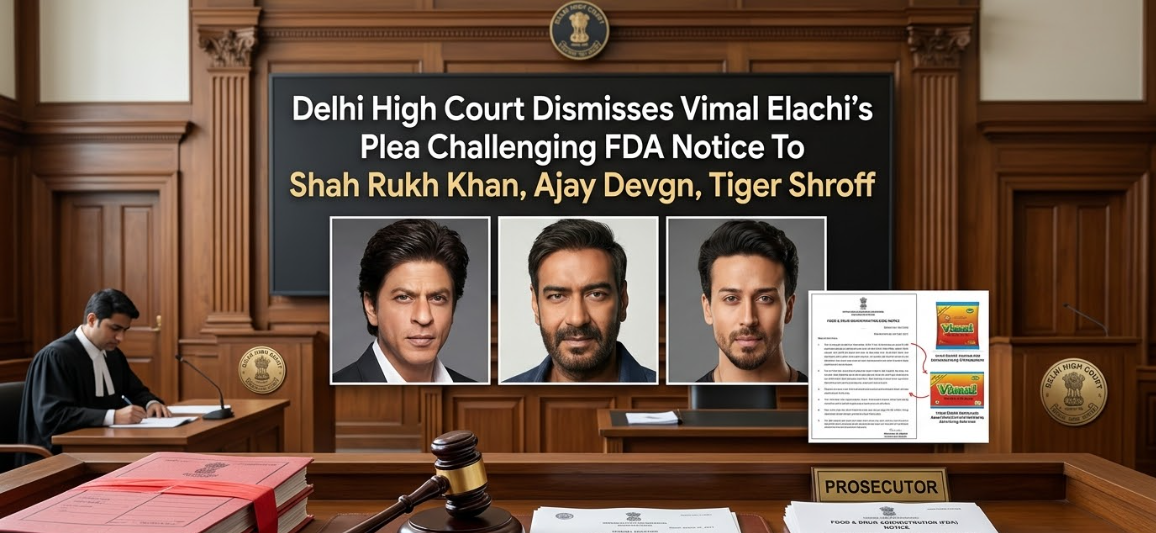
Delhi High Court Dismisses Vimal Elaichi's Plea Challenging FDA Notice To Shah Rukh Khan, Ajay Devgn, Tiger Shroff
Delhi High Court Dismisses Vimal Elaichi's Plea Challenging FDA Notice To Shah Rukh Khan, Ajay Devgn, Tiger ShroffCase D...
In-Laws Failure to Take Action Against Son for Allegedly Torturing his Wife Is Not Cruelty
In-Laws Failure to Take Action Against Son for Allegedly Torturing his Wife Is Not CrueltyCase DetailsCase Title: Dr. Sa...