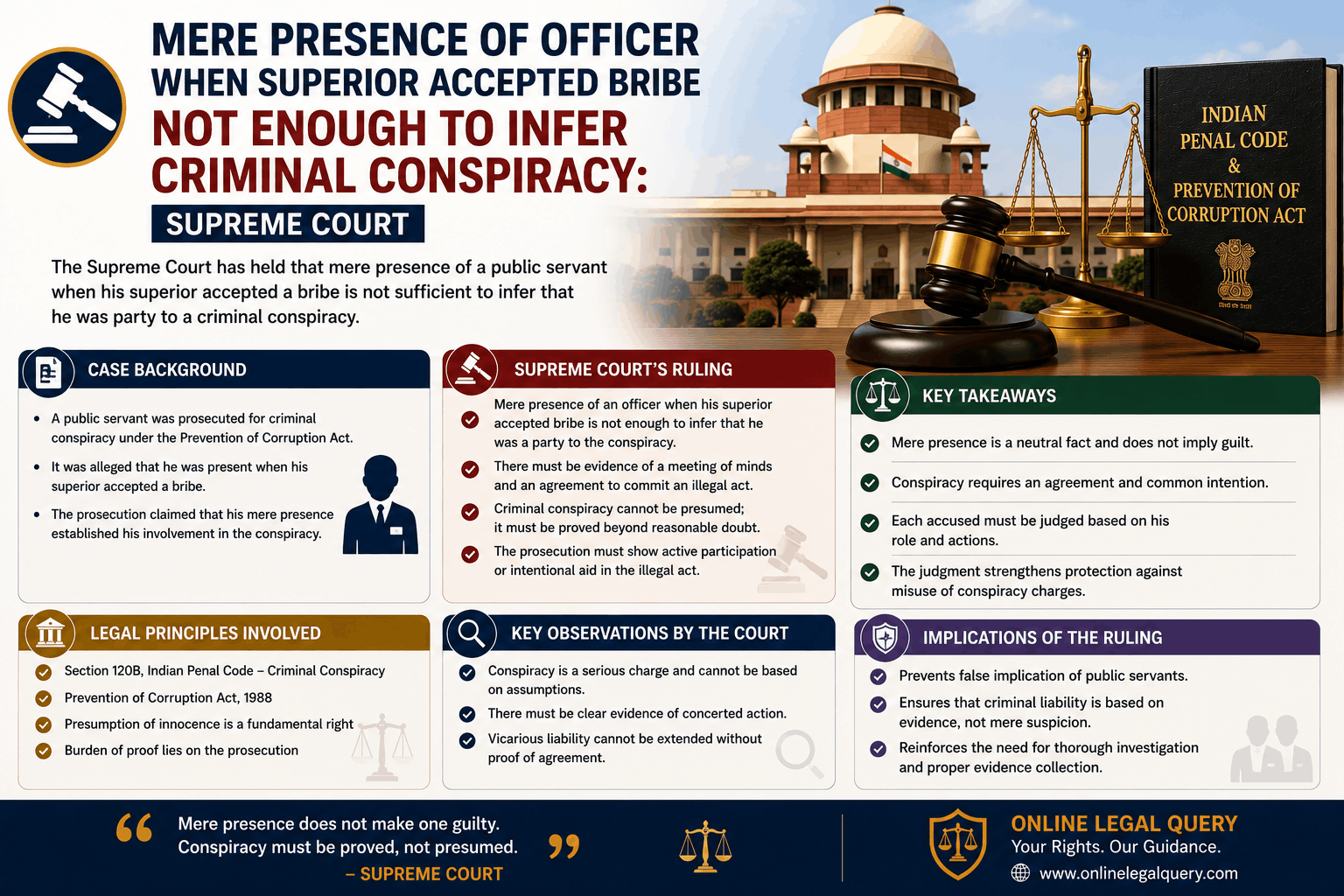
Mere Presence Of Officer When Superior Accepted Bribe Not Enough To Infer Criminal Conspiracy: Supreme Court
“When procedure meets justice, every judgment leaves a lasting precedent”.
Mere Presence Of Officer When Superior Accepted Bribe Not Enough To Infer Criminal Conspiracy: Supreme Court
“When procedure meets justice, every judgment leaves a lasting precedent”.
In its verdict in the case of “ State of Uttar Pradesh vs. A.K. Gaba” (June 2026), the Supreme Court of India gave a clear ‘no’ in response to this. This judgement ensures an essential safeguard for government employees, clarifying that mere presence or administrative involvement does not amount to criminal conspiracy.
CBI Trap in 1995
A detailed review of the 1995 CBI trap incident, To understand the impact of this verdict, we must look back at a dispute that began in January 1995.
Officials from the Central Excise Department visited a factory in Bababanki, Uttar Pradesh, and seized company documents without issuing any formal acknowledgement
of receipt.
When a factory representative went to fetch the documents, the prime accused, Superintendent R.K. Srivastava- allegedly demanded a bride of Rs. 80,000.
The CBI conducted a raid at the residence of the superintendent to unearth a trap after a complaint was filed. During the raid, specially marked ‘tained bills’ were recovered from the house.
The Judgement of the case
Inspectors A.K.Gaba, Alok Gupta, and Dushyant Kumar faced legal complications. The prosecution alleged that since these junior inspectors were present at some stage, either when the bribe was demanded or during the raid, they would be considered conspirators under section 120B of the IPC and the Prevention of Corruption Act.
Although the special trial court accepted this theory and convicted them, the Allahabad High Court ultimately set aside the verdict. Subsequently, the Uttar Pradesh government appealed to the Supreme Court.
The Supreme Court Dismissed the State’s Appeal……Why?
A Supreme Court bench comprising Justice Pankaj Mithal and Justice Prasanna B. Varale dismissed the state’s appeal and upheld the acquittal of the junior officials. Their decision was primarily based on two fundamental principles of criminal law. These are:
Prevention of Corruption Act
Under sections 7 and 13 of the PC Act, India deals with crimes of bribery and criminal misconduct by public servants.
Section 7- Acceptance of a bribe by a public servant. Under this Act, it is an offense for a public servant to accept a bribe in exchange for performing their duties. For instance, if an employee demands money to sign your documents, they are violating this rule.
Section 13- this section deals with more serious and persistent offenses. This offense is deemed to have been committed if an employee habitually accepts bribes, steals public assets, or possesses assets disproportionate to their known sources of income.
Punishments:
Not less than 3 years, but it can extend to 7 years of imprisonment, or fine, or both.
Section 120B of IPC - (Replaced by Section 61 of the BNS)
Section 120B punishes a person who is part of a criminal conspiracy, an agreement between two or more persons to commit an illegal act.
Punishments:
For a serious offence- punishable with imprisonment with 2 years or more, life imprisonment and punishable with death.
For a petty offence- the imprisonment up to 6 months, or fine, or both.
FAQs
OLQ Law Firm protects your legal rights and liability through legal support.
1. What was the main issue in A.K. Gaba case?
A: Whether daily-wage workers are entitled to the same pay scale as regular employees.
2. What did the Court decide in A.K. Gaba?
A: Court denied equal pay, stating classification based on mode of appointment is valid.
3. How OLQ Law Firm assists using A.K. Gaba judgment?
A: OLQ structures employment contracts and consultant agreements to avoid equal pay claims.
4. Can OLQ defend a startup if contract staff claim equal pay?
A: Yes, OLQ uses A.K. Gaba precedent to defend against claims lacking legal basis.
5. How OLQ ensures compliance after A.K. Gaba?
A: OLQ audits appointment letters and pay structures for proper classification.
How can OLQ help?
Drafting compliant employment & consultant contracts.
Preventing equal pay claims from contract/daily-wage staff.
HR policy audits based on Supreme Court guidelines.
Court representation in labour & service matters.
Legal opinion on cadre classification & pay parity risks.
Contact OLQ for professional legal consultation on employment structuring & labour law matters.
OLQ LAW FIRM
Call/WhatsApp: 89819 49111
Employment Structuring | Contract Drafting | Labour Law Compliance | Court Representation | Legal Consultation
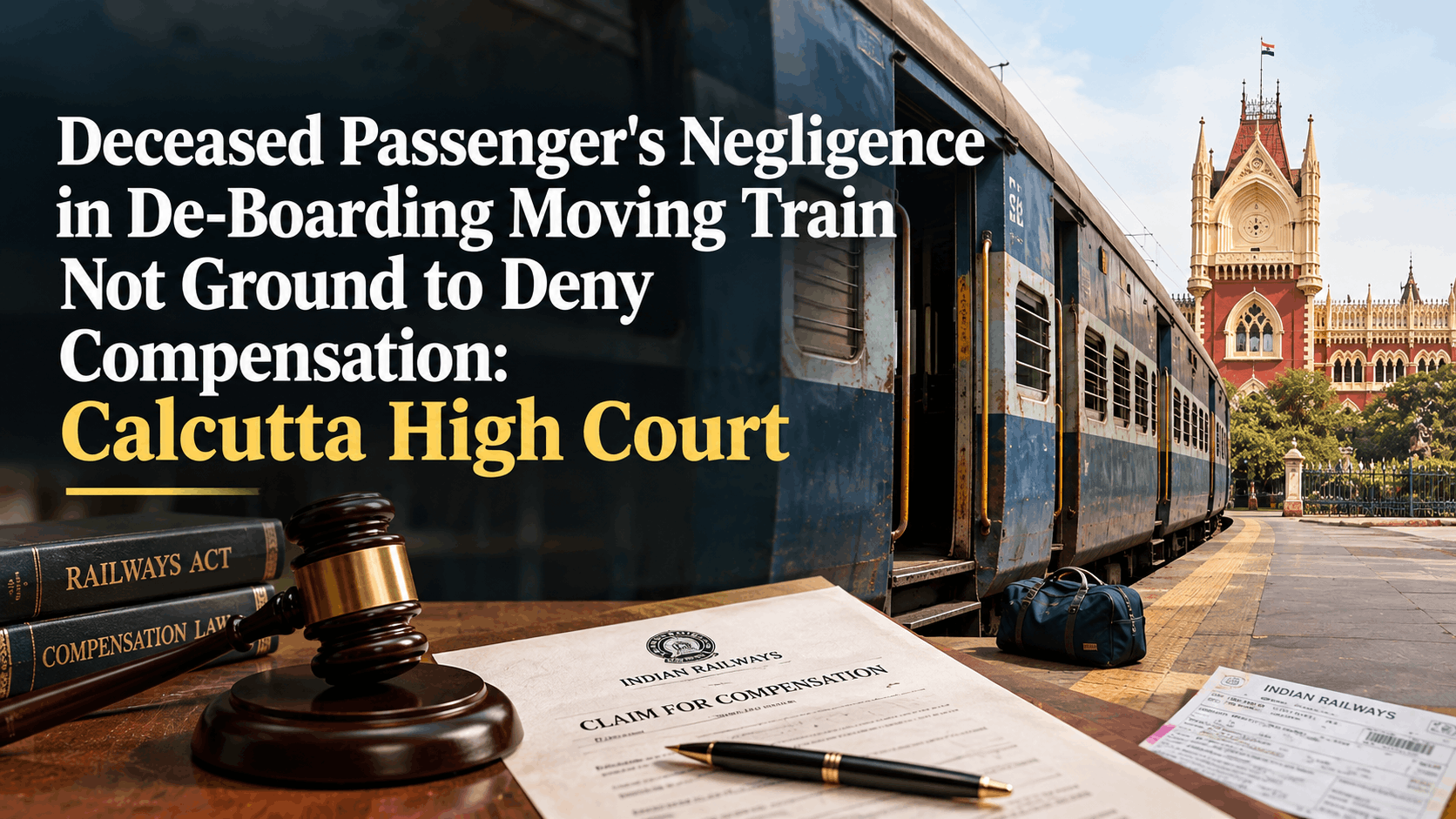
Deceased Passenger's Negligence in De-Boarding Moving Train Not Ground to Deny Compensation: Calcutta High Court
Deceased Passenger's Negligence in De-Boarding Moving Train Not Ground to Deny Compensation: Calcutta High CourtCase Det...
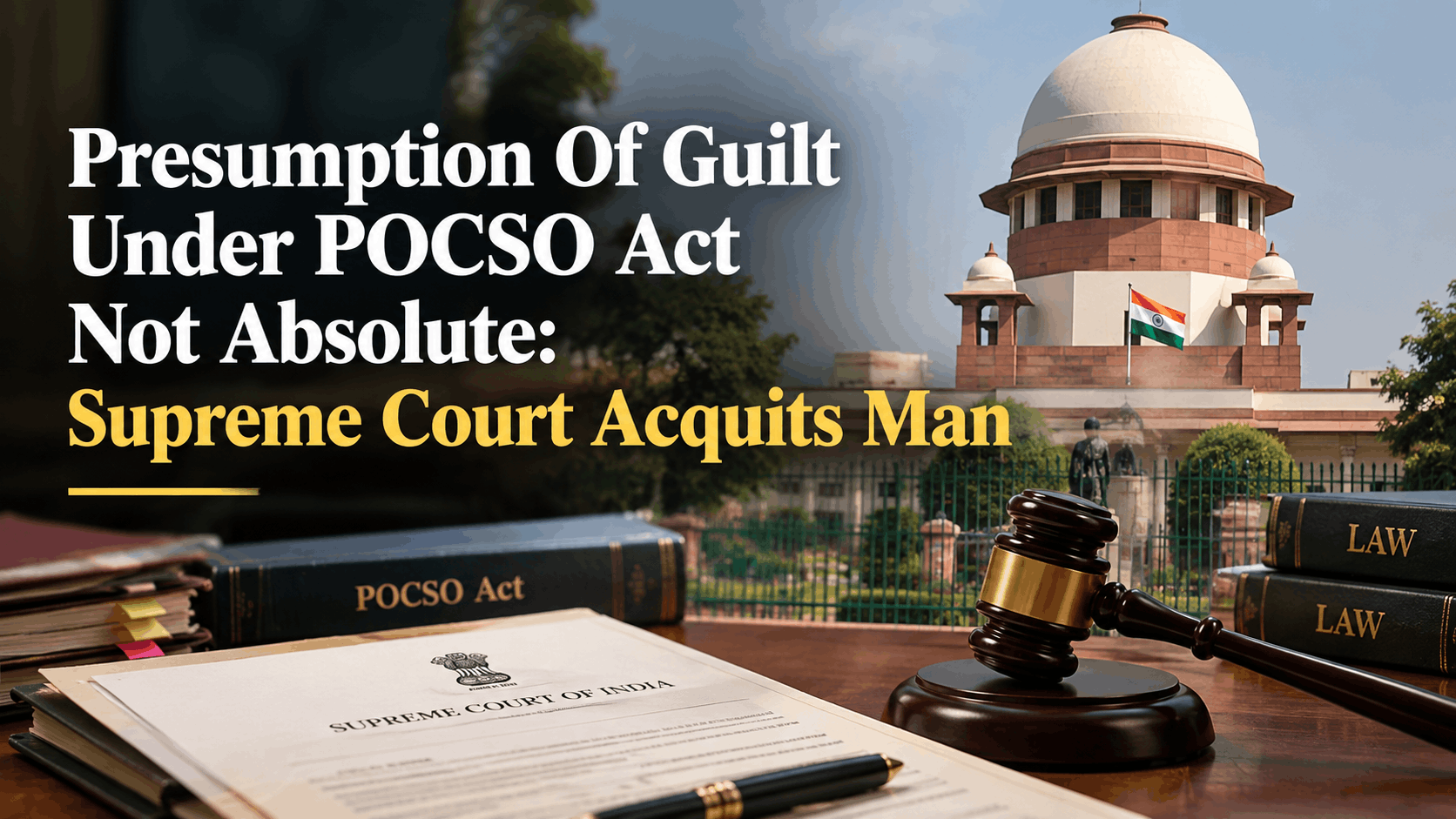
Presumption Of Guilt Under POCSO Act Not Absolute: Supreme Court Acquits Man
Presumption Of Guilt Under POCSO Act Not Absolute: Supreme Court Acquits Man Case DetailsCase Title: Deepak in JC v...
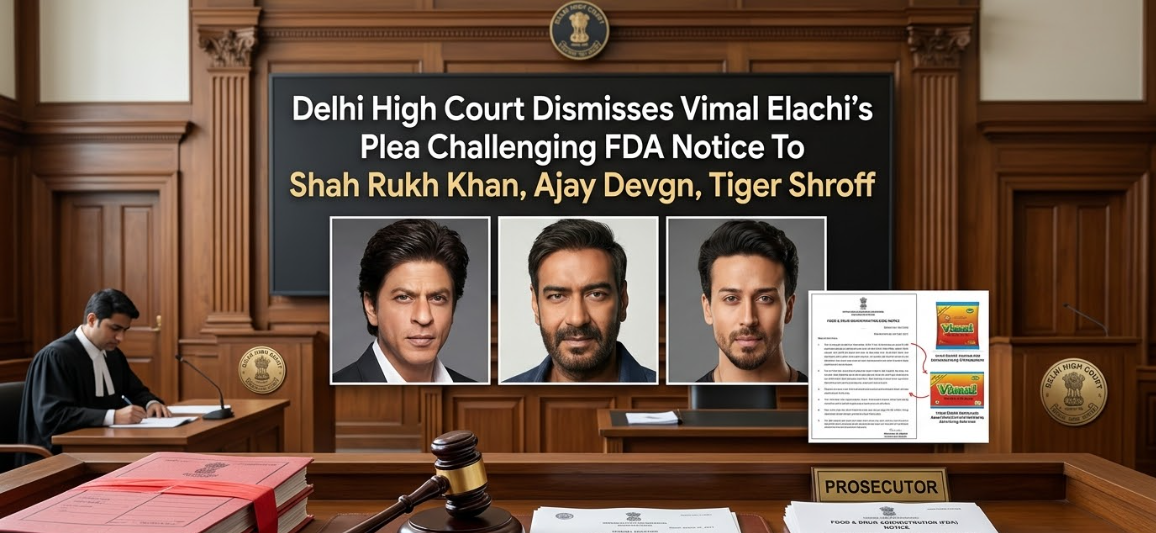
Delhi High Court Dismisses Vimal Elaichi's Plea Challenging FDA Notice To Shah Rukh Khan, Ajay Devgn, Tiger Shroff
Delhi High Court Dismisses Vimal Elaichi's Plea Challenging FDA Notice To Shah Rukh Khan, Ajay Devgn, Tiger ShroffCase D...