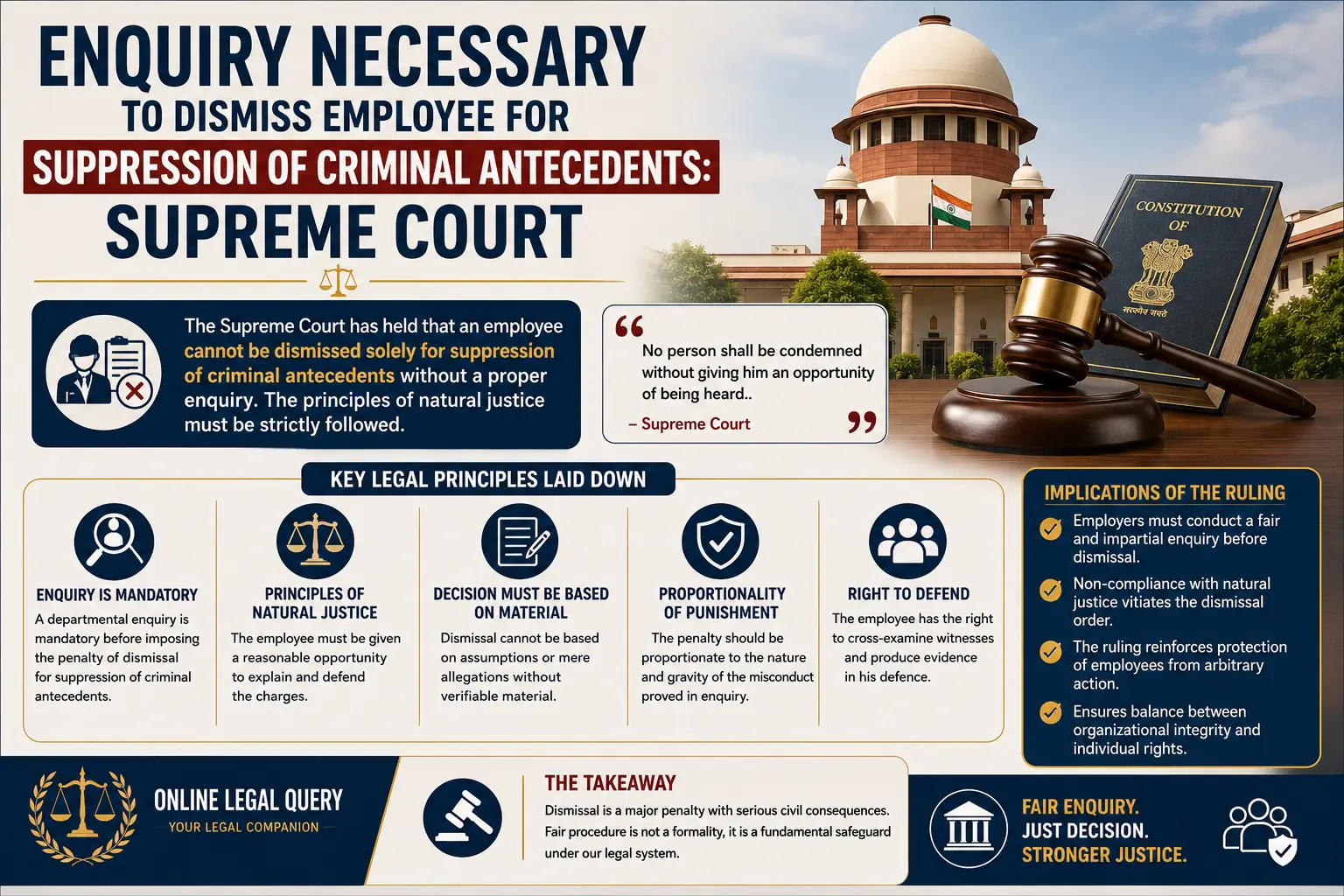
Enquiry Necessary to Dismiss Employee for Suppression of Criminal Antecedents: Supreme Court
The Supreme Court of India made a significant ruling that non-disclosure of criminal antecedents cannot automatically lead to termination of an employee, the employer must apply its mind based on the nature of concealment whether it was a deliberative attempt to suppressing of such antecedents. The Kerela High Court’s decision was dismissed by the Supreme Court of India based on its erred decision of not considering the facts and circumstances of the case.
Enquiry Necessary to Dismiss Employee for Suppression
of Criminal Antecedents: Supreme Court
Case Details
Case Title: - Shatrugan Yadav Versus Fertilizers and Chemicals Travancore
Ltd.
(F.A.C.T) and Others
Case No.:- SLP (Civil) No. 7197 of 2026
Bench:- Hon’ble Justice Sanjay Karol
Hon’ble Justice Augustine George Masih
Counsel for Appellant: - Mr. PV. Dinesh, Sr. Adv. Ms. Anna Oommen and
Adv. Mr. Abdulla Naseeh
Counsel for Respondent: - Mr. Parthiv Goswami, Sr. Adv. Mr. Siddhartha Jha,
AOR Mr. Kartik Jha, Adv. Ms. Atiga Singh, Adv. Ms. Nitika Sud
Decided:- August 11, 2026
Summary
The Supreme Court of India made a significant ruling that non-disclosure of
criminal antecedents cannot automatically lead to termination of an employee,
the employer must apply its mind based on the nature of concealment whether it
was a deliberative attempt to suppressing of such antecedents. The Kerela High
Court’s decision was dismissed by the Supreme Court of India based on its
erred decision of not considering the facts and circumstances of the case.
What Happened?
The Appellant Shatrugan Yadav was employed by Fertilizers and Chemicals
Travancore Ltd. (F.A.C.T) in the post of Technician (Process). At the time of
Joining, he was required to disclose information concerning criminal
antecedents. Later on, checking the background of the appellant it was found
that a non-cognizable Report was registered against him, which was not
disclosed by him. On receiving such report, the Company treated the non-
disclosure as suppression of material information and therefore terminated the
employment. The Appellant then by a Writ Petition in the Kerela High Court
challenged such termination with the statement that he did not have any
knowledge of existence of the proceeding at the time of filling his declaration
form.
Supreme Court’s Observation
The Supreme Court observed that knowledge of a fact is a necessary
requirement for its suppression. If an employee was genuinely unaware of a
criminal proceeding, non-disclosure cannot automatically be treated as
misconduct. Employers must conduct a fair and reasoned enquiry instead of
adopting a mechanical approach. It held that termination for non-disclosure of
criminal antecedents cannot be mechanical. The employer must examine
whether there was conscious suppression, the nature of the offence, the
employee’s knowledge, and the surrounding circumstances before imposing
termination.
Final Order
The Supreme Court set aside the termination order, directed FACT to reinstate
Shatrughan Yadav with consequential service benefits, and awarded 50% back
wages, payable within eight weeks.
Why this Judgement matters
This judgment establishes that suppression of criminal antecedents does not
automatically mean termination. If a person genuinely did not know about the
criminal proceeding against him, it would be difficult to say that the person
deliberately did not disclose it. The Court observed that knowledge is a
necessary requirement for suppression. At the same time, the Court did not say
that every claim of ignorance should automatically be accepted.
Conclusion
This judgment establishes the principles of fairness, and natural justice in public
employment. It makes clear that termination based on non-disclosure of
criminal antecedents should not be automatic and must be based on a careful
assessment of the employee's knowledge, the seriousness of the allegations, and
the overall circumstances of the case.
OLQ LAW FIRM
Call/WhatsApp: 89819 49111



Deceased Passenger's Negligence in De-Boarding Moving Train Not Ground to Deny Compensation: Calcutta High Court
Deceased Passenger's Negligence in De-Boarding Moving Train Not Ground to Deny Compensation: Calcutta High CourtCase Det...
Presumption Of Guilt Under POCSO Act Not Absolute: Supreme Court Acquits Man
Presumption Of Guilt Under POCSO Act Not Absolute: Supreme Court Acquits Man Case DetailsCase Title: Deepak in JC v...
Delhi High Court Dismisses Vimal Elaichi's Plea Challenging FDA Notice To Shah Rukh Khan, Ajay Devgn, Tiger Shroff
Delhi High Court Dismisses Vimal Elaichi's Plea Challenging FDA Notice To Shah Rukh Khan, Ajay Devgn, Tiger ShroffCase D...