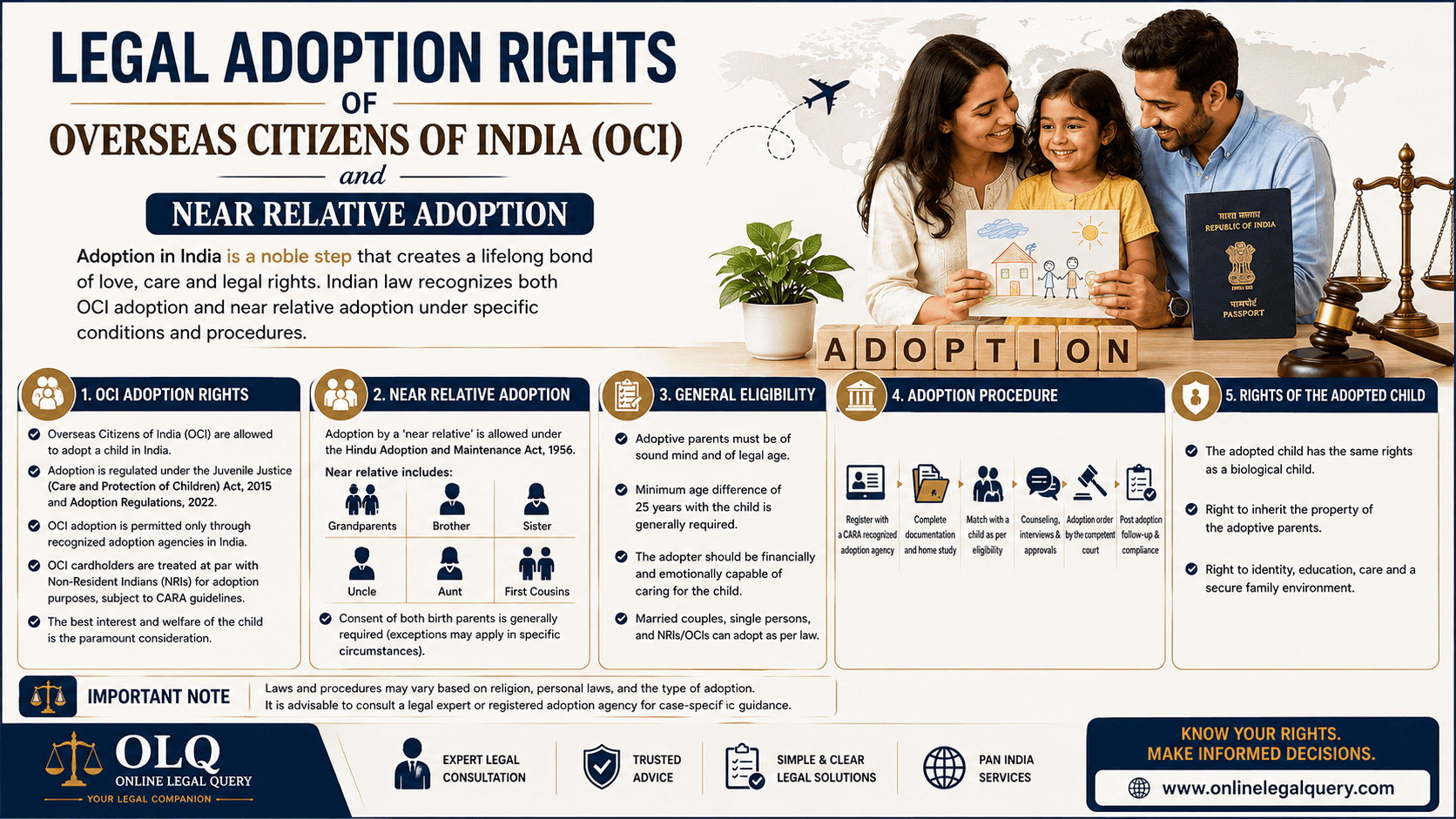
Legal Adoption Rights of Overseas Citizens of India(OCI) and Near Relative Adoption
A Child’s Right to Family Knows No Borders A child brings joy, love and hope in a family. Adopting a child means taking responsibility for growing a family by accepting a child legally, which is not one’s own but is treated as one’s own biological child. The main goal of adoption is to provide a permanent protective home to a child who cannot be raised by their parents, or who are abused or neglected, or who are orphans, to give them an environment full of nurturing love and affection. Adoption rights extend to the citizens of India as well as to the OCI Parents who are settled abroad. The adoption process for OCI/NRI Parents is available through CARA (Central Adoption Resource Authority) and HAMA (Hindu Adoption and Maintenance Act, 1956)
Legal Adoption Rights of Overseas Citizens
of India(OCI) and Near Relative Adoption
Introduction
A Child’s Right to Family Knows No Borders
A child brings
joy, love and hope in a family. Adopting a child means taking responsibility
for growing a family by accepting a child legally, which is not one’s own but
is treated as one’s own biological child. The main goal of adoption is to
provide a permanent protective home to a child who cannot be raised by their
parents, or who are abused or neglected, or who are orphans, to give them an
environment full of nurturing love and affection. Adoption rights extend to the
citizens of India as well as to the OCI Parents who are settled abroad. The
adoption process for OCI/NRI Parents is available through CARA (Central
Adoption Resource Authority) and HAMA (Hindu Adoption and Maintenance Act,
1956)
What is
near-relative Adoption?
Near-relative
adoption basically means the adoption within one’s own extended family where
the child to be adopted is already a known biological family member to the
adoptive parents. Relative adoption is allowed in relation to paternal/maternal
grandparents or Paternal/maternal uncles and Paternal/maternal aunts. Near
relative adoption can be done through both the adoption process under CARA and
HAMA.
What is the Central
Adoption Resource Authority (CARA)?
CARA is a main
statutory body under the Ministry of Women and Child Development that is
responsible for monitoring and regulating the adoption procedure of children in
the country as well as inter-country adoptions. It allows OCI/NRI nationals to
adopt children from India and to take them to their home country.
Step-by-Step
Process of Adoption under CARA?
The OCI/NRI
parents can apply for adoption under the Central Adoption Resource Authority
(CARA) in India. The following steps are to be followed: -
Step-1
The first step as
an OCI/NRI parent is to approach any Authorised Foreign Adoption Agency (AFAA)
or any other central authority or the Indian Diplomatic Mission available in
your home country because you cannot directly access the Indian Portal being an
OCI/NRI national. The authorised agency then makes a Home Study Report after
assessing the financial, stability, health factors, and living standards of the
NRI/OCI national.
Step-2
The authorised
foreign agency then creates a profile in the Official CARA Portal and registers
them as an OCI/NRI Parent in the Portal. Further, the agency uploads the
required documents such as Financial Slips, bank balances, fitness reports or
background clearance as required under Schedule VI Part 2. In case there is an
adoption of a near relative, then additional documents are required such as
Certified family lineage trees, identity documents establishing specific blood
relationships and a Deed of Consent signed by the biological parents of the
child in India.
Step-3
CARA then inspects
the documents carefully provided in the portal by the authorised agency and
checks the documents provided. If CARA further approves, then they are eligible
to adopt a child in India.
Step-4
Then the OCI/NRI parents'
requests are lined up according to the seniority list. The portal then shows
the parent’s registered preference child and a strict 96-Hour window (4 days)
where the registered OCI/NRI Parent can, within 4 days, reserve the child’s
profile, and if the child’s profile is not reserved, then it moves to the next
in line on the seniority list. Once the child profile is reserved, then the
parents are provided with the Child Study Report (CSR) and Medical Examination
Report (MER) and a time period of 30 days is provided to formally accept it.
In case the
adoption is of a near relative, then CARA instructs the District Child
Protection Unit (DCPU) to look into the matter. Then a local social welfare
officer visits the family of the biological child who is up for adoption to
perform family background checks, to find out whether the consent is free or
not or is done with a motive of illegal trafficking of the child, and then,
after observation, shall submit a compiled Family Background Report(Schedule
XXI).
Step-5
The further step
is that the Child Welfare Committee then officially declares that the
orphan/abandoned child under them is legally free for Adoption. In case of
adoption of a near relative, then the biological parents of
the child residing in India must sign a consent form under Schedule XIX. If the
relative child is of age 5 years or older, then his written consent must also
be legally recorded.
Step-6
The CARA further ensures that the adoption process is
recognised in the foreign country and that the home country of OCI/NRI parents'
permanent residence is a signatory member of the Hague Adoption Convention.
Once this is confirmed, the statutory authority (CARA) issues the Non-Objection
Certificate (NOC) within 10 days of such confirmation. When dealing with the
adoption of a near relative, CARA first does biological verification of the adopted
child with that of the OCI/NRI Parents and issues a pre-approval letter instead
of an NOC, which is a legal confirmation that the adoption with the near relative
is lawful.
Step-7
After this, the next step would be that the Local
Specialised Adoption Agency (SAA) or the family’s representative submits the
case files to the regional administrative authorities, and then the legal
paperwork is reviewed by the DCPU within 5 days. In case of a near relative,
the application is filed before any local authority or before the District
Magistrate where the adoptive child resides, as mentioned under Schedule XXI.
Step-8
Then the adoption application is filed before the
competent District Magistrate (DM). Then the DM further conducts closed-door
hearings and, after observing the matter, issues a legally binding and
irrevocable order within 60 days of the application being filed. The same
action is initiated in case of a near relative put up for adoption. The OCI/NRI Parents then need to travel
to India to accept physical custody of the child.
Step-9
The final DM order
is uploaded in the CARA Portal. After reviewing the final decree, CARA issues a
Conformity Certificate under Schedule XI within 3 days of such upload. This
certification is a legally valid document globally, which ensures adoption that
aligns with international treaty standards. The same action is considered for near-relative-type
adoption.
Step-10
After getting the
clearance, the next step would be for the Specialised Adoption Agency (SAA) or
the relative-authorised representative to apply for the adopted child’s
passport in the regional passport office with the adopted parents' names listed
as legal parents. The adoptive OCI/NRI parents would then apply for a dependent
visa to the embassy of the home country located in India, and they, after
reviewing all the legal documents, shall issue an entry visa of their country
to the adopted child. Then the Ministry of Home Affairs of India, through a
Foreigners Regional Registration Officer, shall issue an exit visa for the
adopted child to safely cross all the checkpoints in India. Then the adoptive
OCI/NRI parents, along with the adopted child, are legally permitted to fly to
their settled country.
Step-11
After both the
adoptive parents and the child reach their destination country safely, the
2-year mandatory reporting window is important to monitor the inspection report
submitted by the adoption agency overseas, based on the routine checks and to
ensure whether the recognition of Indian adoption is recognized in foreign law
or accepts the residency of the child or its citizenship or any issues arising
which hampers the well-being of the adopted child is to be ensured by them.
What is the Hindu
Adoption and Maintenance Act, 1956 (HAMA)?
HAMA is a codified
personal law for adoption that allows adoption directly and privately among families.
HAMA also applies to OCI/NRI nationals apart from Indian Citizens who follow the
religion of Hinduism, Sikhism, Jainism, and Buddhism and excludes people
belonging to Muslims, Christian, Parsi, and Jewish religions.
Step-by-Step
Process of Adoption under HAMA
For OCI/NRI Parents,
the execution of the adoption deed under HAMA is not sufficient, it requires a
specific process for adopting the child and then moving him abroad, the process
is as follows: -
Step-1
The first step as
an OCI/NRI Parent is that, you cannot directly access the Indian Portal, you
first need to approach any Authorised Foreign Adoption Agency (AFAA) or any
other central authority or the Indian Diplomatic Mission available in your
country. The foreign agency will further conduct a background check and based
on it, produce a Home Study Report (HSR).
Step-2
Further, the
Adoption Agency or Indian Mission, after making the HSR report, will submit it
in the CARINGS Portal under the inter-country HAMA category. After the adoption
application is submitted in the Portal, the OCI/NRI nationals need to travel to
India and perform the give-and-take ceremony with the biological parents and
then execute the Adoption Deed and register it in the local Sub-Registrar’s
office.
Step-3
After the Adoption
Deed is uploaded in the Portal, CARA directs the local District Child
Protection Unit (DCPU) to do a background check to ensure the child’s safety.
The District Magistrate, after receiving the report of the unit, issues a
Verification Certificate confirming the adoption to be safe and is done
legally.
Step-4
The further step
is to see whether your resident country is a signatory member of the Hague
Adoption Convention or not. If yes, then you must obtain an Article 5/17 Letter
from the central authority of your home country to ensure that your country recognises
and allows adoption and can guarantee the child’s permanent residence there. Then
the Verification Certificate as well as the Article 5/17 Letter are submitted to
CARA. Then CARA issues a Non-Objection Certificate (NOC), which is the
mandatory clearance for applying for the child’s passport and visa process.
Comparison
between CARA and HAMA
CARA (Central
Adoption Resource Authority)
Adoption
procedure by CARA for OCI/NRI Parents
·
CARA
is a statutory body that is regulated under the Juvenile Justice Act, and
allows all eligible OCI, NRI, and Indian citizens to adopt a child and apply
for adopting a child and taking them to their resident country. Whereas HAMA is
a private kind of adoption, only allowing adoption within the specified
religions, which is not open to all, and certain restrictions apply to this
kind of adoption for OCI/NRI parents of such specified religion.
·
CARA
issues a Non-Objection Certification or support letter that allows the adopted
child to be freely accepted by the foreign embassies and also has universal
acceptance among Hague Adoption Convention members. Whereas the HAMA deed
cannot alone prove proper clearance in foreign embassies to obtain passports
and visas and can be blocked at checkpoints and embassies,
·
User
registration is required in the CARINGS Portal of CARA, it requires certain
documents to be submitted in the portal, such as the Home Study Report,
financial statements, etc., and the portal then provides a structured form of
queue where the waiting time is much longer. In case of HAMA, an Adoption Deed
is required to be executed, and for taking the adopted child abroad, a District
Magistrate (DM) permission is required, and then the adoption is successful for
OCI/NRI parents.
·
CARA’S
guidelines are strict and slow in nature, but the adoption is done in a legal
and verified manner and is a safe certification allowing crossing borders
without any restriction as well as acceptance in the resident country of the
adoptive parents. HAMA is considered a more flexible and faster manner of
adoption with less formality and avoiding the queues in the seniority list.
Conclusion
When an OCI/NRI
parent wants to adopt a child from India and take them to their resident
country without facing any restrictions from the Indian border or the foreign
embassies, then they should go for a valid, legal, official, and safer process
of adoption through the statutory body of the Indian Government that is CARA (Central
Adoption Resource Authority). This is the best option and reliable path for
adoption, although it requires waiting in a queue of the seniority list, but the
certification document from this authority ensures a smooth adoption process
for the adopted child, from clearing Indian borders and foreign embassies to
reaching the destination state without worrying about any blockage along the
way.
FAQs
1. What is the difference between CARA and
HAMA adoption?
CARA (Central Adoption Resource Authority) regulates
the adoption of orphaned, abandoned, and surrendered children under the
Juvenile Justice Act through a structured legal process. HAMA (Hindu Adoptions
and Maintenance Act, 1956) governs adoption among Hindus, Buddhists, Jains, and
Sikhs, primarily for relative and direct adoptions, subject to the conditions
laid down under the Act.
2. Is CARA registration
mandatory for every adoption?
No. CARA registration is mandatory for adoptions of
orphaned, abandoned, and surrendered children. However, adoptions under HAMA,
such as certain relative adoptions, follow the provisions of HAMA instead of
the CARA adoption process, although additional procedures may apply in specific
circumstances, especially for international relocation.
3. What documents are required for
adoption?
Common documents include:
(i) Identity
and address proof
(ii) Marriage
certificate (if applicable)
(iii) Medical
fitness certificate
(iv) Income
proof
(v) Photographs
(vi) Home
Study Report (for CARA cases)
(vii) Other
documents prescribed under the Adoption Regulations
4. Is adoption under HAMA eligible to apply for passport
and visa
clearance for the adopted child without any
restriction?
Yes, HAMA is a valid and recognised kind of adoption and is eligible to
apply for passport and visa
clearance of the adopted child, but specific
domestic and inter-country
regulations compliance are required. No
authorities can deny any
passport or visa clearance for adoption under
HAMA.
5. How Does OLQ Law Firm Help?
(a)Legal
consultation on CARA and HAMA adoption laws
(b)Assistance
with CARA registration and documentation
(c)Assistance
in relative, step-parent, and intra-family adoptions
(d) Drafting
and reviewing adoption deeds under HAMA
(e) Representation
before the District Magistrate or other competent
authorities
where required
(f) Legal
support for NRI and OCI adoption cases
HAMA adoption|CARA
adoption|Inter-country HAMA adoption process|





Deceased Passenger's Negligence in De-Boarding Moving Train Not Ground to Deny Compensation: Calcutta High Court
Deceased Passenger's Negligence in De-Boarding Moving Train Not Ground to Deny Compensation: Calcutta High CourtCase Det...
Presumption Of Guilt Under POCSO Act Not Absolute: Supreme Court Acquits Man
Presumption Of Guilt Under POCSO Act Not Absolute: Supreme Court Acquits Man Case DetailsCase Title: Deepak in JC v...
Delhi High Court Dismisses Vimal Elaichi's Plea Challenging FDA Notice To Shah Rukh Khan, Ajay Devgn, Tiger Shroff
Delhi High Court Dismisses Vimal Elaichi's Plea Challenging FDA Notice To Shah Rukh Khan, Ajay Devgn, Tiger ShroffCase D...