
Supreme Court Acquits Teacher in POCSO Case: Why Evidence Matters More Than Presumption
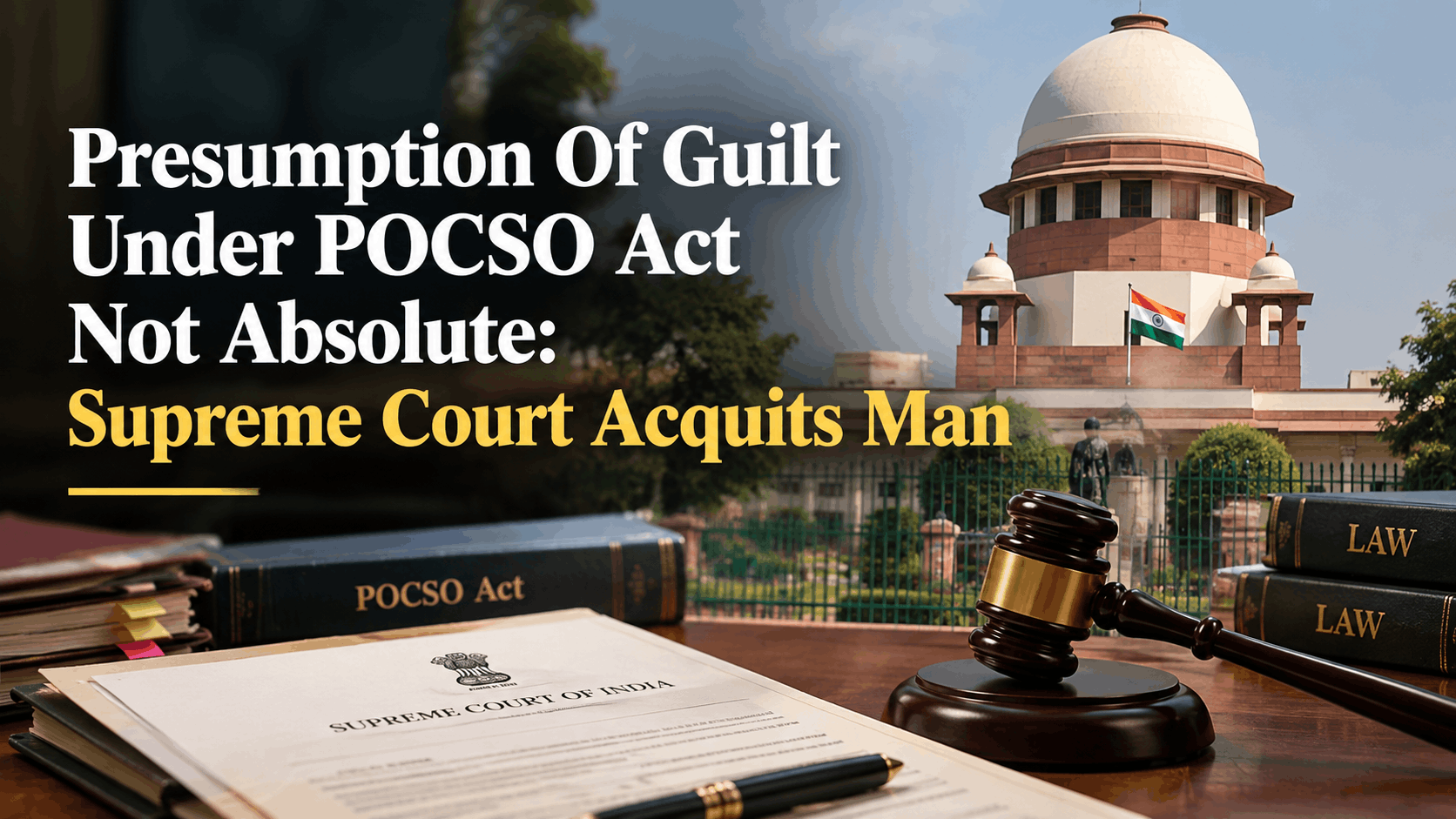
The Supreme Court of India set aside conviction in a POCSO case, stressing inconsistencies in evidence, delay in FIR and limits of Section 29 presumption.
Case Title & Bench
Case: Debraj Dutta v. State of West Bengal & Anr.
Court: Supreme Court of India
Bench: Justice Sanjay Kumar and Justice K. Vinod Chandran
Supreme Court Acquits Teacher in POCSO Case: A Closer Look
The Supreme Court of India made a ruling. They changed a verdict under the Protection of Children From Sexual Offences Act, 2012. A teacher accused of assaulting a student was cleared of charge.
This decision highlight that having evidence is crucial. It help prove allegation against someone suspected of a crime like abuse of children. The Supreme Court of India stressed that evidence is key in cases.
The court reinstated the acquittal of the teacher. This show that the court priorities evidence in its judgment.
The Protection of Children From Sexual Offences Act 2012 aim to protect children. The Supreme Court of India makes sure that the law is applied fairly.
What Happened in This Case?
A tuition teacher was accused of touching a 14 year old student in the wrong way.
The court first said the teacher was not guilty because there was no proof.
Then the Calcutta High Court changed that decision and said the teacher was guilty.
The High Court relied on Section 29 of the POCSO Act which allow court to presume guilt once certain fact are established.
The accused then approached the Supreme Court.
What Did the Supreme Court Examine?
The Court focused on key questions:
Was the victim’s statement reliable and consistent?
Were the basic facts of the offence proved?
Was the High Court right in applying legal presumption under POCSO law?
Key Findings of the Court
Inconsistencies in Testimony
The Court noticed that the victim statement were not consistent.
What she told her mother was different from what she later said in court
Important details were missing during testimony
This created serious doubt about the reliability of the allegations.
Delay in Filing FIR
There was a delay of about one day in file the complaint.
No proper explanation was given
The victim’s father was a police officer, making the delay more questionable
The Court said this delay weakens the prosecution case.
No Medical Examination
The victim’s mother refused to allow a medical examination.
No clear reason was provided
Even a basic check could have supported the case
The Court treated this as a negative factor against the prosecution.
Doubts from Other Witness
Another witness indicated that other people were present in the house at the time.
This made the alleged incident less believable and raised further doubt.
Section 29 POCSO Cannot Be Misused
The Court clarified an important legal point:
Presumption under Section 29 applies only when basic fact are first proved.
In this case since the foundation itself was weak, the presumption could not be applied.
Final Decision
The Supreme Court held that:
The prosecution failed to prove the case beyond reasonable doubt
The High Court made an error in reversing the acquittal
Result: The accused was acquitted again.
Why This Judgment Matter
This judgment reinforce some core principle of criminal law:
A person is innocent until proven guilty
Evidence must be strong and consistent
Presumptions cannot replace proof
Benefit of doubt goes to the accused
Conclusion
The court must continue to be careful and balanced in its approach to serious cases such as those arising under POCSO and this case demonstrate the importance of basing judgments on actual evidence rather than making assumption about someone guilt or innocent.
It is equally crucial that victims should be protected from harm; equally important that people are not punished for offences they did not commit due to a lack of substantiated evidence.
Contact OLQ Law Firm for Legal Assistance
If you are facing any kind of legal issue and need professional legal guidance, you can contact OLQ Law Firm for trusted legal support.
Our legal team assists in all kinds of legal matters including civil disputes, criminal matters, family disputes, divorce cases, cheque bounce cases, banking disputes, property matters, corporate compliance, income tax issues, charitable trust registration, POSH compliance, employment matters, consumer disputes, and many other legal concerns.
Whether you need legal advice, notice drafting, case filing, documentation support, or court representation, OLQ Law Firm is here to help.
For any kind of legal matter, feel free to contact OLQ Law Firm for reliable legal solutions and expert guidance.

Supreme Court’s Call for a “Romeo-Juliet Clause” in POCSO: Rethinking Consent and Criminalisation
Supreme Court’s Call for a “Romeo-Juliet Clause” in POCSO: Rethinking Consent and CriminalisationThe Supreme Court of In...
Explores situations where minors are accused under POCSO and the intersection with the Juvenile Justice (Care and Protection of Children) Act, 2015.
Introduction: The intersection of the Protection of Children from Sexual Offences (POCSO) Act, 2012, and the Juveni...