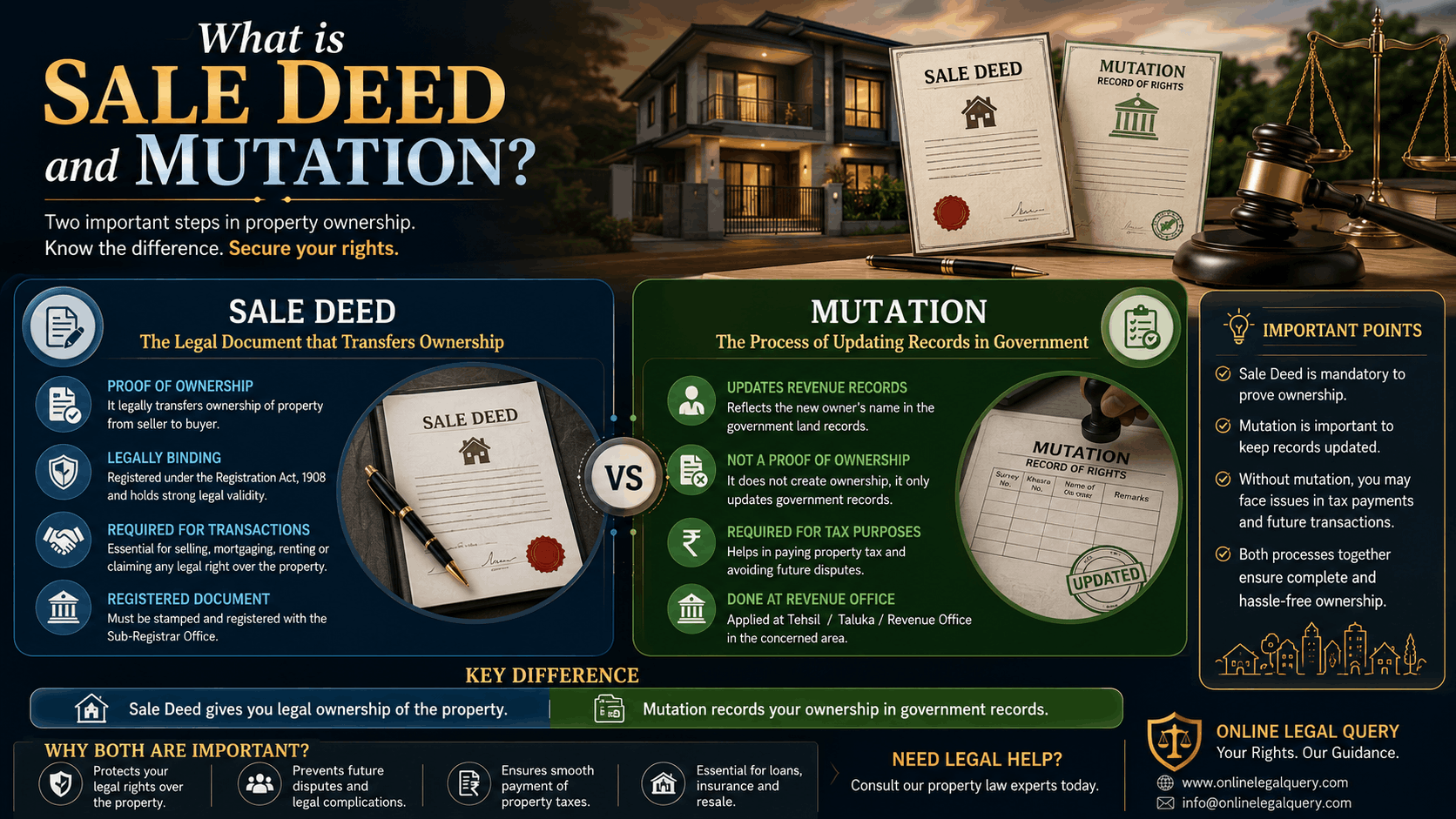
What is Sale Deed and Mutation
Property is not truly yours until the deed speaks and the record agrees.
Introduction
A sale deed is a legal document that records the transfer of property ownership from the seller to the buyer. It outlines the property details, sale price, payment terms, and conditions agreed upon by both parties. Once signed by both parties and registered, the buyer becomes the lawful owner of the property. It serves as the primary proof of ownership and is an essential document in all property transactions. “Property is not truly yours until the deed speaks and the record agrees.”
Why is Sale Deed important:
A property is registered based on the information provided in the sale deed.
Sale deed is the proof of the legal ownership of the property and is an essential document in legal report submission of proof of the sale of property from seller to the buyer.
The sale deed is complete and is registered upon the signature of the seller and the buyer. Thus, the sale/purchase is legally complete after all the requirements of buyer and seller are completed as mentioned above.
Elements of a Sale Deed
· Parties involved
· Name and address of the executing parties
· Description of the property
· Sale Consideration
· Payment terms
· Possession
· Transfer of the title
· Indemnity
· Registration
· Encumbrance certificate
· Warranties and representations
It provides legal protection and acts as evidence of ownership of right. Understanding sale deed in property transactions is crucial for anyone involved in property transactions.
A sale deed is an important document that not only signifies the transfer of property ownership but also protects both the parties (the seller/and the buyer) that are involved in the transaction of the property.
Mutation
Mutation is the process of updating the ownership details of a property in government land or municipal records after its transfer through sale, gift, inheritance, partition, succession, or a will. It helps maintain accurate ownership, land, and property tax records.
Why is Property Mutation Important
· A mutation is an important step in property because it helps in keeping ownership records up to date after a property changes hands. If the records are not updated according to the right information of the property owners and details, it can cause confusion and conflict later in the future or during any resale, inheritance, or even when applying for any property related services.
· It plays an important role in property tax and land revenue records. Once the mutation is property is completed and maintained, the local authorities recognize the new owner for tax related purposes. It reduces the chance of any disputes that arise in future or any complications relating to ownership.
Conclusion
Property mutation may seem like a small step, but it is an important role in keeping land and tax records updated. It helps avoid any future confusion regarding ownership, and it helps make property transactions smooth. It is always better to complete the mutation process without delay and keep all records updated, after buying or inheriting a property.
FREQUENTLY ASKED QUESTIONS (FAQ)
1. What is a sale deed?
· A legal document that transfers property ownership from seller to buyer.
2. Is a sale deed mandatory?
· Yes, it is required to legally complete any property transaction.
3. Who signs the sale deed?
· Both the seller and the buyer must sign the sale deed.
4. What is mutation in property?
· It is the process of updating government land records to reflect the new property owner.
5. Is mutation the same as registration?
· No, registration is done at the sub-registrar office; mutation updates local government records.
6. Why is mutation important?
· It ensures that the new owner is recognized for tax purposes and avoids future ownership disputes.
7. When should mutation be done?
· Immediately after the property transfer through sale, inheritance, gift, or partition.
8. Can a sale deed be cancelled?
· Yes, through mutual consent of both parties and by a court order.
9. Does mutation give ownership rights?
· No, it only updates revenue records; the sale of deed and registration establish legal ownership.
10. What documents are needed for mutation?
· The registered sale deed, identity proof, and an application to the local municipal or revenue authority.
11. How can OLQ LAW FIRM assist?
OLQ LAW FIRM can assist:
· Drafting and reviewing
· Filing the Mutation application
· Resolving any errors or disputes
· Following up the status of mutation application
· Registration assistance
Call/WhatsApp: 8981949111
Legal Consultancy| Drafting Notices| Property Registration Assistance|
Property Ownership Transfer assistance|





Senior Citizens Tribunal Can Order Eviction of Children from Parents' Property: Supreme Court
Senior Citizens Tribunal Can Order Eviction ofChildren from Parents' Property: Supreme CourtCase DetailsCase Tit...
Anticipatory Bail: A matter of Right or Defence?
Anticipatory Bail: A matter of Right or Defence?IntroductionArrest isn’t the end-Know your rights to legal ProtectionAnt...
Fleeing After Friends Drowning Does not prove Murder
Fleeing After Friend's Drowning Does not prove MurderCase DetailsCase Title: -Taher Vajiyuddin Rangwala &amp...