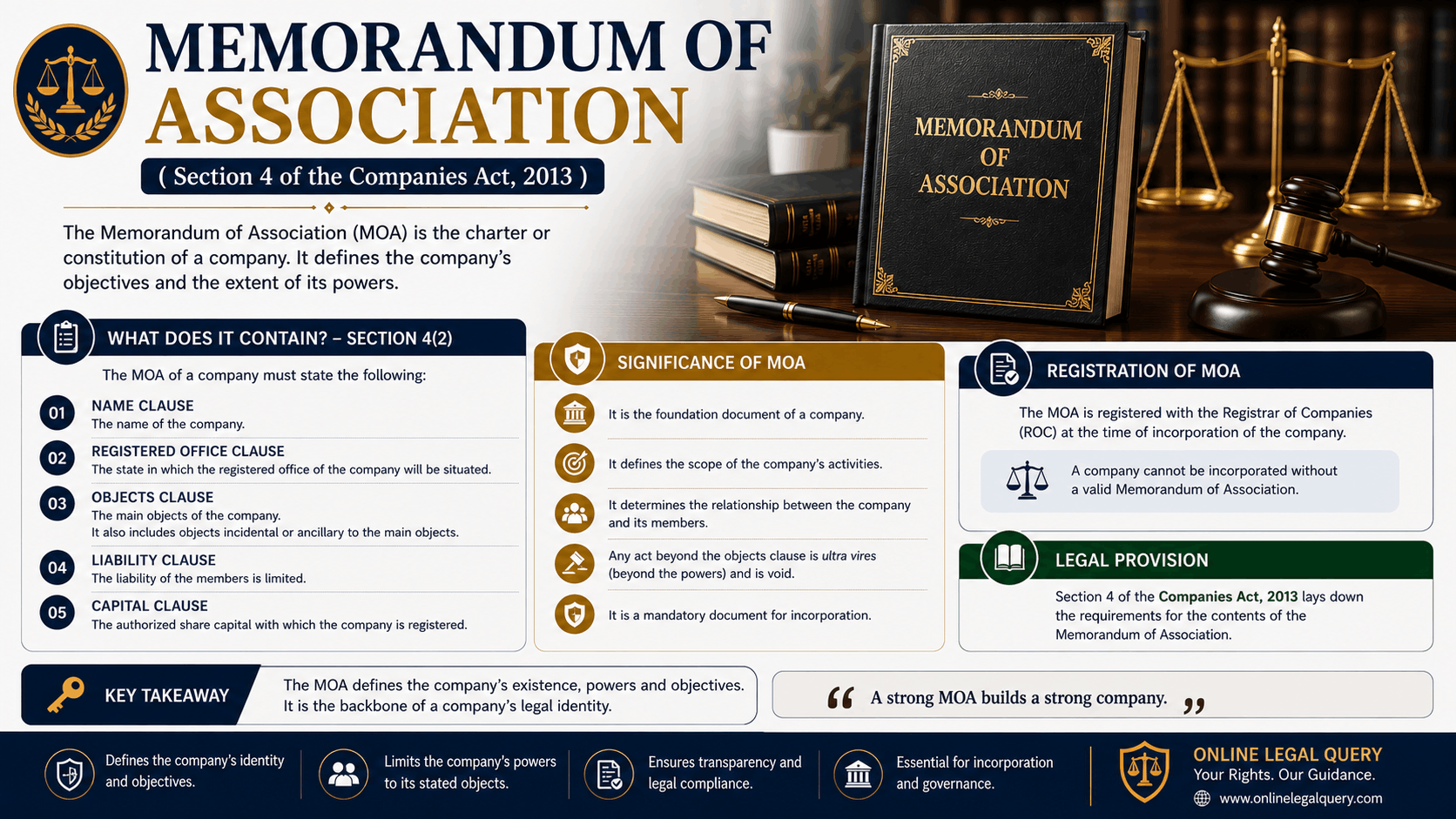
MEMORANDUM OF ASSOCIATION (Section 4 of the Companies Act, 2013)
Every successful company begins with a strong foundation—and that foundation is the Memorandum of Association (MOA).
The Memorandum of Association (MOA) is known as the constitutional documents of a company. Under the Companies Act, 2013, no companies can be registered without a Memorandum of Association. It acts as a public document that informs the shareholders, creditors, and other stakeholders about the company’s detailed activities.
STATUTORY PROVISION GOVERNING MOA
1. Section 4 of the Companies Act, 2013, governs the Memorandum of Association (MOA): The clauses mentioned in the MOA are:
a) Name Clause
b) Object Clause
c) Liability Clause
d) Capital Clause
e) Subscription Clause
DEFINITIONS OF CLAUSES OF THE MOA
a) Name Clause: The name clause in the section 4(2) of the Company’s act, 2013, mentions the name under which the company is incorporated in the initial stage. There are a few requirements, such as:
· A private company’s name should end with "Private Limited” and a public company’s name should end with "Limited."
b) Object Clause: The Object Clause is one of the most important part of the MOA. It specifically mentions the purpose for which the company is formed.
It also protects investors and creditors by ensuring that the company’s funds are used only for specified purposes such as:
· The matters necessary for further continuing of the main objectives.
c) Liability Clause: The Liability Clause in section 4(1)(d) of the Company’s Act, 2013, specifies the liabilities of the members of the company. Depending on the type of company, it requires the following:
· In a company limited by shares, liability is limited to amount unpaid on the shares that are held by them.
· In a company limited by guarantee, liability is limited to the amount guaranteed, or the contribution of each member in the event of winding-up of the company.
d) Capital Clause: The Capital Clause in section 4(1)(e) in the Company’s Act, 2013, specifies the total amount of share capital of the company. It also declares the exact number of shares that the subscribers of the MOA are committing to purchase.
e) Subscription Clause: The Subscription Clause consists of the following:
· Names of subscribers.
· Number of shares subscribed.
· Signatures of subscribers.
· Witness certifications.
DOCTRINE OF ULTRA VIRES
The doctrine of Ultra Vires means “beyond the powers”. It describes any action or transaction taken by a corporation, government agency, performed outside the scope of the MOA, which means that becomes ultra vires and void. Some effects of Ultra Vires are:
· Such acts are classified as unenforceable.
· They cannot be ratified by shareholders.
· Company funds cannot be used for any unauthorized purposes.
CONCLUSION
The Memorandum of Association (AOA) is the founding document of any company that is incorporated under the Company’s Act, 2013. It defines the company’s identity, objectives and powers, etc while also safeguarding the interests of the shareholders, creditors, and the public. The doctrine of Ultra Vires also helps us in understanding the importance of MOA for the company directors, stakeholders, legal practitioners, etc.
FAQs
Q1. What is a Memorandum of Association (MOA)?
It is the charter document that defines a company's objectives and powers.
Q2. Is an MOA mandatory?
Yes, every company must have an MOA at the time of incorporation.
Q3. Can an MOA be amended?
Yes, subject to legal procedures under the Companies Act, 2013.
Q4. How OLQ LAW FIRM Can Help
· Draft and review MOA.
· Ensure Companies Act compliance.
· Assist with company incorporation.
· Provide end-to-end corporate legal support.
Contact OLQ Law Firm for expert MOA assistance.
MOA under Companies Act 2013 | Clauses of MOA | Company incorporation India | MOA legal requirements



Senior Citizens Tribunal Can Order Eviction of Children from Parents' Property: Supreme Court
Senior Citizens Tribunal Can Order Eviction ofChildren from Parents' Property: Supreme CourtCase DetailsCase Tit...
Anticipatory Bail: A matter of Right or Defence?
Anticipatory Bail: A matter of Right or Defence?IntroductionArrest isn’t the end-Know your rights to legal ProtectionAnt...
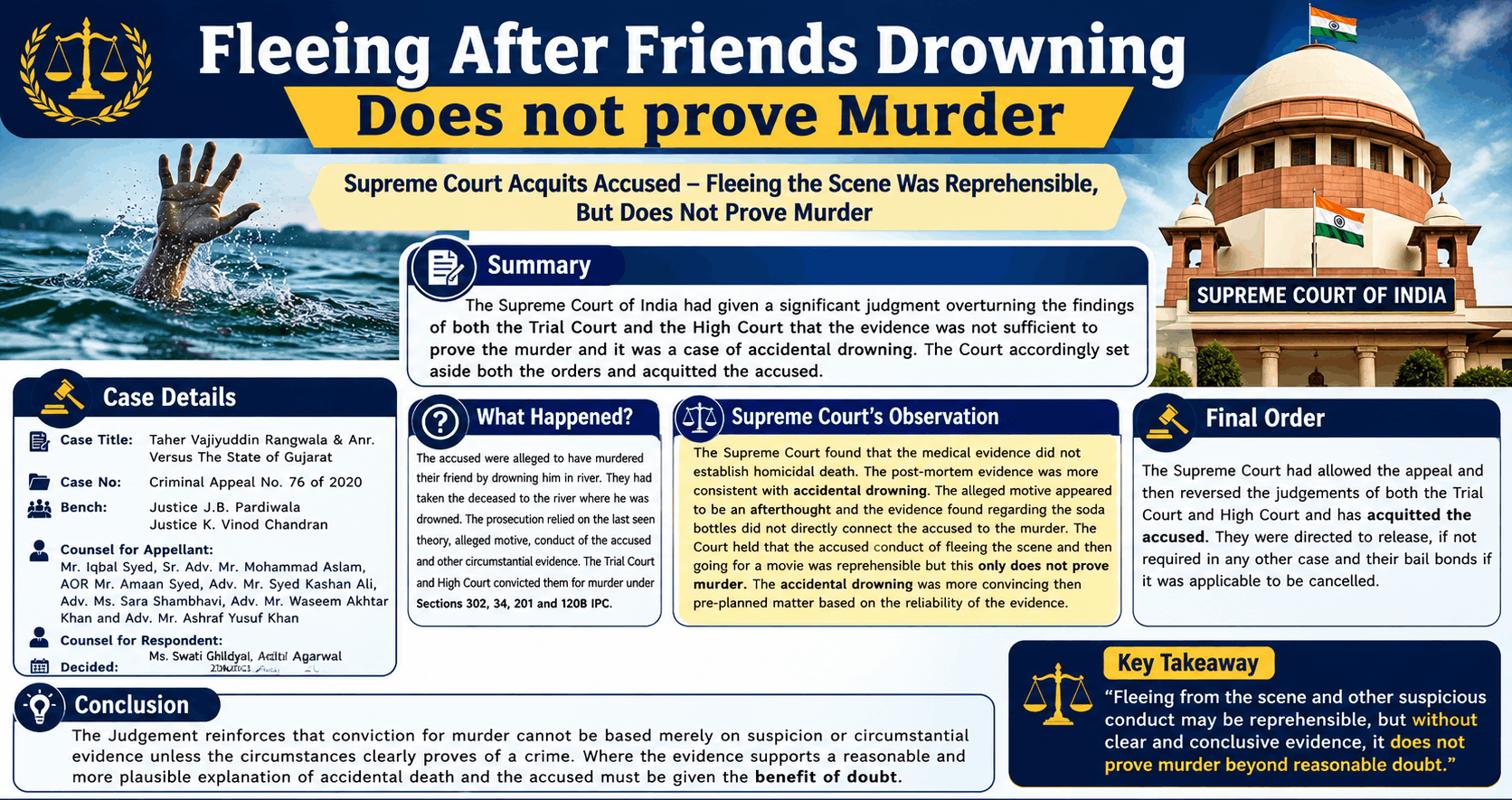
Fleeing After Friends Drowning Does not prove Murder
Fleeing After Friend's Drowning Does not prove MurderCase DetailsCase Title: -Taher Vajiyuddin Rangwala &amp...