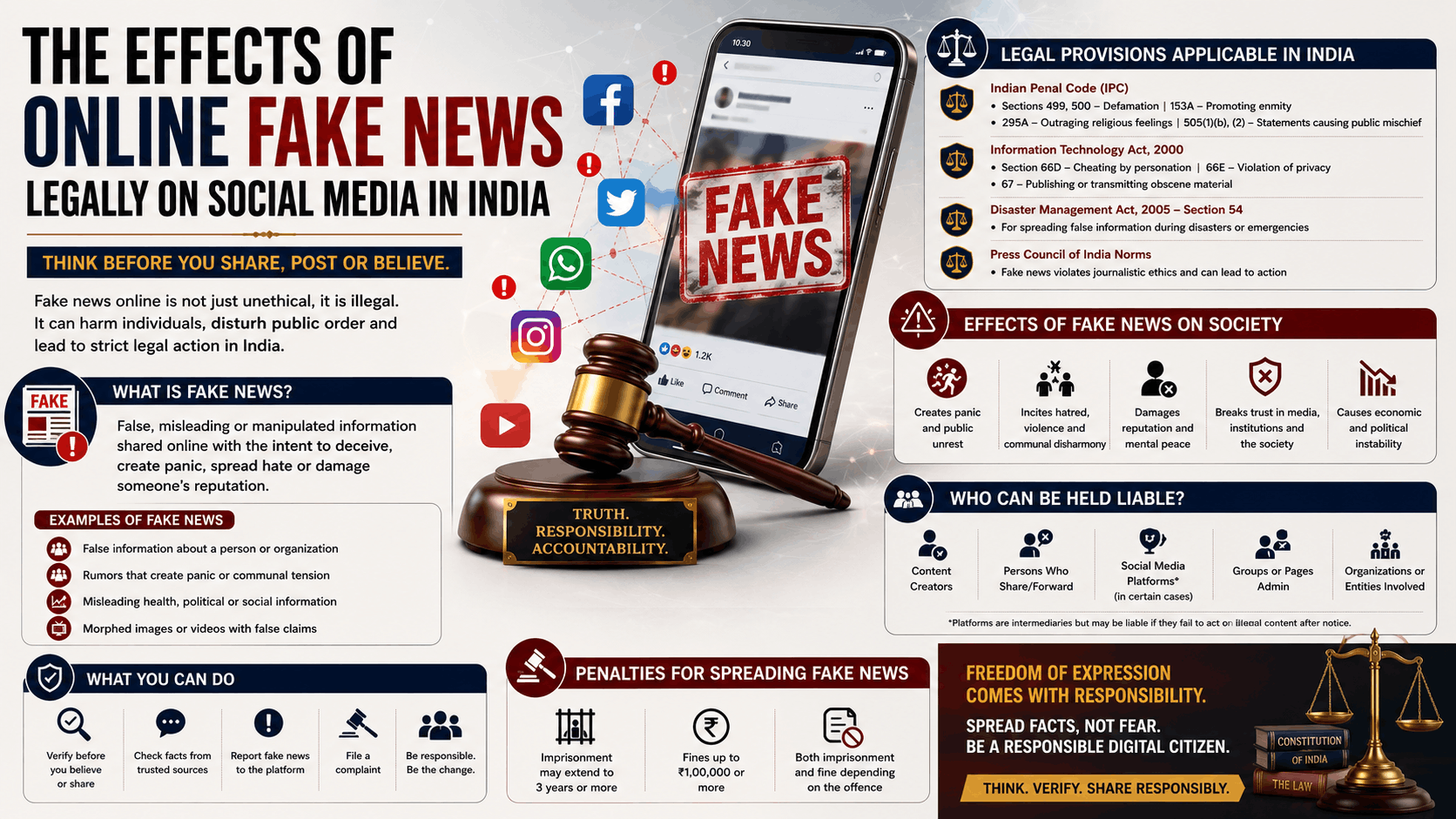
The effects of online fake news legally on social media in India
ndividuals who create, share, or forward fake news on social media platforms face serious criminal consequences under Indian law. This act of forwarding misleading content and information leads to FIR registration under section 505 of IPC. Courts have held that mens rea (guilty intent) is relevant but not always required, particularly when content objectively causes public disorder.
The effects of online fake news legally on social media in India
· Individuals who create, share, or forward fake news on social media platforms face serious criminal consequences under Indian law. This act of forwarding misleading content and information leads to FIR registration under section 505 of IPC. Courts have held that mens rea (guilty intent) is relevant but not always required, particularly when content objectively causes public disorder.
· Social media platforms play a dual role in India's fake news ecosystem. The IT Act’s Section 79 originally provides a safe harbor of protecting the intermediaries from liability from third-party content if they acted as passive hosts without editorial control.
· However, the 2021 IT Rules dissolved this safe harbor by imposing proactive monitoring obligations. Failure to comply with takedown orders or appoint mandatory officers within 30 days of notification can strip platforms of their safe harbor protection, exposing them to criminal and civil liability.
· The election commission of India has recognized fake news as a major threat to fair and free elections. The model code of conduct restricts the spread of false information during elections.
· Online defamation through fake news is addressed under both civil and criminal law. Section 499 of IPC (now section 356 of BNS) recognizes criminal defamation. The digital dimension raises specific challenges like viral spread information makes quantifications of damages extremely difficult, and jurisdiction issues arise when content is posted from foreign servers.
· Courts have granted interim injunctions to remove defamatory fake news in several high court decisions.
Introduction
The rapid spread of online fake news across social media platforms poses serious legal and social challenges in India. “Misinformation is the side effect of being uninformed”.
Legally there is no statutory definition of ‘fake news’ under the Indian law. But these terms are relevant concept of fake news.
· Misinformation: false or inaccurate information spread without deliberate intent to deceive.
· Disinformation: Deliberately false information created and spread with intent to mislead.
· Deepfakes: Ai-generated synthetic media portraying individuals in fabricated scenarios.
The Information Technology Act, 2000 (IT Act)
IT Act is the legislation governed for the online content in India. These provisions directly address the fake news
Section 66A:
Section 66D:
Section 67:
Section 69A:
Section 69B:
Section 79:
The Indian Penal Code, 1860 and Bharatiya Nyaya Sanhita,2023.
Several IPC/BNS provisions are cited in fake news prosecutions
· Section 153A IPC/Section 196 BNS:
promoting enmity between groups- applicable when fake news incites communal/regional hatred.
· Section 295A IPC/Section 299 BNS:
Deliberate acts intended to outrage religious feelings. Fake content targeting religious communities.
· Section 499-500 IPC/Section 356 BNS:
Defamation and false statements of fact damaging reputation.
· Section 505 IPC/Section 353 BNS:
statements conducing to the public mischief, most used against fake news spreading panic.
· Section 124A IPC/Section 150 BNS:
modified and fake news against the state or government.
· Section 420 IPC/Section 318 BNS:
cheating and financial fraud via fake news.
IT (Intermediary Guidelines and Digital Media Ethics Code) Rules, 2021.
The 2021 IT Rules dictate significant obligations on social media intermediaries
Significant Social Media intermediaries (SSMIs) with over 5 million users must appoint a Nodal Officer, Chief compliance officer, and Grievance officer all based in India.
Requirement to enable traceability of the first originator of the messages on end-to-end encrypted platforms, a contentious provision challenged by WhatsApp.
Takedown of any sexual content within 24 hours for nudity and sexual content and in 72 hours for any other flagged content.
Mandatory monthly compliance reports disclosing content taken down.
Publishers of digital news content must follow a three-tier grievance redressal mechanism.
Landmark Cases
Kunal Kamra v. Union of India (Bombay High Court, 2024)
Kunal Kamra a well-known stand-up comedian, challenged a rule that gave the government PIB (press information bureau) fact check unit power to label any online content as “fake news”. Once any content that is labelled as “fake news” by PIB, the social media platforms are required to remove it.
Kunal argued that this was dangerous as it gives the power to the government itself to decide what is false and what is true, so this could be misused easily. silenced the journalists, critics, comedians, and opposition voices.
The Bombay high court agreed with these concerns and put a stay on this rule. The court stated that allowing the government to be the sole judge of “fake news” could have the negative effect on free speech, meaning people would stop expressing out of fear and unfairness. This case is a landmark reminder that fighting fake news case cannot be without expressing themselves freely.
Rakesh Kumar Paul v. State of Assam (Supreme Court, 2017)
Rakesh Kumar Paul was arrested and kept in jail for spreading information/news what was claimed to be fake and provocative content online. He then approached the supreme court to seek bail.
The supreme court, while dealing with his application of bail, mentioned an important observation that serious charges like sedition must not be dealt with carelessness or loosely. The law must only be used when there is a real and genuine threat to the security of the state and not use simple because the government or the authority finds the content uncomfortable or critical.
This case is significant because it expressed the act of misuse of the heavy criminal charges against individuals who post contents online and reminded authorities to apply such laws strictly and carefully.
conclusion
The legal effect of online fake news on social media in India is vast, varied, wide-ranging, and still evolving. It has caused serious problems from mob violence and electoral manipulation to reputational harm, etc. India’s legal response has been reactive rather than systematic, resulting in a patchwork of criminal provisions, platform obligations, and judicial interventions that often pull in conflicting directions.
FREQUENTLY ASKED QUESTIONS (FAQ)
1.what is “fake news” and how is it defined under Indian law?
· No statutory definition exists for “fake news” in Indian law. However, it covers misinformation, disinformation, and deepfakes.
2.which provisions of the IT Act, 2000 deal with fake news?
· Sections 66D, 69A, 69B, and 79 (safe harbor). Section 66A was struck down in 2015.
3.which IPC/BNS provisions are used in fake news prosecutions?
· Sections on communal enmity, defamation, public mischief, sedition, and cheating (section: 505, 153A, 499-500 IPC and BNS equivalents).
4. What obligations do the IT Rules, 2021 place on social media platforms?
· Appoint compliance officers, enable message traceability, remove flagged content within 24-72 hours, and publish monthly reports.
5.can individuals be prosecuted for simply forwarding fake news?
· Yes. Forwarding can attract an FIR under section: 505 IPC even without proven intent.
6. What happened to the “Safe Harbor” protection for platforms after the 2021 Rules?
· Platforms that fail to comply lose section 79 protection and become criminally and civilly liable.
7.what is the significance of Kunal Kamra v. Union of India (2024)?
· Bombay High Court stayed on the PIB fact Check Unit rule, calling it a threat to free speech.
8. What is the significance of Rakesh Kumar Paul v. State of Assam (2017)?
The Supreme Court cautioned that sedition must not be invoked loosely against online content.
9.how does fake news affect elections in India?
· The Election Commission treats it as a threat; model code of conduct restricts its spread.
10.what is the central legal tension in regulating fake news in India?
· Article 19 (1) (a)- free speech vs. State's duty to maintain public order- still unresolved.
11.how can OLQ LAW FIRM assist in fake news on social media legally?
OLQ LAW FIRM can assist in:
· Advising individuals regarding FIRs
· Representing platforms on safe harbor compliance under the 2021 IT Rules
· Filing Writs
· Defamation litigation/cases
· Legal Advisory and Counselling
· Assisting social media platforms with compliance
Call/WhatsApp: 8981949111
Legal Consultancy |Social Media Compliance| Defamation Compliance
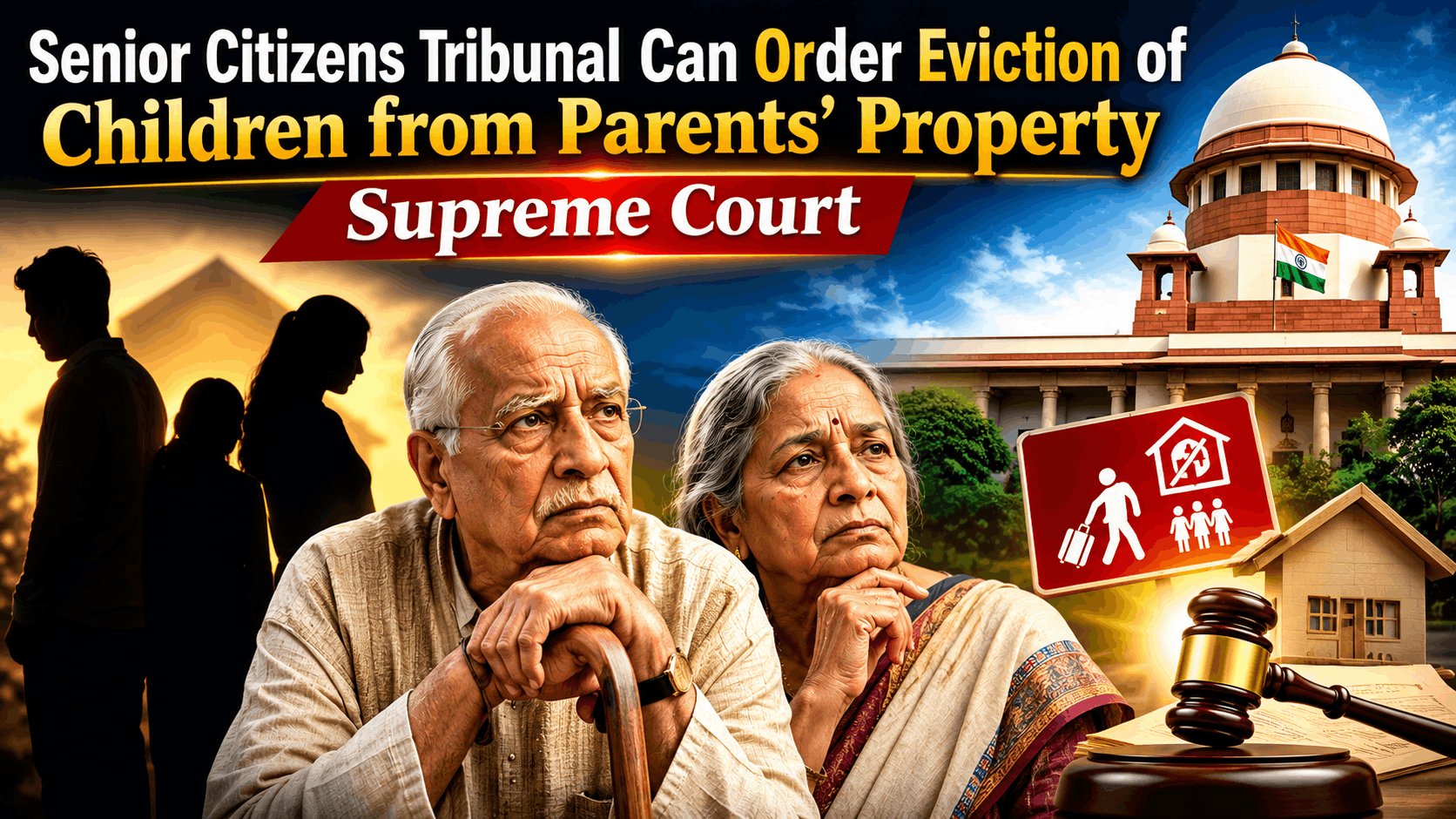

Senior Citizens Tribunal Can Order Eviction of Children from Parents' Property: Supreme Court
Senior Citizens Tribunal Can Order Eviction ofChildren from Parents' Property: Supreme CourtCase DetailsCase Tit...
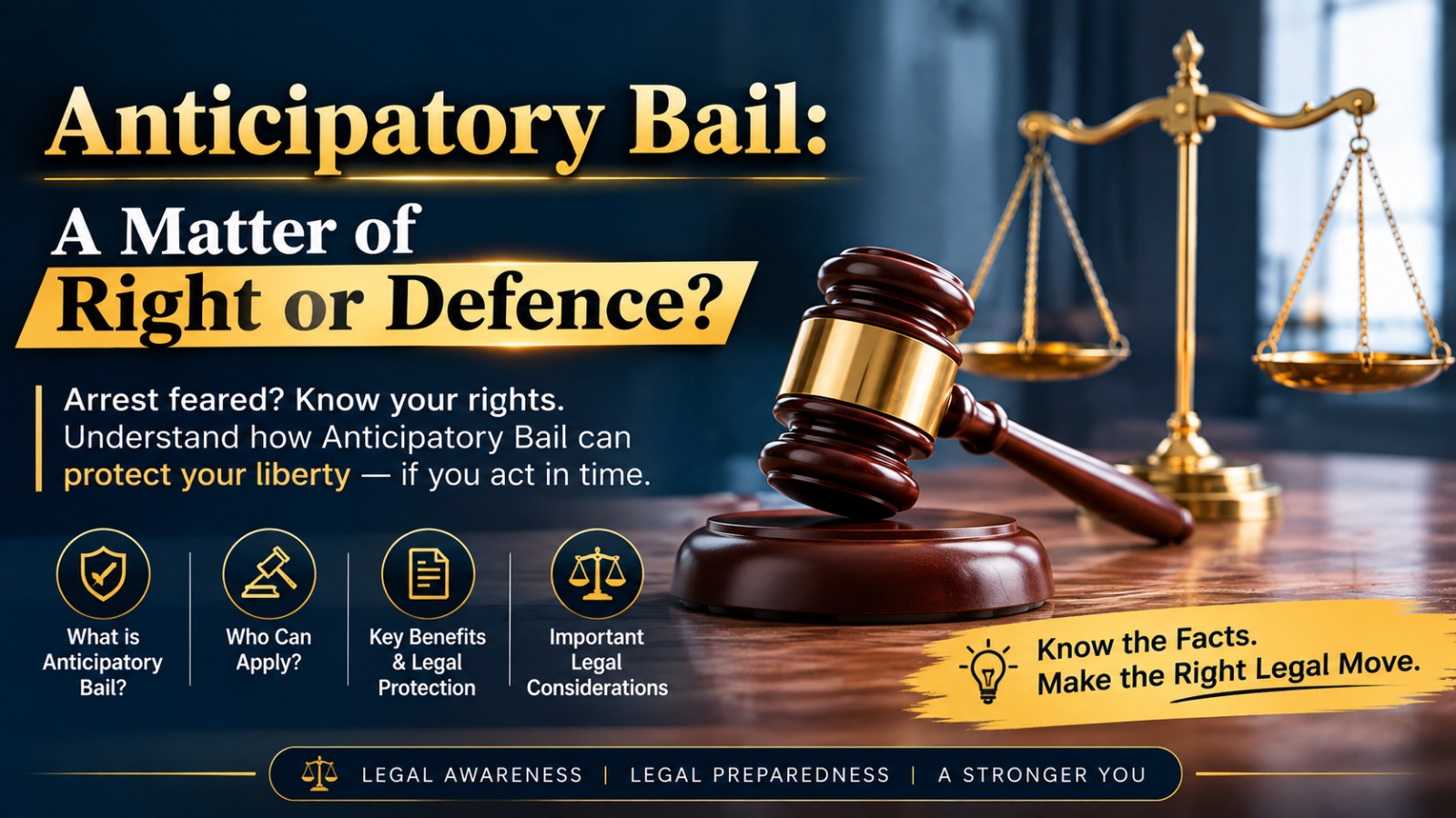
Anticipatory Bail: A matter of Right or Defence?
Anticipatory Bail: A matter of Right or Defence?IntroductionArrest isn’t the end-Know your rights to legal ProtectionAnt...
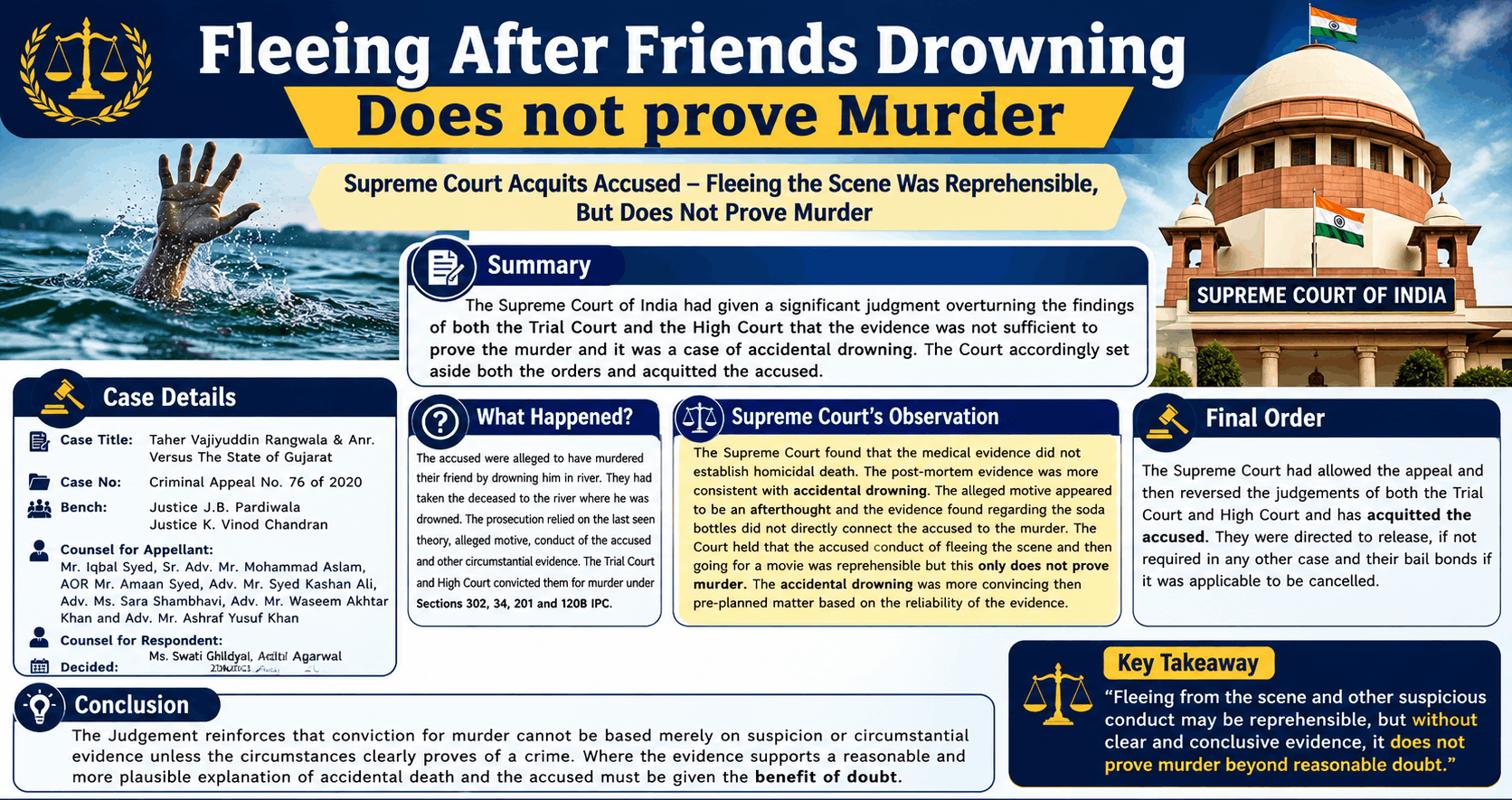
Fleeing After Friends Drowning Does not prove Murder
Fleeing After Friend's Drowning Does not prove MurderCase DetailsCase Title: -Taher Vajiyuddin Rangwala &amp...