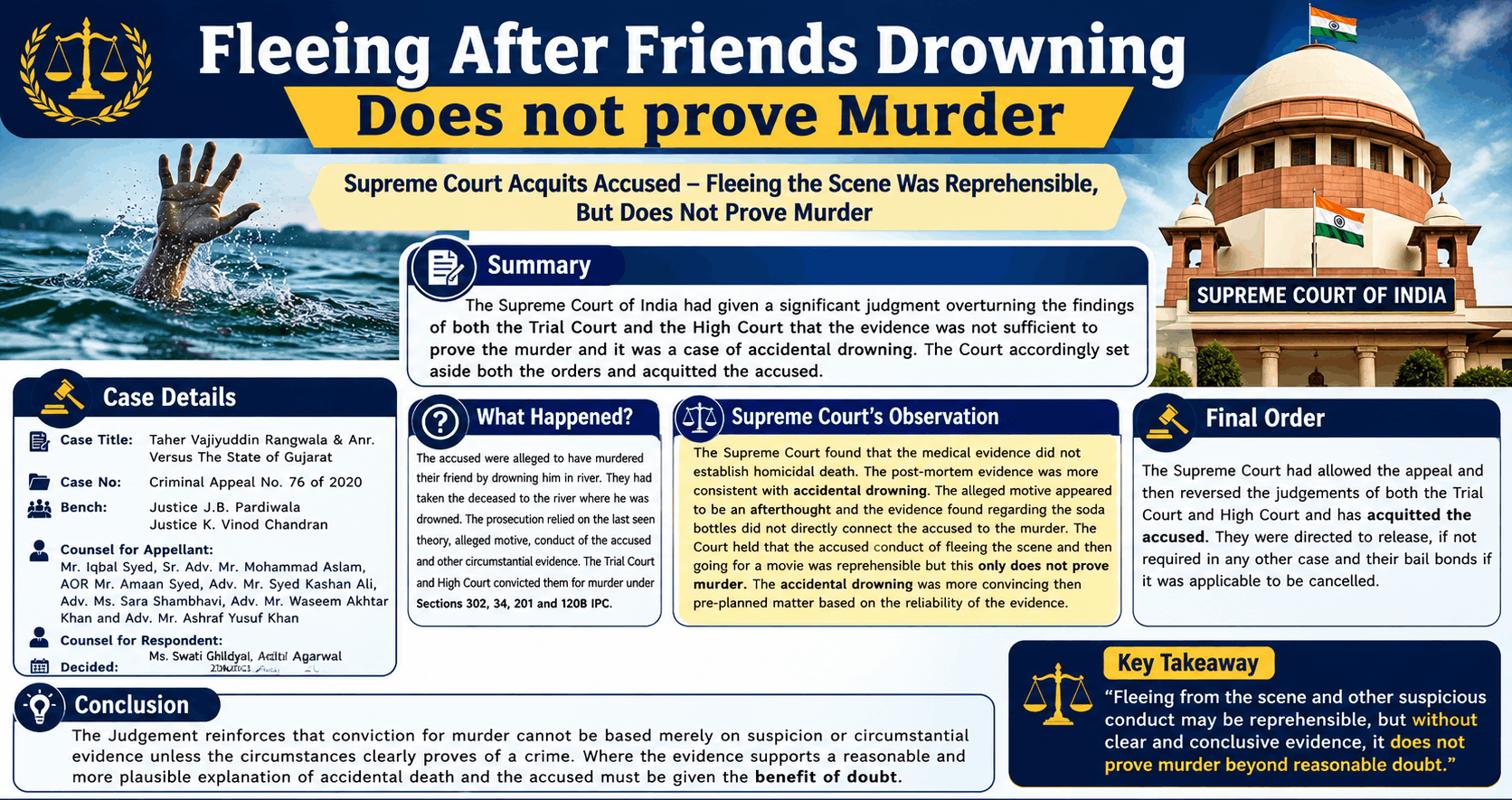
Fleeing After Friends Drowning Does not prove Murder
Case Title: -Taher Vajiyuddin Rangwala & Anr. Versus The State of Gujarat Case No: - Criminal Appeal No. 76 of 2020 Bench: - Justice J.B. Pardiwala Justice K. Vinod Chandran
Fleeing After Friend's Drowning Does not prove Murder
Case Details
Case Title: -Taher Vajiyuddin Rangwala & Anr. Versus The State of
Gujarat
Case No: - Criminal Appeal No. 76 of 2020
Bench: - Justice J.B. Pardiwala
Justice K. Vinod Chandran
Counsel for Appellant: - Mr. Iqbal Syed, Sr. Adv. Mr. Mohammad Aslam,
AOR Mr. Amaan Syed, Adv. Mr. Syed Kashan Ali, Adv. Ms. Sara Shambhavi,
Adv. Mr. Waseem Akhtar Khan and Adv. Mr. Ashraf Yusuf Khan
Counsel for Respondent: - Ms. Swati Ghildiyal, AOR Ms. Aditi Agarwal
Decided: - 13 August 2026
Summary
The Supreme Court of India had given a significant judgment overturning the findings of
both the Trail Court and the High Court that the evidence was not sufficient to prove the
murder and it was a case of accidental drowning. The Court accordingly set aside both the
orders and acquitted the accused.
What happened?
The accused were alleged to have murdered their friend by drowning him in river. They had
taken the deceased to the river where he was drowned. The prosecution relied on the last seen
theory, alleged motive, conduct of the accused and other circumstantial evidence. The Trial
Court and High Court convicted them for murder under Sections 302, 34, 201 and 120B IPC.
Supreme Court’s observation
The Supreme Court found that the medical evidence did not establish homicidal
death. The post-mortem evidence was more consistent with accidental
drowning. The alleged motive appeared to be an afterthought and the evidence
found regarding the soda bottles did not directly connect the accused to the
murder. The Court held that the accused conduct of fleeing the scene and then
going for a movie was reprehensible but this only does not prove murder. The
accidental drowning was more convincing then pre-planned matter based on the
reliability of the evidence.
Final Order
The Supreme Court had allowed the appeal and then reversed the judgements of
of both the Trail Court and High Court and has acquitted the accused. They
were directed to release, if not required in any other case and their bail bonds if
it was applicable to be cancelled.
Conclusion
The Judgement reinforces that conviction for murder cannot be based merely
on suspicion or circumstantial evidence unless the circumstances clearly proves
of a crime. Where the evidence supports a reasonable and more plausible
explanation of accidental death and the accused must be given the benefit of
doubt.



Anticipatory Bail: A matter of Right or Defence?
Anticipatory Bail: A matter of Right or Defence?IntroductionArrest isn’t the end-Know your rights to legal ProtectionAnt...
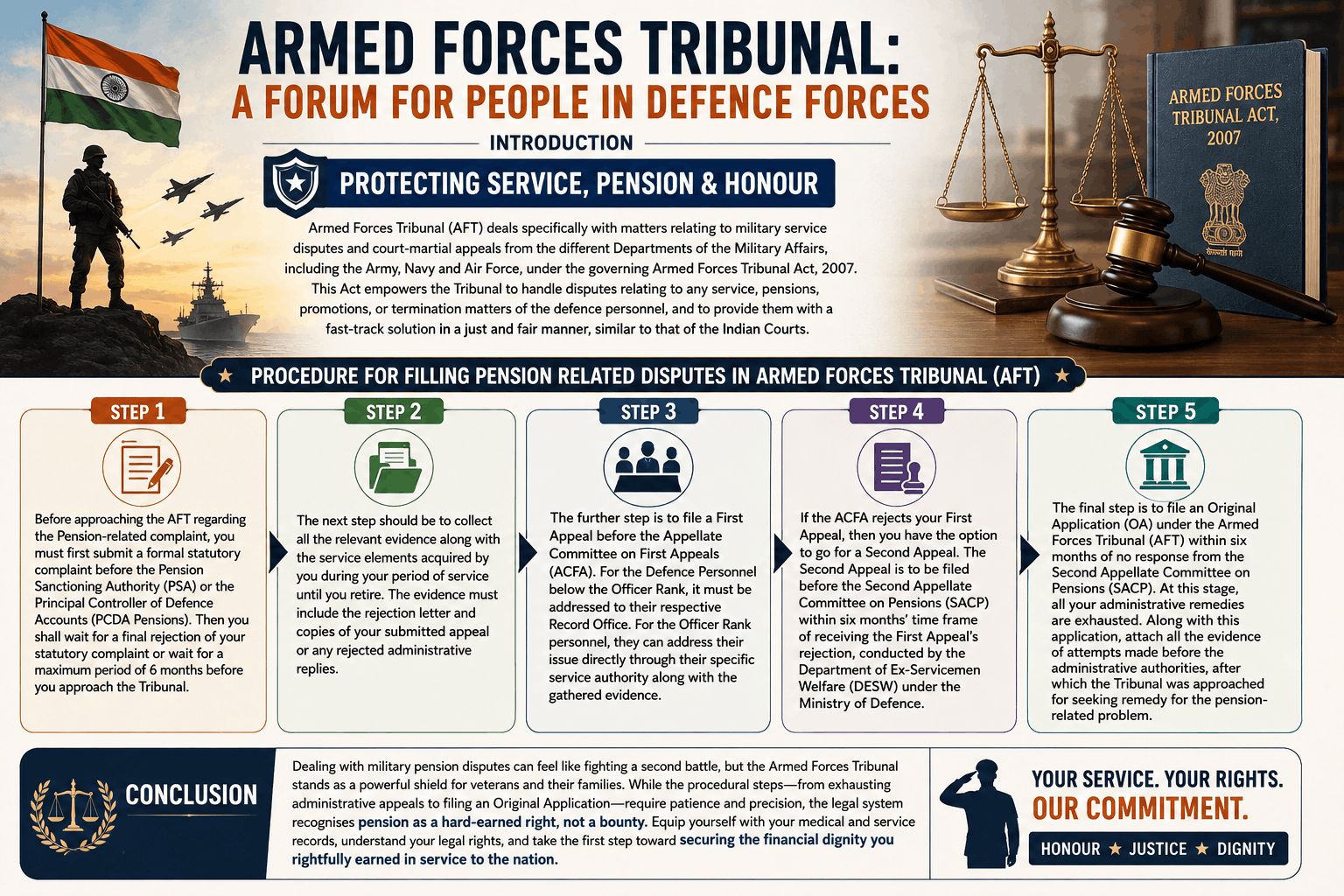
Armed Forces Tribunal (AFT) Legal Support for AFT Issues
Armed Forces Tribunal (AFT)Legal Support for AFT IssuesThe duty of serving a nation gives a feeling of Pride and Honour....
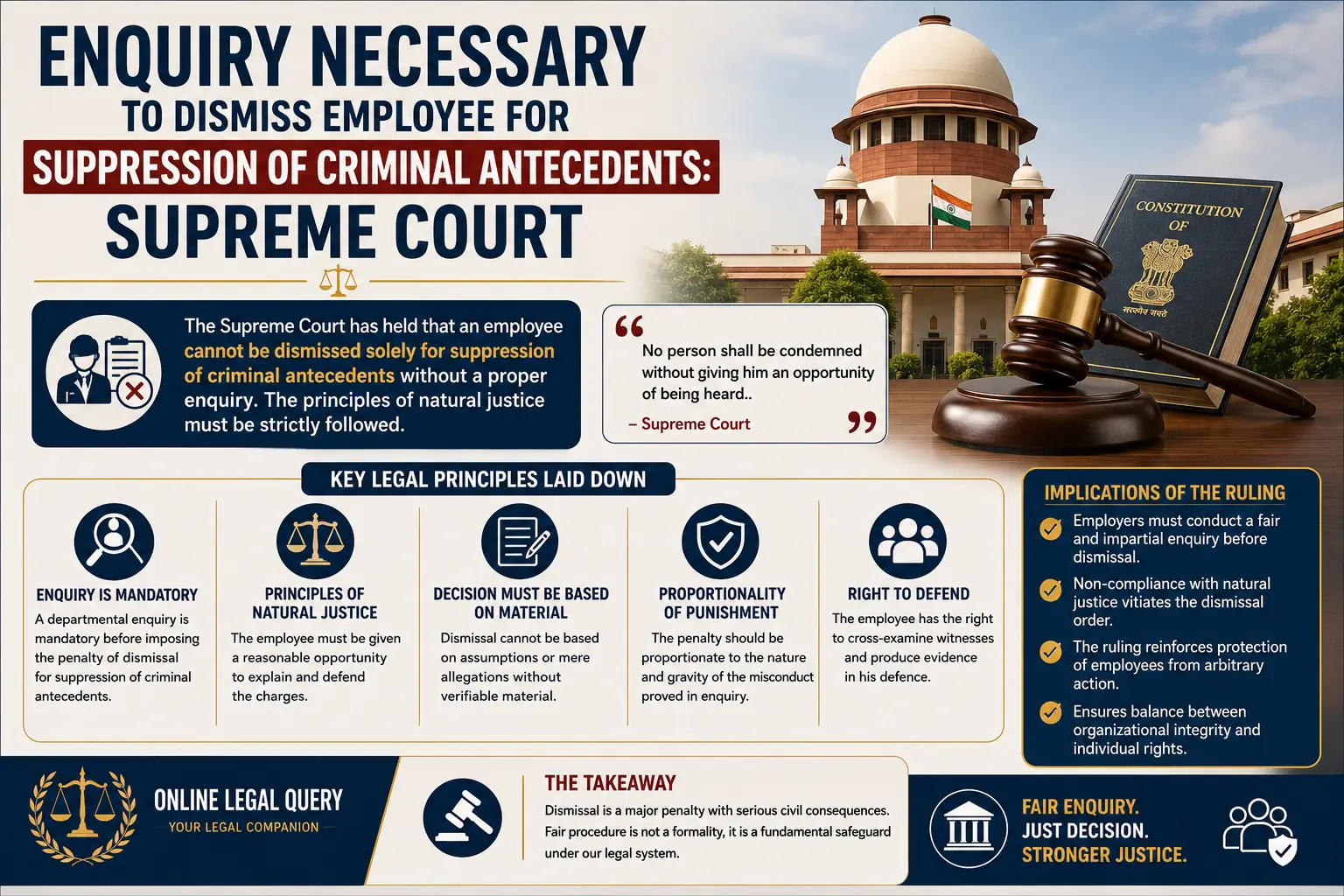
Enquiry Necessary to Dismiss Employee for Suppression of Criminal Antecedents: Supreme Court
Enquiry Necessary to Dismiss Employee for Suppressionof Criminal Antecedents: Supreme CourtCase DetailsCase Title: - Sha...