
Fundamental Rights in India
Fundamental Rights are not just legal rights; they are the shield that protects every citizen’s dignity, freedom, and equality, making democracy meaningful in everyday life
Fundamental rights are the basic human rights guaranteed to all citizens of India and enshrined in the Constitution of India. Fundamental Rights are one of the key elements of the Constitution of India. It ensures that every individual gets freedom, equality, and justice.
Fundamental rights are mentioned in Part III of the Constitution of India, from Articles 21 to 35. Fundamental rights protect the people from any unfair treatment, injustice by the government and help in maintaining democracy in India. It acts as a pillar of democracy, promoting justice, liberty, equality, and fraternity among all citizens of India.
Fundamental rights are not just legal rights, but are important for living with dignity and respect in society.
Understanding Fundamental Rights
Fundamental rights are important for the personal development of an individual and for living freely. It protects and ensures that every individual can enjoy freedom and justice. Fundamental rights also protect the individual from any misuse of power by the state or government, and it makes a perfect balance between the government and the people of India.
Fundamental rights provide a framework that protects individuals from arbitrary actions by the state. When fundamental rights are violated, an individual can directly approach the Supreme Court under Article 32 or the High Courts under Article 226 to seek justice. This framework makes the fundamental rights more powerful and meaningful in nature.
Categories of Fundamental Rights
The Constitution of India recognises six fundamental rights, each of which ensures specific issues related to individual freedoms and societal welfare.
The following are the six broad groups of fundamental rights:
1. Right to Equality ( Articles 14-18)
The right to equality is covered under Articles 14 to 18 of the Constitution of India, which ensures that every individual is treated equally before the law. These fundamental rights help in the prevention of discrimination between individuals.
2. Right to Freedom( Articles 19-22)
The right to freedom is mentioned in Articles 19 to 22 of the Indian Constitution, which protects individual liberties and personal freedom.
3. Right Against Exploitation (Articles 23-24)
The right against exploitation is mentioned under Articles 23 to 24. This right protects individuals from exploitation and inhumane practices.
4. Right to Freedom of Religion (Articles 25-28)
The Right to Freedom of Religion is mentioned in Articles 25 to 28; it plays a vital role in maintaining the secular nature of the state.
5. Cultural and Educational Rights (Articles 29-30)
The cultural and educational rights are mentioned in Articles 29 to 30. These rights protect diversity by protecting the cultural identity of minorities and ensuring access to education.
6. Right to Constitutional Remedies (Article 32)
The right to constitutional remedies is mentioned in Article 32. This right plays as a powerful mechanism for individuals to seek justice.
Rights that are available to everyone
There are some fundamental rights that are available for everyone, both citizens and non-citizens of India. The following are those rights:
· Equality before the law is mentioned in Article 14, which ensures every individual is treated equally.
· Protection of life and personal liberty is mentioned under Article 21 of the Indian Constitution.
· Prohibition of Human Trafficking under Article 23 of the Indian Constitution.
· Protection Against Arbitrary Arrest under Article 22 of the Indian Constitution.
THE ROLE OF THE JUDICIARY IN PROTECTING FUNDAMENTAL RIGHTS
The judiciary plays an important role in protecting fundamental rights. The Supreme Court and High Court have the power to review and expand the scope of these rights through various landmark judgements.
The judiciary has the ability to issue writs under Article 32 and Article 226, this give rights to individual to seek immediate justice against the violations of their fundamental rights.
The court has broadened the meaning of Fundamental Rights through landmark cases, such as Maneka Gandhi v. Union of India and Vishakha v. State of Rajasthan. Also, the Kesavananda Bharati case shows the judiciary’s role in fundamental rights, as this landmark case invokes the doctrine of “ basic structure”, and ensures that legislative amendments do not infringe the core principles of the Constitution.
Challenges and Limitations of Fundamental Rights
The fundamental rights are strong in law, but there are still many challenges faced by the people, such as:
· Enforcement issues, such as many individuals from the marginalised community are unaware of their rights.
· The people from poor and marginalised groups face difficulties in accessing justice because of a lack of knowledge about it.
· State overreach is also one of the most challenging issues in fundamental rights, such as the misuse of power by authorities, which can lead to the violation of rights.
· The challenges, like socioeconomic disparities, lead to inequalities in individuals' right to exercise their rights, mostly in terms of accessing education, healthcare, and legal assistance.
Conclusion
Fundamental rights act as the backbone of Indian democracy. They protect the liberty, equality, and dignity of the people. Fundamental rights prevent the government from misusing and abusing its power over the citizens and ensure that citizens can live freely and safely. The fundamental rights not only protect the citizens of India but also the non-citizens, which is why it is one of the powerful laws of the Constitution of India.
The fundamental rights protect the basic rights of the citizens and ensure equality, freedom and justice, but rights come with responsibilities. Every citizen should respect the rights of others and should focus towards creating a better society. Democracy can only progress when people are aware of their rights and exercise them properly. Understanding the fundamental rights is important as they lay the foundation for justice and freedom in India.
FAQs
OLQ LAW FIRM: Protecting Your Rights. Upholding Justice.
1. What are Fundamental Rights?
Fundamental Rights are basic rights guaranteed by the Constitution of India to protect the freedom and dignity of individuals.
2. Where are Fundamental Rights mentioned?
They are mentioned in Part III of the Constitution of India.
3. How many Fundamental Rights are there in India?
There are six Fundamental Rights under the Constitution.
4. Who can enjoy Fundamental Rights?
Some rights are available only to citizens, while some are available to all persons.
5. Can Fundamental Rights be restricted?
Yes, reasonable restrictions can be imposed by law in certain situations.
6. What is the Right to Equality?
It ensures equal treatment before the law and prohibits discrimination.
7. What is the Right to Freedom?
It gives freedoms like speech, movement, profession, and peaceful assembly.
8. What is the Right against Exploitation?
It protects people from human trafficking, forced labour, and child labour.
9. What is the Right to Constitutional Remedies?
It allows a person to approach the court if their rights are violated.
10. How can OLQ help?
· Legal advice on Fundamental Rights
· Filing writ petitions
· Court representation
· Guidance in rights violation cases
· Constitutional law assistance
Contact OLQ for professional legal consultation and protection of your constitutional rights.



Senior Citizens Tribunal Can Order Eviction of Children from Parents' Property: Supreme Court
Senior Citizens Tribunal Can Order Eviction ofChildren from Parents' Property: Supreme CourtCase DetailsCase Tit...
Anticipatory Bail: A matter of Right or Defence?
Anticipatory Bail: A matter of Right or Defence?IntroductionArrest isn’t the end-Know your rights to legal ProtectionAnt...
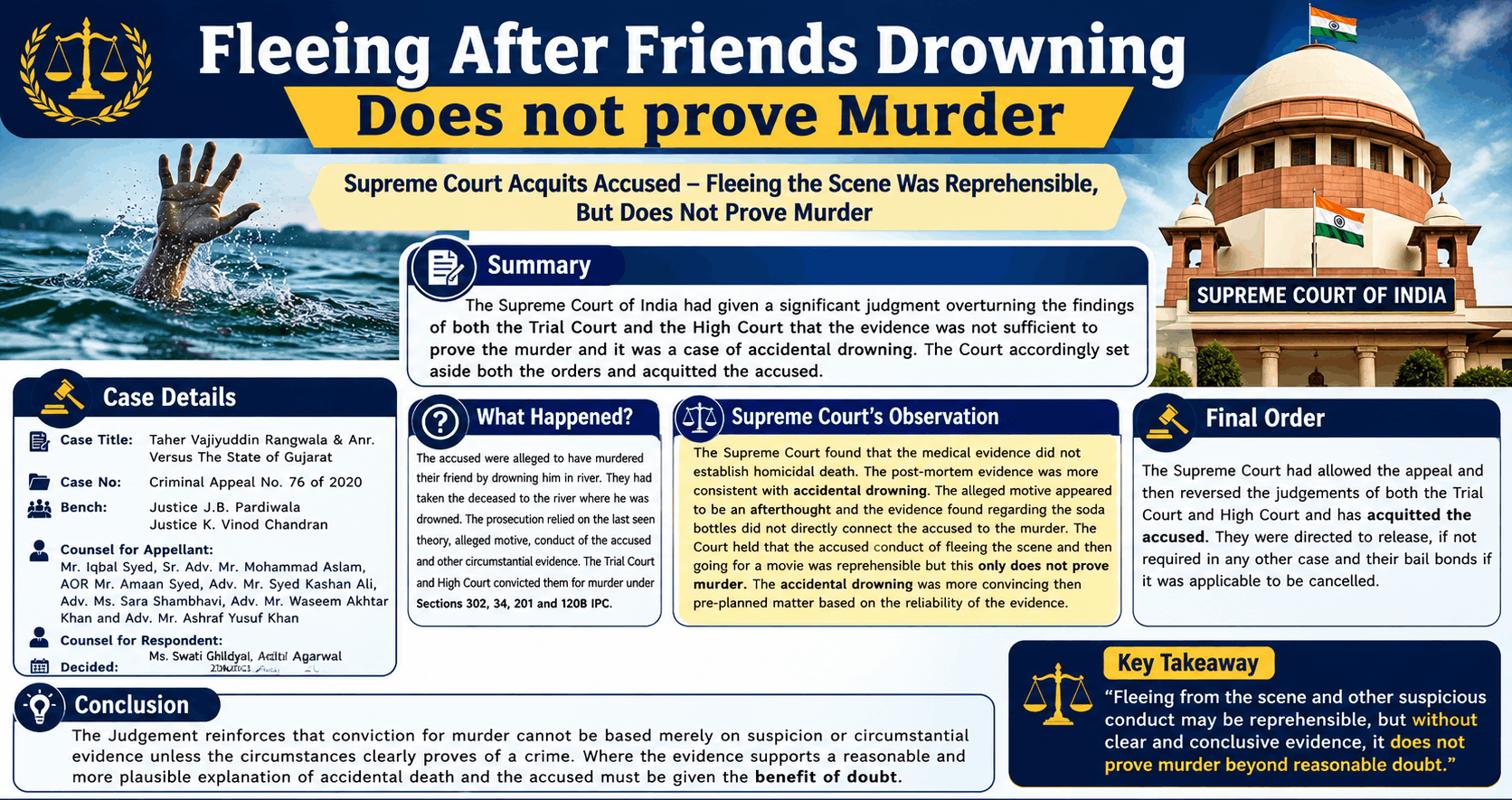
Fleeing After Friends Drowning Does not prove Murder
Fleeing After Friend's Drowning Does not prove MurderCase DetailsCase Title: -Taher Vajiyuddin Rangwala &amp...