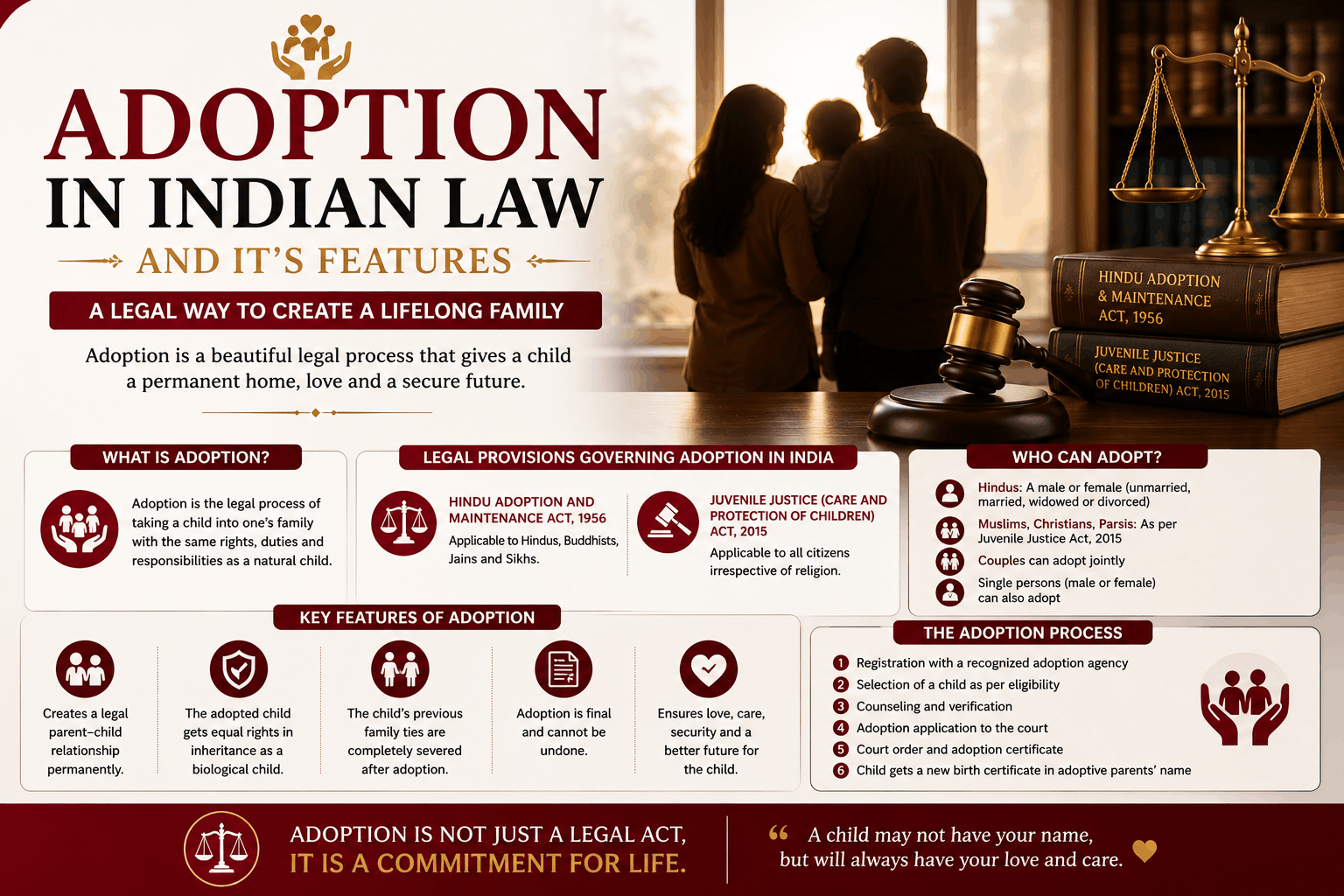
Adoption in Indian Law and it’s features.
Every child deserves a home, and every home deserves hope.
Adoption is a legal process through which a child can be adopted and becomes the lawful child of adoptive parents and acquires all the rights, privileges, and responsibilities of that of a biological child. It is a very important legal and social institution that provides a permanent family to children who are orphaned, abandoned, or in need of care and protection. Adoption not only secures the welfare of the child but also ensures that individuals and couples can create a family relationship that is recognized by law.
LEGAL FRAMEWORK GOVERNING ADOPTION IN INDIA
Adoption in India is governed by the following laws:
1. Hindu Adoption and Maintenance Act, 1956 (HAMA): This applies to Hindus, Buddhists, Jains and Sikhs.
2. Juvenile Justice (Care and Protection of Children) Act, 2015: The Juvenile Justice Act provides a secular adoption mechanism irrespective of religious beliefs. The body responsible for regulating adoptions in India is the Central Adoption Research Authority (CARA)
PROCEDURE OF ADOPTION IN INDIA
The adoption process in India is primarily governed by the Juvenile Justice (Care and Protection of Children) Act, 2015 and the Adoption Regulations framed by CARA. The following steps are required to be follows for a successful adoption:
1. Registration: The PAPs, if interested to adopt an orphan or abandoned or surrendered child, may apply for the same on the Designated Portal by filling up the online application form, as provided in the Schedule VI, and uploading the relevant documents within thirty days thereby registering themselves as prospective adoptive parents.
2. Home Study Report: “Home Study Report” means a report containing details of the prospective adoptive parents, which shall include social and economic status, family background, description of home and atmosphere therein and health status.
3. Referral of Child: All prospective adoptive parents shall be able to indicate whether they want to adopt a specific category of child having special needs and shall be able to reserve a child from the "Hard to Place Child" category
4. Follow-up visit: Provided that first follow-up report of the adopted child shall be done within three months from the date of pre-adoption foster care.
5. Pre-Adoption Foster Care: The child shall be taken in pre-adoption foster care by the prospective adoptive parents within ten days from the date of matching, after signing the preadoption foster care undertaking in the format provided in the Schedule VIII.
6. Adoption Order: The Specialised Adoption Agency shall file an application with the District Magistrate of the district through District Child Protection Unit where the child is located, along with relevant documents as provided in the Schedule IX within ten days from the date of matching of the child with the prospective adoptive parents
7. Birth Certificate: The Specialised Adoption Agency shall apply to the birth certificate issuing Authority for obtaining the birth certificate of the child within five days from the date of issuance of adoption order, with the name of adoptive parents as parents, and date of birth as recorded in the adoption order and the same shall be issued by the issuing Authority within five days from the date of receipt of the application.
ELIGIBILITY FOR ADOPTION
1. Eligibility of Adoptive Parents:
The prospective adoptive parents shall be physically, mentally, emotionally and financially capable, they shall not have any life threatening medical condition and they should not have been convicted in criminal act of any nature or accused in any case of child rights violation.
2. Eligibility of Child:
· Any orphan or abandoned or surrendered child, declared legally free for adoption by the Child Welfare Committee;
· A child of a relative defined under clause (52) of section 2;
· Child or children of spouse from earlier marriage, surrendered by the biological parents for adoption by the step-parent.
RIGHTS OF AN ADOPTIVE CHILD
After adoption, the child:
· Becomes the lawful child of the adoptive parents.
· Acquires inheritance, and succession rights.
· Is entitled to maintenance, education, and protection.
· Enjoys equal status with biological children.
· Has the right to dignity, care, and family.
CHILD WELFARE COMMITTEE
The Child Welfare Committee shall take actions as provided in regulations 6 and 7 and as provided in rule 18 and 19 of the rules. Explanation: Further for removal of doubt, it is hereby clarified that, in cases where a child is willingly surrendered by the biological mother, the child being born out of non-consensual sexual relations or where cases have been registered under the Protection of Children from Sexual Offences Act or Indian Penal Code, the Child Welfare Committee is obliged to issue an order clearing the child legally free for adoption within the stipulated period within which the Dioxyribo Nucleic Acid (DNA) sample collection should be completed to avoid undue harassment to the families who adopt the children in such cases.
CONCLUSION
Adoption in India has evolved from a religious and personal-law concept into a child-centric legal institution. Through the Hindu Adoptions and Maintenance Act, 1956, the Juvenile Justice Act, 2015 (Sections 56–73), CARA regulations. Indian law seeks to ensure that every adopted child receives a safe, permanent, and nurturing family environment while enjoying equal legal status and protection.
FAQs
Let OLQ Law Firm guide your adoption journey with confidence and care.
1. Who can adopt under HAMA?
Any eligible Hindu adult fulfilling the legal conditions.
2. Which law governs Hindu adoption?
The Hindu Adoption and Maintenance Act, 1956.
3. Can a single person adopt under HAMA?
Yes, subject to the Act's conditions.
4. Is the adopted child treated as a natural child?
Yes, with equal legal rights.
5. Is registration of adoption compulsory?
No, but a registered adoption deed is advisable.
6. How can OLQ LAW FIRM help?
· Legal consultation on adoption laws.
· Eligibility assessment under HAMA.
· Drafting and reviewing adoption documents.
· Assistance with court and legal procedures.
· Ensuring compliance with all legal requirements.
· End-to-end legal support for a smooth adoption process.
Connect with OLQ Law Firm and begin your adoption journey with confidence.
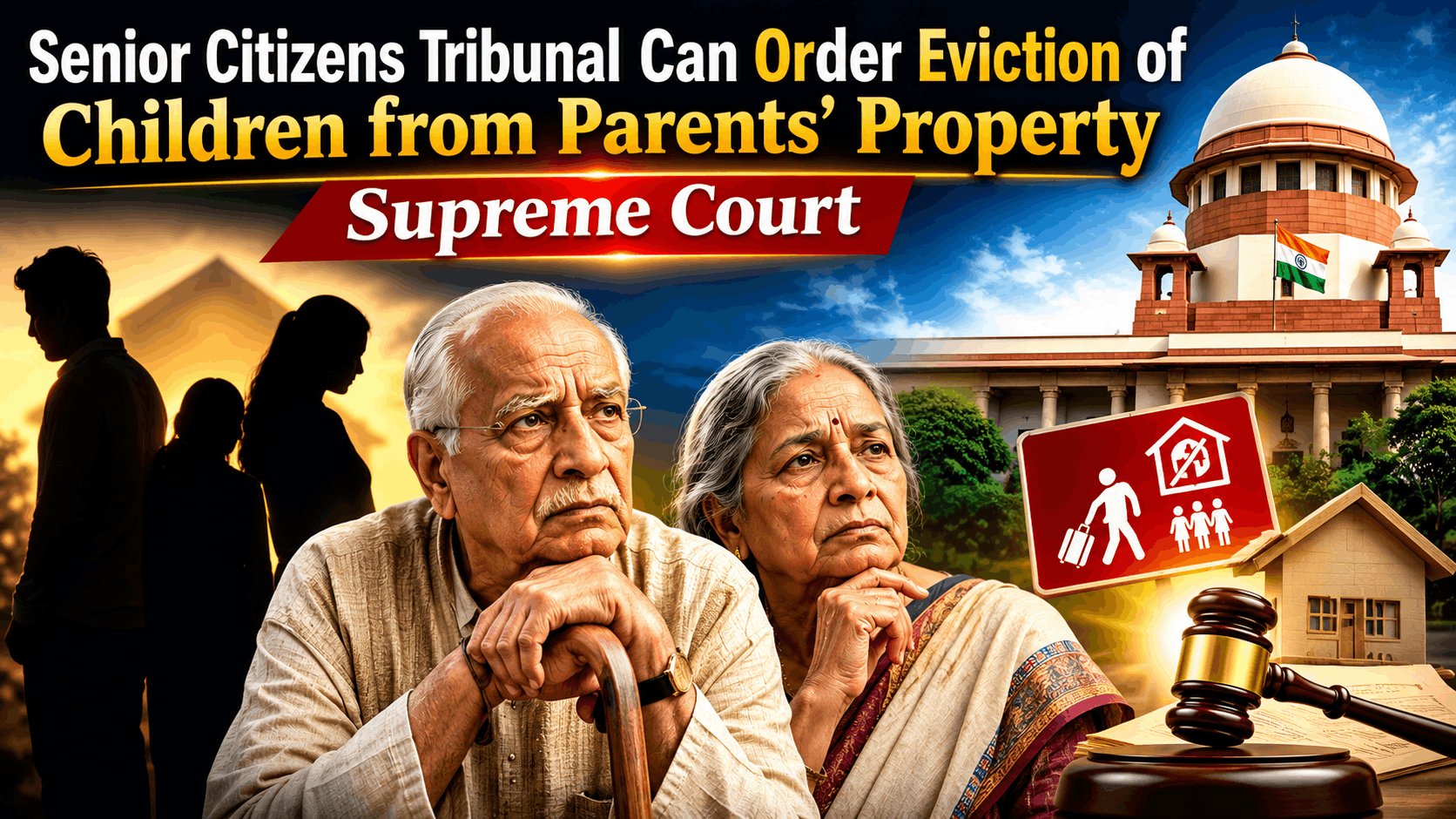

Senior Citizens Tribunal Can Order Eviction of Children from Parents' Property: Supreme Court
Senior Citizens Tribunal Can Order Eviction ofChildren from Parents' Property: Supreme CourtCase DetailsCase Tit...
Anticipatory Bail: A matter of Right or Defence?
Anticipatory Bail: A matter of Right or Defence?IntroductionArrest isn’t the end-Know your rights to legal ProtectionAnt...
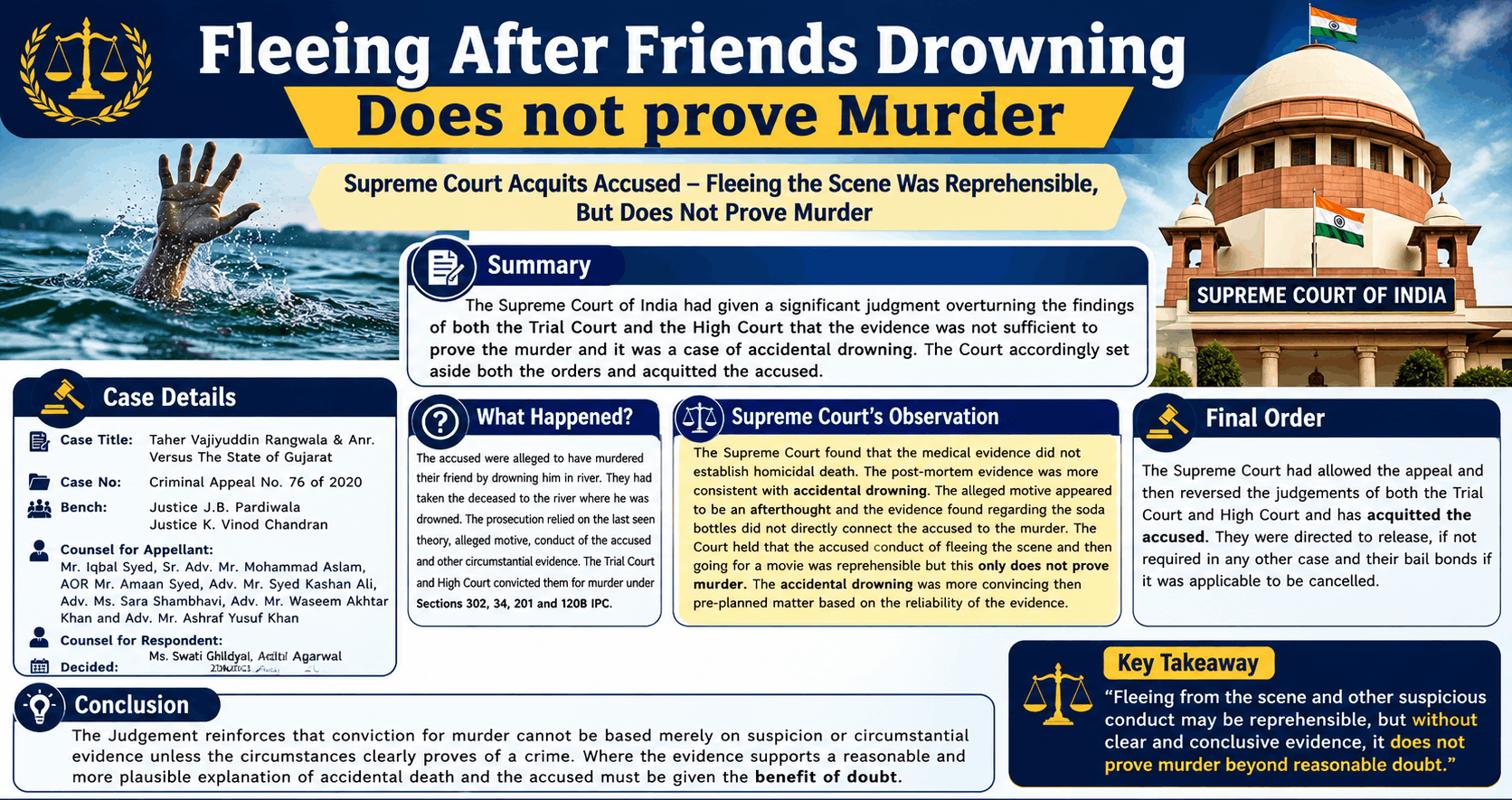
Fleeing After Friends Drowning Does not prove Murder
Fleeing After Friend's Drowning Does not prove MurderCase DetailsCase Title: -Taher Vajiyuddin Rangwala &amp...