Right to Information
Your tax, your right, your truth
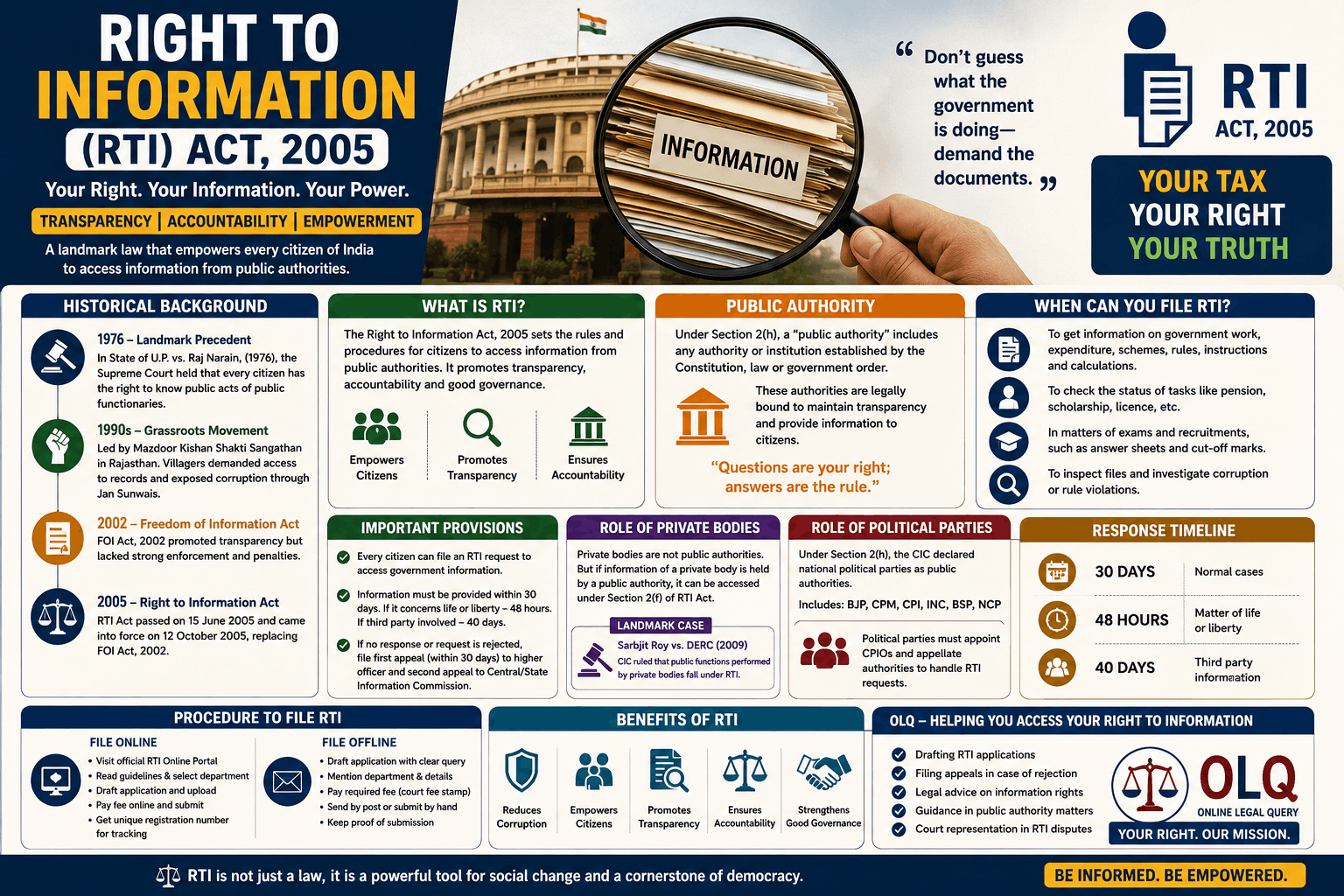
The Right to Information Act, was enacted by the parliament of India in 2005. it sets the rules and procedures regarding citizens’ right to access information from public authorities, “Your tax, your right, your truth”. Replacing the Freedom of Information Act,2002. the RTI is a landmark Indian law that empowers all citizen of India to officially and legally request information from public authorities.
The main goal of this act is to promote transparency and accountability in governance, giving citizens the right to monitor the government and voice their preference before the government.
Right to Information is not the fundamental right under the Constitution of India, no statute can define the RTI is a fundamental right of the citizens, but it protects the Article 19(1)(a) that refers to Freedom of expression and speech, and also the Article 21 Right to life and personal liberty under Indian Constitution.
Historical Background-
The historical background of the RTI Act, acts as a major role in legal system of India.
1976 landmark precedents: In the landmark case of State of Uttar Pradesh vs. Raj Narain, (1976) the first foundation for the RTI was established. Based on Article 19(1)(a) that refers right to freedom of speech and expression, in this case the Supreme Court of India delivered a judgement stating that every citizen of India has a right to know every public act performed by public functionaries in a public manner.
The Grassroots Movement in 1990: This Grassroots movement was happened in 1990s. villagers arise this movement for transparency, shifting the focus from the courts to the villages. In Rajasthan, people began officially demanding access to government records, basically focusing on expenditure for development schemes. This movement is was led by The Mazdoor Kishan Shakti Sangathan. They exposed severe corruption and laid the groundwork for a boarder campaign demanding the legal right to information through the Jan Sunwais.
The freedom of Information Act, 2002: The Freedom of Information 2002, was created to promote transparency, accountability and citizens’ right to access information. citizens could monitor the records and obtain certified copies or hardcopies from government departments and ministries. this act was criticized by civil society for not lacking a strong enforcement mechanism, and penalties for non- compliance.
The Right to Information Act,2005: In parliament of India, the RTI bill was passed by on 15 June 2005 and came into force from 12 October 2005. The act was replaced the Freedom of Information Act,2002. this act promotes transparency, ensures accountability, reduces corruption, empowers citizens, plays an important role in social justice and establishes good governance.
Public Authority-
Under section 2(h) of RTI Act, a “public authority” is defined as any authority or institution of self- government established by the constitution, by any other law made by parliament or a state legislature, or by and order issued by the appropriate government. these authorities are legally promoted to maintain transparency ensure accountability and provide information to citizens “Questions are your right; answers are the rule”.
When can you file RTI-
· To get any information about government work, like expenditure details of budget or any government scheme, to get copies of rules, instructions and calculations of government offices.
· For check the status of individual tasks, such as pension, scholarship and licence etc. in matters of government examination or recruitments, these include answer sheets in government job examinations or to know the cut- off marks.
· To View the file records, to investigate corruption or violation rules by any government departments.
Important provisions of RTI-
· Every citizen of India can file an RTI request to access government records, and public information officers must provide the requested information to the citizen.
· Officers must deliver the information within 30 days. if the requested information concerns a matter of liberty or life, it must be delivered within 48 hours. if the information involves third party, the time period for providing it is 40 days, “Don't guess what the government is doing—demand the documents”.
· citizen have the right to appeal, if no response is received or the request is rejected, the person can file a first appeal to a higher official within 30 days, and the second appeal to the central or state information commission.
Role of the Private bodies-
The private bodies do not fall directly within the definition of public authorities. but under section 2(f) of the RTI Act, that refers to if the information of the private body is officially or legally accessible to a public authority then citizens can request information about a private body.
Landmark Legal Precedent: The central information commissions ruled for decision in Sarbjit Roy vs. Delhi Electricity Regulatory commission,2009, this case the CIC ruled in favor of Sarbjit Roy. the case involved a person seeking specific information regarding the financial capacity of Delhi’s Private Power distribution companies. this decision established that public unities performing public functions fall under the RTI Act.
Role of Political Parties-
Political parties are also known as public authorities and have responsibility to provide answer to citizens under the RTI Act.
Under section 2(h) of RTI, the Central Information commission declared that Indias national political parties are public authorities. the six national parties included are the BJP, CPM, CPI, INC, BSP and NCP.
These political parties were required to appoint chief public information officers and establish appellate authorities to handle citizens’ requests.
Procedure of file-
Any citizen of India can file a request to access government information through the RTI act. online application basically accesses information for state and central governments. The filing procedure is divided into two categories. such as, file in online and file in offline.
File in online:
In modern era, any citizen can file an RTI through a digital or online process via the official portal. The filing process is as follows:
first of all, open the official RTI online portal. then, read the guidelines for submitting a request based on your subject matter. select the specific government department and ministry for your query. draft the application using the portal by clearly starting your query, pay the fees directly on the portal, and submit the application. after submission, a unique registration number will be provided for tracking.
File in Offline:
Offline filing is basically used for state and local departments. To file offline RTI, draft an application clearly stating your query and relevant department, along with all necessary details. pay the required fee in court and must be stamp on your drafted application and submit the application via post.
Response timeline: officers must deliver the information within 30 days. if the requested information concerns a matter of liberty or life, it must be delivered within 48 hours. if the information involves a third party, the time period for provided the information is within 40 days.
Conclusion-
The RTI bill was passed on 15 June 2005 and came into force on 12 October 2005, replacing the Freedom of Information Act,2002. it is a pillar of good governs. its main goals are empowering citizens, reducing corruption, and promote transparency and accountability in governance while helping to promote social justice.
FAQs
OLQ – Helping You Access Your Right to Information
1. What is RTI?
RTI means the right of citizens to seek information from public authorities.
2. Which law governs RTI in India?
The Right to Information Act, 2005 governs RTI in India.
3. Who can file an RTI application?
Any Indian citizen can file an RTI application.
4. What kind of information can be asked under RTI?
Information related to government departments, public records, decisions, and policies can be requested.
5. Where can an RTI application be filed?
It can be filed before the Public Information Officer (PIO) of the concerned department.
6. Is there any time limit for reply?
Yes, usually the authority must reply within 30 days.
7. What if information is denied?
The applicant can file an appeal before the higher authority.
8. Can private companies be questioned under RTI?
Generally no, unless they are substantially controlled or funded by the government.
9. Is there any fee for filing RTI?
Yes, a small application fee is usually required.
How can OLQ help?
* Drafting RTI applications
* Filing appeals in case of rejection
* Legal advice on information rights
* Guidance in public authority matters
* Court representation in RTI disputes
Contact OLQ for professional legal consultation on RTI matters and protection of your information.



Senior Citizens Tribunal Can Order Eviction of Children from Parents' Property: Supreme Court
Senior Citizens Tribunal Can Order Eviction ofChildren from Parents' Property: Supreme CourtCase DetailsCase Tit...
Anticipatory Bail: A matter of Right or Defence?
Anticipatory Bail: A matter of Right or Defence?IntroductionArrest isn’t the end-Know your rights to legal ProtectionAnt...
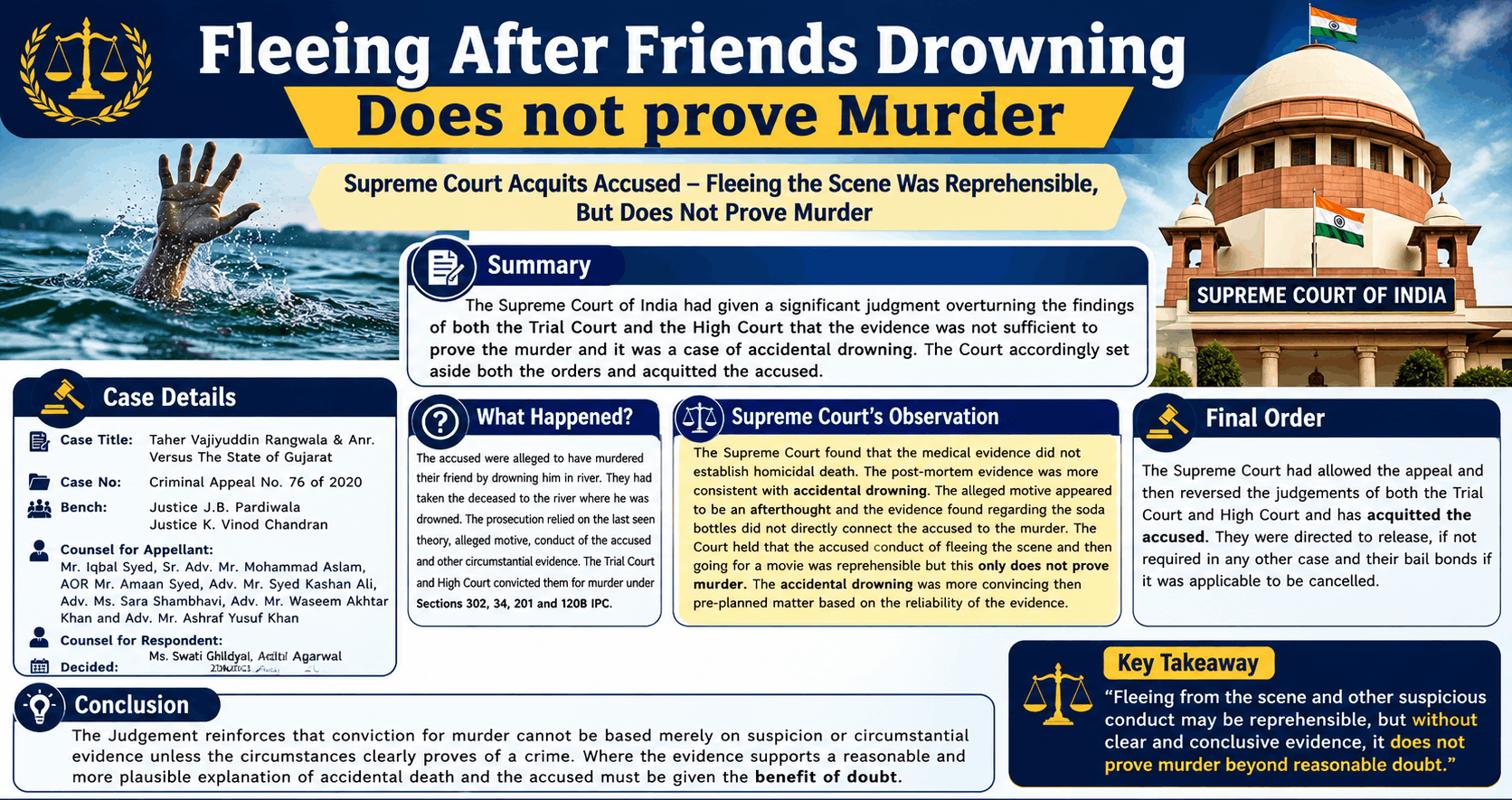
Fleeing After Friends Drowning Does not prove Murder
Fleeing After Friend's Drowning Does not prove MurderCase DetailsCase Title: -Taher Vajiyuddin Rangwala &amp...