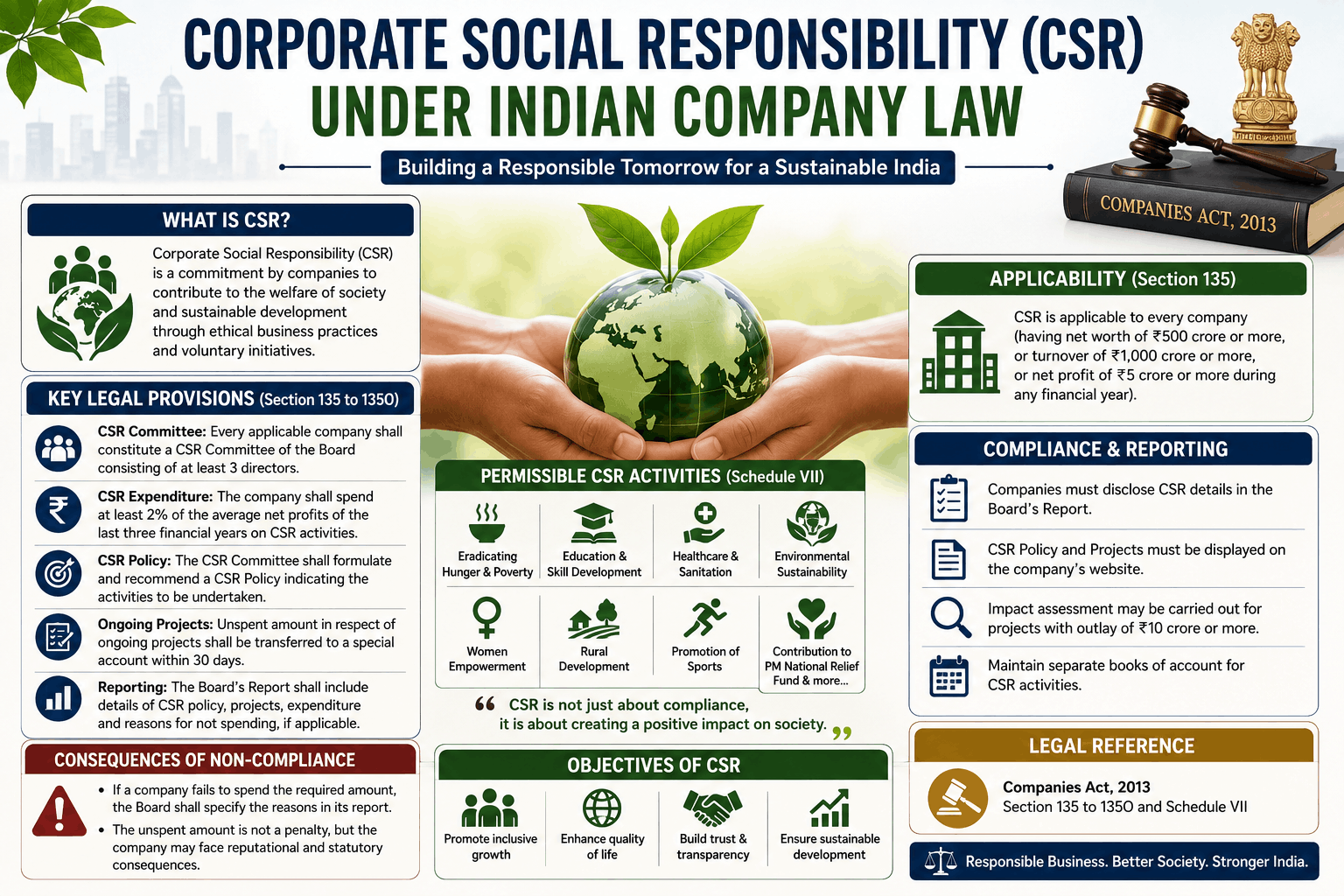
Corporate Social Responsibility (CSR) under Indian company law
CSR can be very hard for employees to relate to if we don’t make it tangible to their everyday working life.
Corporate social responsibility (CSR) is an essential element of modern corporate governance. It highlights the responsibility of the companies towards society and the environment beyond their core purposes of earning profits/benefits. India became the first country in the world to introduce a mandatory CSR regime through the enactment of the companies Act, 2013. The objective behind CSR is to certify that companies contribute to social welfare and sustainable development while conducting business operations. CSR can be very hard for employees to relate to if we don’t make it tangible to their everyday working life.
CSR no longer is seen as a voluntary charitable activity: rather, it is a statutory responsibility enforced on eligible companies. Through CSR initiatives, companies contribute towards education, healthcare, environmental sustainability, poverty alleviation, gender equality, rural development, and various other social causes.
Meaning of Corporate Social Responsibility
Corporate social responsibility relates to a company’s commitment to operate ethically and contribute to economic growth while improving the quality of life of employees, local communities, and society at large. The concept is relevant to the principles in which corporations derive benefits from society and thus have a responsibility to give back to society.
CSR activities may include:
· Promotion of education
· Healthcare and sanitation projects
· Environmental conservations
· Rural development initiatives
· Women empowerment programs
· Disaster relief and rehabilitation
· Protection of national heritage and culture
· Contributions to government relief funds
Legal Framework Governing CSR in India
The primary legislation governing CSR in India is:
Companies Act, 2013
The statutory basis of CSR is contained in section 135 of the companies Act, 2013, with schedule VII of the act.
Applicability
CSR provisions Under section 135(1) of the companies Act, 2013, every company having at least one of the following during the preceding financial year must adhere with CSR requirements:
1. Net worth: Rs.500 crore or more.
2. Turnover: Rs.1,000 crore or more.
3. Net profit: Rs.5 crore or more.
Once a company falls within the CSR framework, it must continue to comply until it ceases to meet the prescribed criteria for a specified period under the applicable rules.
CSR committee
Constitution of CSR committee, a qualifying company must create a board and should consist of at least 3 or more directors, including at least 1 independent director.
However, certain classes of companies are exempted from the requirements of appointing an independent director.
Functions of CSR committee
· The CSR committee is responsible for:
· Formulating CSR policy
· Recommending CSR expenditure
· Monitoring implementations of CSR projects
· Reviewing CSR performance
· Recommending changes to CSR initiatives when necessary
· The board of directors retains the ultimate responsibility for ensuring compliance.
· CSR spending requirements
· Mandatory expenditure
Section 135 (5) requires eligible companies to spend at least 2% of the average net profits made during the three preceding financial years on CSR activities.
Schedule VII Activities
Schedule VII for specific activities that qualify as CSR activities.
Major areas include:
Promotion of education: Companies may establish schools, provide scholarships, and support educational institutions.
Eradication of hunger and poverty: Programs aimed at nutrition, food security, and poverty reduction qualify under CSR.
Healthcare and sanitation: Activities promoting healthcare facilities, medical aid, and sanitation projects are recognized for CSR activities.
Environmental sustainability: Projects relating to ecological balance, biodiversity protection, renewable energy, and conservation of natural resources are covered.
Gender equality and women empowerment: Initiatives promoting equal opportunities and empowerment of women are eligible CSR activities.
Rural development projects: Infrastructure and development projects in rural areas fall within CSR obligations.
Disaster management: Relief, rehabilitation, and reconstruction efforts during disasters are included within schedule VII.
CSR Policy
CSR policy explains the activities to be undertaken by the company as named in the schedule VII of the Act. The activities must not be the same as the company working during the normal course of the business. Every eligible company must formulate a CSR policy that includes:
· The contents of the CSR policy must be put on the website of the company by the board.
· The company's activities mentioned in the policy must be undertaken.
· The companies can join hands, with the other companies for undertaking projects or programs or CSR activities and can report it separately on such programs or projects.
· The CSR policy must do Monitoring mechanisms on the projects or the programs.
Reporting Procedures
The board must approve the policy and place it on the company’s social responsibility initiatives.
· The boards that report referring to any financial year initiating on or after the 1st day of April 2014 must include a report on CSR.
· In any case of a foreign company, the balanced sheet filed must contain an annexure regarding a report on CSR.
Penalties and Fines for Non-Compliance
· In case a company fails to maintain with the provision of policy of the CSR spending, transferring and utilizing the unspent amount, the company will be punishable with Rs.1 crore or twice the amount as a penalty it must be transferred by the company to the CSR fund, specified in the schedule VII of the Act or the Unspent Corporate Social Responsibility Account.
· Further, the company officer dealing with the matter who defaults in compliance will be liable to pay Rs.2 Lakh or one-tenth of the amount required to be transferred to the CSR fund specified in the schedule VII of the Act or the Unspent Corporate Social Responsibility account.
Advantages of CSR
CSR brings out many advantages and benefits to the business, and it helps in branding, engaging employees, investors attracting, and being beneficial to the community. This way the business and the company seem to be responsible and organized that cares more than it show.
· Improved Brand Image: CSR engagement with the companies seems to be more likeable by the consumer, improving brand trust and loyalty.
· Employee engagement: CSR activities help in the employee's engagement with the company showcasing the talents and the company benefits with the activities and help the employees feel proud and confident.
· Compliance with Legal: CSR follows the regulations that help with compliance and enables the company to establish its reputation and ethical responsibility.
· Community Impact: The community directly gets benefits in terms of education, poverty, health, and environment through CSR activities.
Conclusion
The concept of Corporate Social Responsibility (CSR) was introduced through the Company Act, 2013 that puts a greater responsibility in the companies in India to set out a clear CSR framework. The Act introduced the culture of Corporate Social Responsibility (CSR), in Indian corporate it is regulated to formulate the CSR policy and engage in social upliftment. CSR is all about giving back to the Society.
CORPORATE SOCIAL RESPONSIBILITY (CSR)-
FREQUENTLY ASKED QUESTIONS (FAQ)
1. What is CSR?
Corporate Social Responsibility (CSR) is a legal obligation imposed on certain companies to contribute towards social, environmental, and economic development activities for the benefits of society.
2. Which law governs CSR in India?
CSR is governed by section 135 of the Companies Act, 2013 read with the Companies (Corporate Social Responsibility Policy) Rules, 2014.
3. Which companies are required to comply with CSR provisions?
A company must comply with CSR provisions if during the immediately preceding financial year it has:
Net worth of Rs. 500 Crore or more; or
Turnover of Rs. 1,000 Crore or more; or
Net Profit of Rs. 5 Crore or more.
4. How much CSR expenditure is mandatory?
Eligible companies are required to spend at least 2% of their average net profits of the three immediately preceding financial years on CSR activities.
5. What is a CSR Committee?
The CSR Committee is a committee of the Board responsible for formulating and monitoring the CSR Policy and recommending CSR expenditure.
6. Is a CSR Policy mandatory?
Yes. Every company covered under CSR provisions must formulate and adopt a CSR Policy detailing its CSR initiatives and implementation framework.
7. What activities qualify as CSR?
· CSR activities generally include:
· Education and skill development
· Healthcare and sanitation
· Environmental sustainability
· Women empowerment
· Rural development projects
· Disaster relief
· Promotion of sports
· Protection of national heritage
· Contributions to specified government funds
8.can CSR funds be used for employee welfare?
No. Activities benefiting only employees and their families do not qualify as CSR activities.
9.can a company undertake CSR projects through NGOs?
Yes. Companies may implement CSR projects through eligible registrations of trusts, societies, Section 8 Companies, or other approved implementing agencies.
10.can CSR expenditure be carried forward?
Unspent CSR amounts must be dealt with in accordance with companies Act and transferred to the prescribed account or fund within the specified timelines.
11. Is CSR spending tax deductible?
The tax treatment depends on the nature of the expenditure and applicable tax laws. Professional tax advice should be obtained in specific cases.
12. Is CSR applicable to foreign companies?
Yes. Foreign companies having branches or people offices in India may also be required to comply if they meet the prescribed thresholds.
13. What are the consequences of non-compliance?
Failure to comply with CSR provisions may attract penalties under the Companies Act, 2013 and may require disclosure of non-compliance in statutory filings.
14. Is CSR reporting mandatory?
Yes. Eligible companies must disclose CSR activities, expenditure, and compliance details in their Board’s Report and statutory filings.
15.can companies collaborate for CSR projects?
Yes. Two or more companies may jointly undertake CSR project provided they are able to separately report their CSR contributions.
16.how can OLQ LAW FIRM assist in CSR Compliance?
OLQ LAW FIRM can assist in:
· CSR Compliance Advisory
· CSR Policy Drafting
· CSR Committee Guidance
· Due Diligence of NGOs and Implementing Agencies
· CSR Documentation and Reporting
· Legal Compliance Review
· CSR Agreements and MOUs
· Corporate Governance Advisory
Call/WhatsApp: 8981949111
Corporate Compliance| CSR Advisory| POSH Compliance| Legal Consultancy





Senior Citizens Tribunal Can Order Eviction of Children from Parents' Property: Supreme Court
Senior Citizens Tribunal Can Order Eviction ofChildren from Parents' Property: Supreme CourtCase DetailsCase Tit...
Anticipatory Bail: A matter of Right or Defence?
Anticipatory Bail: A matter of Right or Defence?IntroductionArrest isn’t the end-Know your rights to legal ProtectionAnt...
Fleeing After Friends Drowning Does not prove Murder
Fleeing After Friend's Drowning Does not prove MurderCase DetailsCase Title: -Taher Vajiyuddin Rangwala &amp...