
Apartment Ownership Rights in India
The right to property is not only a right to possess; it is also a right to use and enjoy.
An apartment ownership law is a legal framework made for property holders, individual ownership. Owners of individual apartments units within a multi-storied building. This legislation aims to protect the rights of apartment owners, look after proper management, and maintain shared space. “The right to property is not only a right to possess; it is also a right to use and enjoy.”
West Bengal Apartment Ownership Act, 1972.
v The Act defines key terms such as ‘apartment, common areas, association of apartment owners, declaration and shared property’. This helps in a better understanding of all the stakeholders involved.
v Each apartment owner shall be entitled to an undivided interest in the common areas and facilities in the percentage expressed in the declaration.
v The act requires a declaration to be filled by the property owner. Highlighting the details of the building, the individual apartment, and the common areas. Each owner receives a deed. Which includes ownership rights and responsibilities.
v The owners of the apartment get legal clarity and security for apartment ownership. The acts help prevent disputes and ensure that owners can enjoy their property without legal ambiguities.
· The owner has the right to control the trespassing by exercising the right to exclusion which gives him/her control over who gets to enter the premises and who doesn’t.
· The apartment owner can use the premises as he/she pleases, without inconveniencing the rights of the neighbors.
· The property owner has the right to rent out the premises to a tenant for business purposes or residential purposes as long as he/she as the legal documents of rental agreement in order. The owner is entitled to earn income from the property.
· The property owner has the right to sell his/her property as and when desired. The only thing that must be cleared before selling out the property is if he/she has any house loan obtained to be cleared before any sale agreement is proceeding.
· The apartment owner has all the legal rights to expel or evict any tenant in case the tenant or his/her family creates any trouble or breaking any rules or law set by the society board or creates any trouble for the landlords.
· Apartment owners have the right to be members of the Apartment Owners Association (AOA) or Resident Welfare Association (RWA), attend general meetings, vote on resolutions, and seek election to the managing committee. This governance right enables owners to participate in decisions about common maintenance, by-laws, and expenditure.
· Under RERA, allottees are entitled to receive all documents and information pertaining to the projects, including sanctioned plans, completion certificates, and occupancy certificates. The developer must provide copies of the documents upon request. Post-possession, the AOA is entitled to receive all project documents from the developer for maintenance purposes.
Restrictions on Apartment Owners
· An apartment owner cannot make structural alterations that affect the building’s integrity, shared systems (plumbing, electrical), or the rights of other owners. Such restrictions are typically codified in the building’s by-laws and reinforced by municipal regulations. Unauthorized structural changes may lead to demolition of orders by municipal authorities under applicable town planning laws.
· Every owner is obligated to pay their proportionate share of maintenance charges, sinking fund contributions, and other levies determined by the AOA. Failure to pay maintenance may result in suspension of services (e.g., parking rights, access to common amenities) and civil recovery proceedings by the association.
· Owners cannot use their apartment in a manner that constitutes a nuisance to other residents. By-laws may prohibit commercial use of residential apartments, keeping certain pets, and certain activities that disturb peace and quiet. Many metropolitan housing societies have byelaws restricting short-term rentals (e.g., Airbnb-type letting).
· In government-allotted leasehold properties, owners typically cannot sub-let, mortgage, or alter the property without the written consent of the lessor (e.g., DDA, CIDCO, etc.) Unauthorized transfer may result in cancellation of the allotment and forfeiture of the property.
1. The Maharashtra Apartment Ownership Act, 1970.
Enacted to provide a specific legal framework for condominiums, this act provides flat buyers as an alternative to forming a standard Cooperative Housing Society.
2. The Tamil Nadu Apartment Ownership Act,2022.
This modern legislation completely replaced the 1994 act, which was outdated. It was drafted to align modern real estate with the central Real Estate Act, 2016.
3. The West Bengal Apartment Ownership Act, 1972.
This act passed to combat chaotic urban development and unclear titles and expanding cities like Kolkata. This act created a safe legal pathway for individual apartment owners.
Impact of RERA on Apartment Owners
The Real Estate (Regulation and Development) Act, 2016 brought about a paradigm shift in protecting the rights of apartment purchasers. The key impacts include:
· Transparency and Disclosure
· Escrow Mechanism
· Penalty for delayed possession
· Structural defect liability
· Regulation of real Estate agents
Inheritance and Succession of Apartments
On the death of an apartment owner, the apartment is heritable property and devolves according to the applicable personal law of the deceased:
· Hindu owners: Hindu Succession Act, 1956 (as amended in 2005).
· Muslim owners: Muslim Personal Law (Shariat) Application Act, 1937.
· Christian and Parsi owners: Indian Succession Act, 1925.
Conclusion
The apartment owners have all the legal rights to enjoy his/her ownership if he/she is within the guidelines of the governed act and has all legal required documents accordingly. Apartment ownership in India is a layered legal concept that has progressively developed through a combination of state legislation, central regulatory frameworks like RERA, judicial pronouncements, and evolving social practices. The apartment owner’s rights and spanning exclusive possession, transfer, governance participation, and collective enjoyment of common areas are balanced against any obligations of maintenance, structural compliance, and adherence to association rules.
FREQUENTLY ASKED QUESTIONS (FAQ)
1.What is apartment ownership?
It is the legal right to own, use, and transfer to an apartment.
2. Can an apartment be sold or gifted?
Yes, the owner can sell, gift, or transfer it as per law.
3. Is registration of an apartment necessary?
Yes, registration is essential for legal ownership.
4. Are apartment owners required to pay maintenance charges?
Yes, maintenance charges are generally mandatory.
5. Can ownership rights be inherited?
Yes, apartment ownership can pass to legal heirs according to applicable succession laws.
6. How can OLQ LAW FIRM assist?
OLQ LAW FIRM can assist:
· Property title verification
· Sale and transfer documentation
· Registration assistance
· Legal dispute resolution
· End-to-end property legal support
Call/WhatsApp: 8981949111
Legal Consultancy | Drafting Notices | Legal Representation | Ownership Rights Compliance|



Senior Citizens Tribunal Can Order Eviction of Children from Parents' Property: Supreme Court
Senior Citizens Tribunal Can Order Eviction ofChildren from Parents' Property: Supreme CourtCase DetailsCase Tit...
Anticipatory Bail: A matter of Right or Defence?
Anticipatory Bail: A matter of Right or Defence?IntroductionArrest isn’t the end-Know your rights to legal ProtectionAnt...
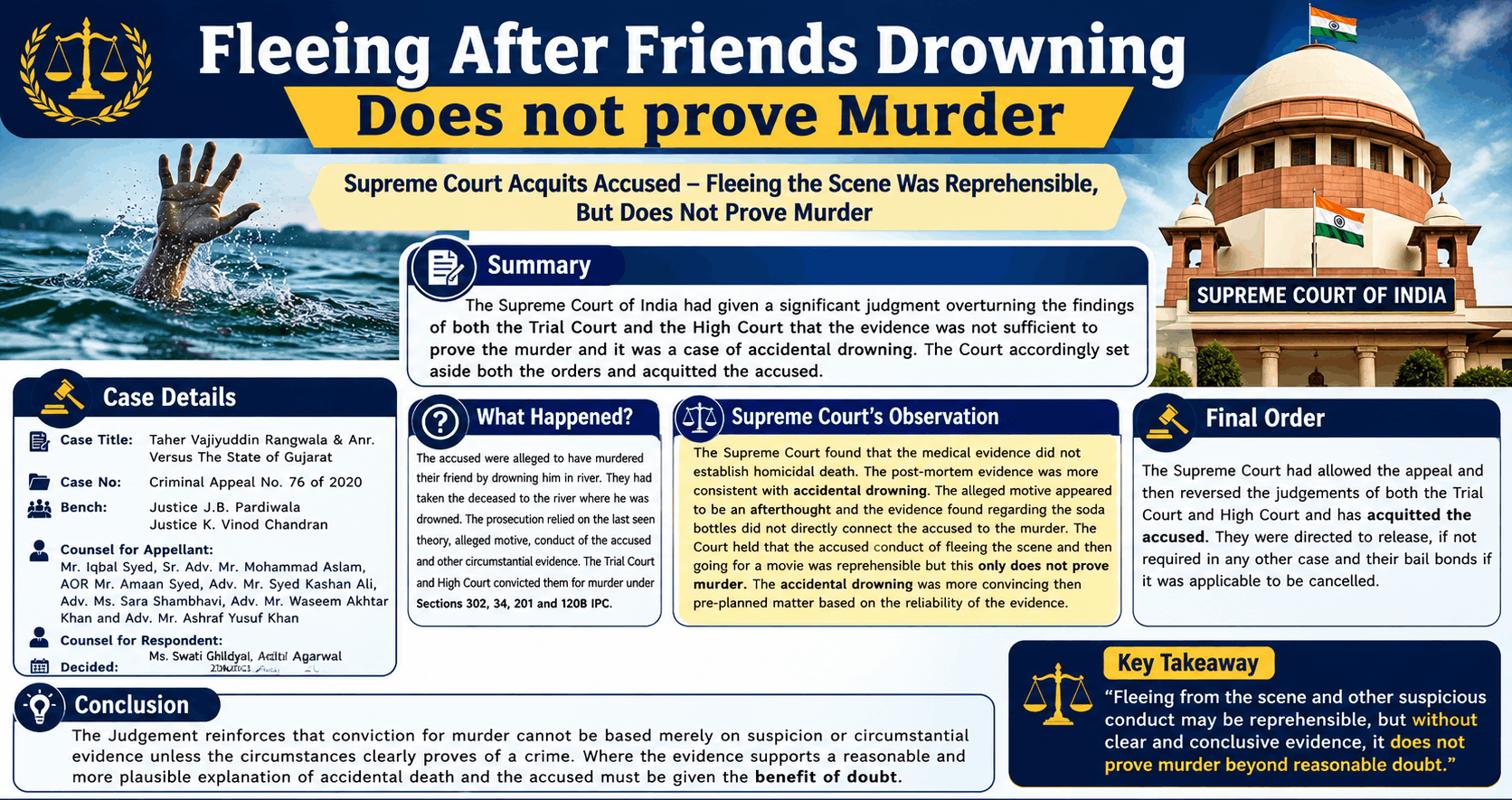
Fleeing After Friends Drowning Does not prove Murder
Fleeing After Friend's Drowning Does not prove MurderCase DetailsCase Title: -Taher Vajiyuddin Rangwala &amp...