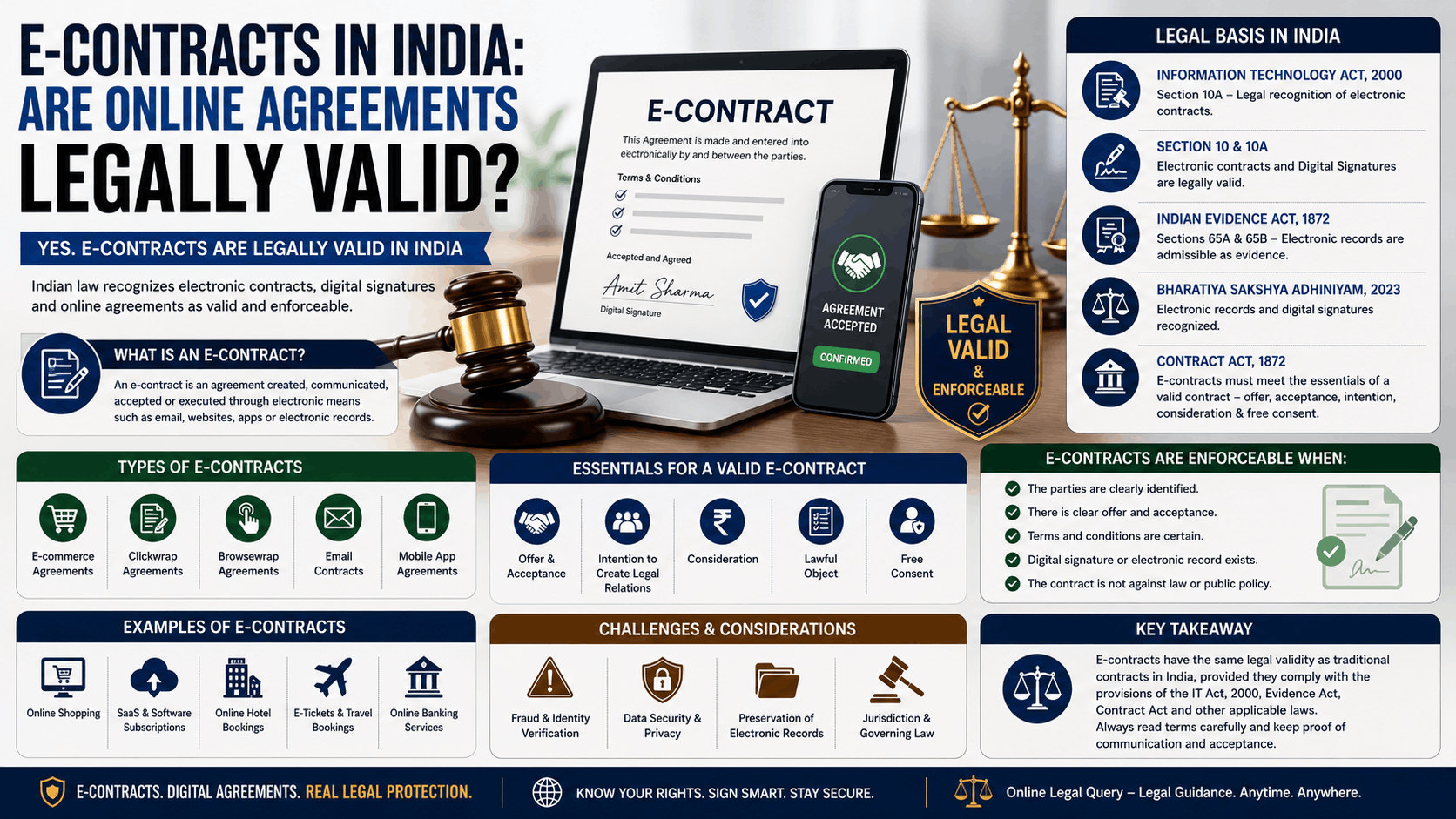
E-Contracts in India: Are Online Agreements Legally Valid?
From pen and paper to screen and click, the law has evolved with technology.
From pen and paper to screen and click, the law has evolved with technology.
Contracts in India have been traditionally made in the paper-and-pen form and had to fulfil the conditions which are mentioned under the Indian Contract Act, but with the growth of technology and the increase in use of the internet in the present time, the internet has become a part of almost every aspect of life. People nowadays shop online, book train tickets online, and even do business deals online without meeting face-to-face. During this process, people often agree to certain terms and conditions online, and these agreements are known as e-contracts.
What is an E-Contract?
An e-contract stands for an electronic contract, and is also known as an online contract or digital contract. It is governed under the Indian Contract Act,1872 and the Information Technology Act, 2000. An e-contract is an agreement made through electronic means such as websites, emails, or other online platforms. It is similar to a contract, but the only difference is that instead of signing on paper, it is done digitally.
Legal validity of E-contract
The most common question that arises is “Are e-contracts legally valid in India?” and the answer to this question is “yes”, e-contracts are valid in India and are recognised under the indian Contract Act,1872 and the Information Technology Act,2000. Indian law does not reject a contract only because it was made online, and it needs to follow the basic rules of a valid contract.
The following are the two main laws related to e-contracts:
Indian Contract Act, 1872
This Act lays down the basic rules for a valid contract. The basic rules are the following:
· A clear offer by one party
· Acceptance by the other party
· Free consent of both the parties
· Lawful consideration
· A lawful object
· Parties must be legally capable of making a contract
If these elements are there in the contract, then it can be legally binding, and it does not matter if it's online or offline
Information Technology Act, 2000
This act recognises electronic contracts and gives legal recognition in India. This Act plays an important role in validating online agreements.
Section 10A of the Information Technology Act, 2000, mentions that a contract cannot be denied legal effect only because it is made in electronic form.
Challenges of e-contracts
Even though e-contracts are easier and more useful, they also have some practical problems:
· Many people accept terms without reading them properly
· The increase in risk of online fraud or hacking
· Sometimes it is difficult to verify the identity of the person agreeing
· In international contracts, choosing the court or jurisdiction is difficult and confusing.
These practical problems show that no matter how useful an e-contract is, people should still be careful while entering into it.
Exceptions of E-contract
An e-contract has some exceptions because not all agreements can be made online. Some of the important documents still require a face-to-face meeting and a physical form or special legal procedure. Such as
· Wills
· Trusts deeds
· Sale deeds of immovable property
· Certain negotiable instruments
Conclusion,,
E-contracts are now becoming an important part of modern life and the digital world. It helps and makes the daily transaction faster and easier. Indian law gives them legal recognition through the Information Technology Act, 2000 and the Indian Contract Act, 1872, which shows that the legal system is adapting with time.
E-contracts also come with responsibility. Many people agree to terms and conditions without reading or understanding them properly, which can later create problems. This is why it is important to be careful and aware before entering into any online agreement.
FAQs
OLQ LAW FIRM: Guiding You Through Digital Agreements and Legal Compliance
1. What is an e-contract?
An e-contract is an agreement made and accepted online through emails, websites, or digital platforms.
2. Are e-contracts legally valid in India?
Yes, e-contracts are legally valid if they fulfil the conditions of the Indian Contract Act, 1872.
3. Which law governs e-contracts in India?
E-contracts are recognised under the Information Technology Act, 2000 and the Indian Contract Act, 1872.
4. Is an electronic signature valid?
Yes, digital and electronic signatures are legally recognised under Indian law.
5. Can an email be treated as a contract?
Yes, if it clearly shows offer, acceptance, and intention to create legal relations.
6. What are click-wrap agreements?
These are online agreements where users click “I Agree” to accept terms and conditions.
7. Can e-contracts be used in business transactions?
Yes, they are widely used for online business, employment, and service agreements.
8. Can an e-contract be challenged in court?
Yes, if there is fraud, misrepresentation, or lack of consent.
9. What makes an e-contract invalid?
Lack of free consent, illegal terms, or absence of essential contract elements.
10. How can OLQ help?
· Drafting and reviewing e-contracts
· Legal advice on digital agreements
· Dispute resolution in online contracts
· Compliance with IT laws
· Court representation in contract disputes
Contact OLQ for professional legal consultation on e-contracts and digital agreements.


Senior Citizens Tribunal Can Order Eviction of Children from Parents' Property: Supreme Court
Senior Citizens Tribunal Can Order Eviction ofChildren from Parents' Property: Supreme CourtCase DetailsCase Tit...
Anticipatory Bail: A matter of Right or Defence?
Anticipatory Bail: A matter of Right or Defence?IntroductionArrest isn’t the end-Know your rights to legal ProtectionAnt...
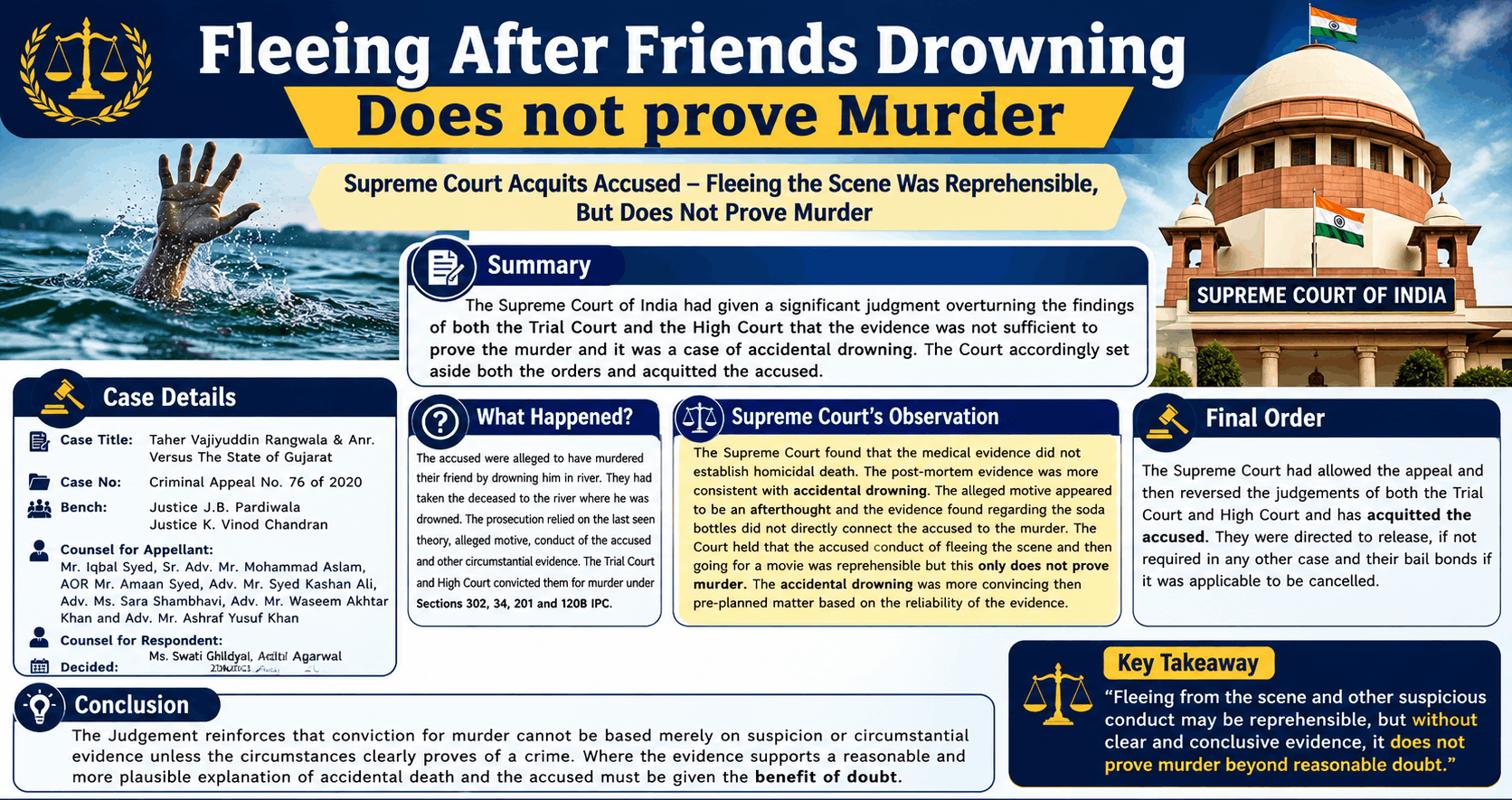
Fleeing After Friends Drowning Does not prove Murder
Fleeing After Friend's Drowning Does not prove MurderCase DetailsCase Title: -Taher Vajiyuddin Rangwala &amp...