Right to privacy in India: how the law protects personal data and personal information
Know Your Privacy Rights. Protect Your Personal Space.
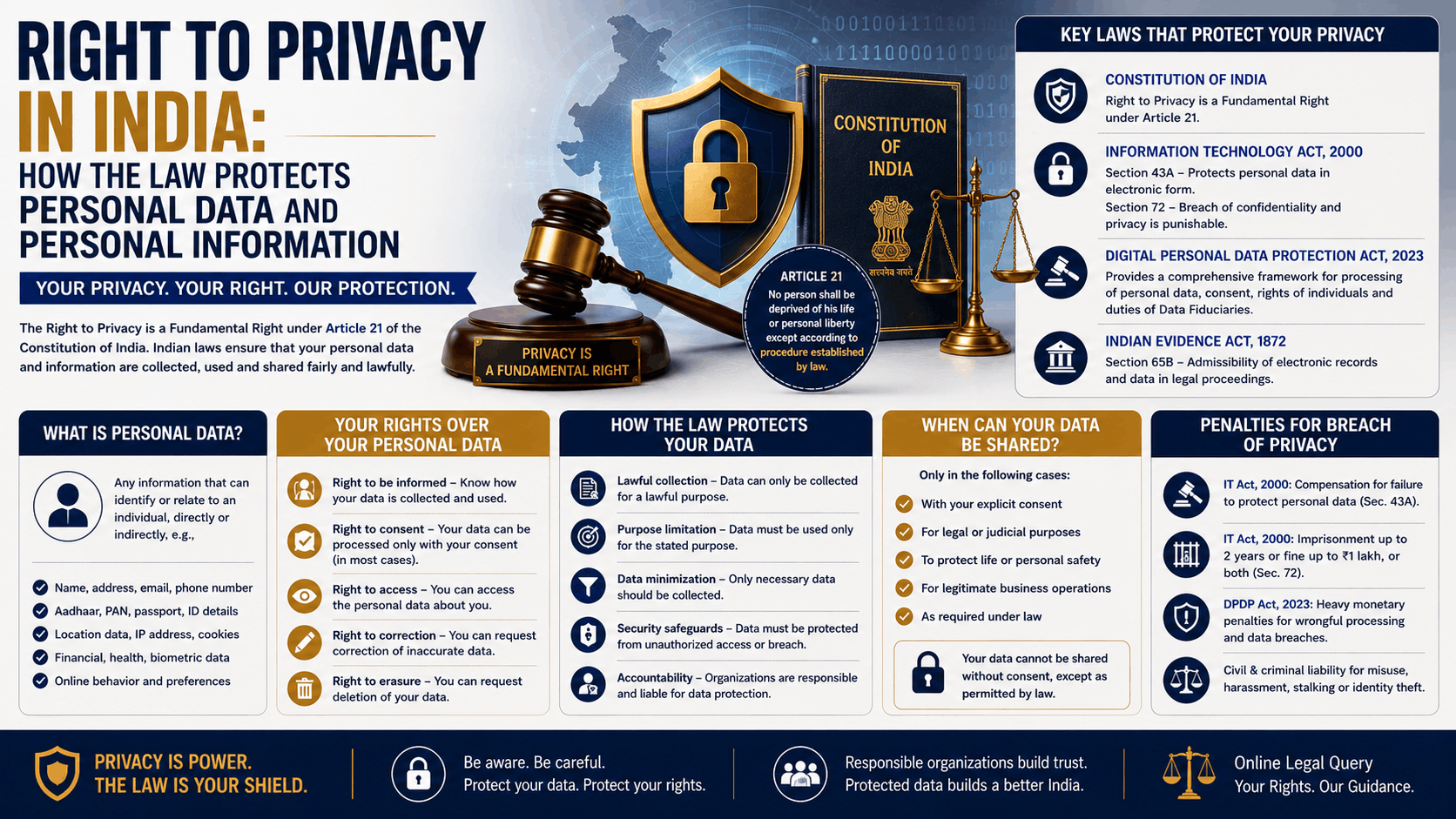
“Know Your Privacy Rights. Protect Your Personal Space.” One of the important fundamental rights in India is the right to privacy. Under Article 21 of the Indian Constitution deals with the Right to Life and Personal Liberty, which is a fundamental right that declares no person shall be deprived of his life or personal liberty except according to procedures established by law. The Indian Government enacted the Digital Personal Data Protection Act.
The Constitutional Framework-
The right to privacy was not specifically mentioned as a fundamental right in the Indian Constitution, but that right is also connected with Article 21 of the Indian Constitution. because, the Supreme Court ruling in the Puttaswamy v. Union of India (2017) case, that the Right to life and personal liberty includes rights to privacy as an integral part guaranteed under part iii of the Constitution.
This means that every citizen of India has the power and right to create their privacy, private spaces, protect their personal information and make intimate personal choices.
The DPDP Act,2023-
“Protecting Personal Freedom in the Digital Age.” The Indian legal system established the Digital Personal Data Protection Act,2023 which is the India’s first comprehensive digital privacy law. This Act protects individuals’ digital privacy through legal rights.
· The Rights of Data Principles-
I. Individuals can withdraw their consent at any time. The data principle has the right to access information, the right to correction and updating that helps individuals can demand the correction of inaccurate data and the updating of outdated information.
II. One of the most important rights of the data principle, is the right to readily access a grievance redressal mechanism provided by the Data Fiduciary.
III. If their concerns are not resolved, then the principles can also escalate complaints to the Data Protection Board of India.
· Responsibility of Data Fiduciary-
The Data Fiduciary bears the primary legal responsibility for compliance. They have some important responsibilities, which include:
I. Ensuring data security, only personal data can be used for a lawful purpose and must be given consent of data principle.
II. Must have content from the legal guardian for any data principle under 18 years of age.
III. In the event of any security breach, then data fiduciary must be notify both the Data Protection Board and the affected data principles.
IV. Non-compliance violations of this act then can result in severe penalties with fines depending on the severity of the Breach.
Conclusion-
One of the important fundamental rights in India, the right to privacy. The Data Protection Board of India was enforced the Digital Personal Data Protection Act 2023, that protects data principles and establishes a strong defense against the misuse of personal information, this guides every citizen of India in create their privacy, private spaces, and making intimate personal choices in an increasingly digital world.
FAQs: Right to Privacy in India – How the Law Protects Personal Data and Personal Information
1. What is the Right to Privacy in India?
The Right to Privacy is a fundamental right protected under Article 21 of the Constitution of India. It safeguards an individual's personal autonomy, dignity, and freedom, including the right to control personal information and make private decisions without unlawful interference.
2. Is the Right to Privacy a fundamental right?
Yes. In the landmark Justice K.S. Puttaswamy (Retd.) v. Union of India (2017) judgment, the Supreme Court of India unanimously held that the Right to Privacy is a fundamental right under Article 21 and forms an essential part of the right to life and personal liberty.
3. What is considered personal data?
Personal data generally refers to any information that can identify an individual, including:
Name and address
Mobile number and email address
Aadhaar or PAN details
Financial and banking information
Medical records
Biometric information
Photographs and videos
Online identifiers such as IP addresses and location data
4. Which laws protect personal data in India?
Personal data in India is protected through a combination of legal frameworks, including:
The Constitution of India (Right to Privacy under Article 21)
The Digital Personal Data Protection Act, 2023
The Information Technology Act, 2000 and related rules
Sector-specific regulations governing banking, healthcare, telecommunications, and financial services
5. Can a company collect my personal information without my consent?
In many cases, organisations must have a lawful basis for processing personal data, including obtaining valid consent where required under applicable law. They are also expected to process personal information fairly, securely, and only for legitimate purposes.
6. What should I do if my personal data is leaked or misused?
If your personal information has been accessed, disclosed, or used without authorisation, you should:
Preserve evidence of the incident.
Notify the concerned organisation immediately.
Report financial fraud to your bank if applicable.
Seek legal advice regarding your available remedies.
Consider filing complaints before the appropriate authorities where applicable.
7. What are my rights regarding my personal data?
Depending on applicable laws, individuals may have rights such as:
Knowing how their personal data is collected and used.
Accessing certain personal information held by organisations.
Requesting correction or updating inaccurate information.
Seeking deletion of personal data in appropriate circumstances.
Withdrawing consent where legally permitted.
Seeking grievance redressal for misuse of personal information.
8. Does the Right to Privacy apply online?
Yes. The Right to Privacy extends to digital activities. Personal information shared through websites, mobile applications, social media platforms, online banking, e-commerce services, and other digital platforms is protected under applicable privacy and data protection laws.
9. Can employers or businesses monitor employees or customers?
Employers and businesses may monitor workplace systems or collect customer information for legitimate business purposes, but such monitoring should comply with applicable laws, respect privacy rights, and follow transparent policies regarding data collection and usage.
How can OLQ Help?
· Advising on privacy rights under Indian law.
· Assisting victims of data breaches and identity theft.
· Advising organisations on compliance with the Digital Personal Data Protection Act, 2023.
· Drafting and reviewing privacy policies, consent notices, and data protection agreements.
· Representing clients in privacy-related disputes and regulatory proceedings.
· Advising on cyber law, digital evidence, and information security compliance.
· Helping businesses establish legally compliant data governance and privacy practices.
Contact OLQ for professional legal consultation on Right to privacy in India: how the law protects personal data and personal information




Senior Citizens Tribunal Can Order Eviction of Children from Parents' Property: Supreme Court
Senior Citizens Tribunal Can Order Eviction ofChildren from Parents' Property: Supreme CourtCase DetailsCase Tit...
Anticipatory Bail: A matter of Right or Defence?
Anticipatory Bail: A matter of Right or Defence?IntroductionArrest isn’t the end-Know your rights to legal ProtectionAnt...
Fleeing After Friends Drowning Does not prove Murder
Fleeing After Friend's Drowning Does not prove MurderCase DetailsCase Title: -Taher Vajiyuddin Rangwala &amp...